



Looking for an accurate quote for your outsourcing needs?
Schedule a FREE call with our outsourcing expert now and get a precise quotation that meets your requirements. Don't wait - get started today!
Australian businesses, particularly in highly regulated industries, are under constant pressure to improve financial visibility, accuracy, and operational efficiency. For many organizations, building an operational hub for accounting and finance has become a strategic priority rather than a back office function. As cost pressures rise and compliance requirements tighten, Australian companies are increasingly turning to offshore expertise to strengthen their accounting and finance operations while maintaining quality and control.
This article explores why accounting and finance outsourcing to the Philippines is gaining momentum, the challenges Australian firms face, and how a structured offshore model supports long term performance, scalability, and compliance.
Background: Accounting and Finance Operations in a Globalized Economy
Accounting and finance operations encompass the processes that support financial reporting, bookkeeping, compliance, payroll, accounts payable and receivable, and management reporting. These functions are essential to business stability and decision making.
For Australian companies, especially those in insurance, professional services, and financial sectors, finance teams must balance accuracy, timeliness, and regulatory compliance. As organizations grow, internal finance teams often struggle to scale without significantly increasing costs.
This has led many Australian firms to explore offshore solutions, particularly in the Philippines, where skilled accounting professionals, strong English proficiency, and deep familiarity with international accounting standards provide a reliable extension of local teams.
Current Challenges Facing Australian Accounting and Finance Teams
Many Australian organizations experience similar operational challenges when managing finance functions in house.
Rising Operational Costs
Hiring and retaining qualified accountants locally continues to become more expensive. Salary inflation, training costs, and employee turnover place pressure on finance budgets.
Talent Shortages
Australia faces ongoing shortages of experienced accounting and finance professionals. This limits scalability and slows down finance operations during peak reporting periods.
Compliance and Reporting Pressure
Australian regulatory frameworks demand accuracy, audit readiness, and timely reporting. Errors or delays can expose businesses to financial and reputational risks.
Process Bottlenecks
Manual workflows, fragmented systems, and limited staff capacity often lead to delayed reconciliations, reporting backlogs, and reduced financial visibility.
Without a scalable support structure, these challenges directly impact business performance and decision making.
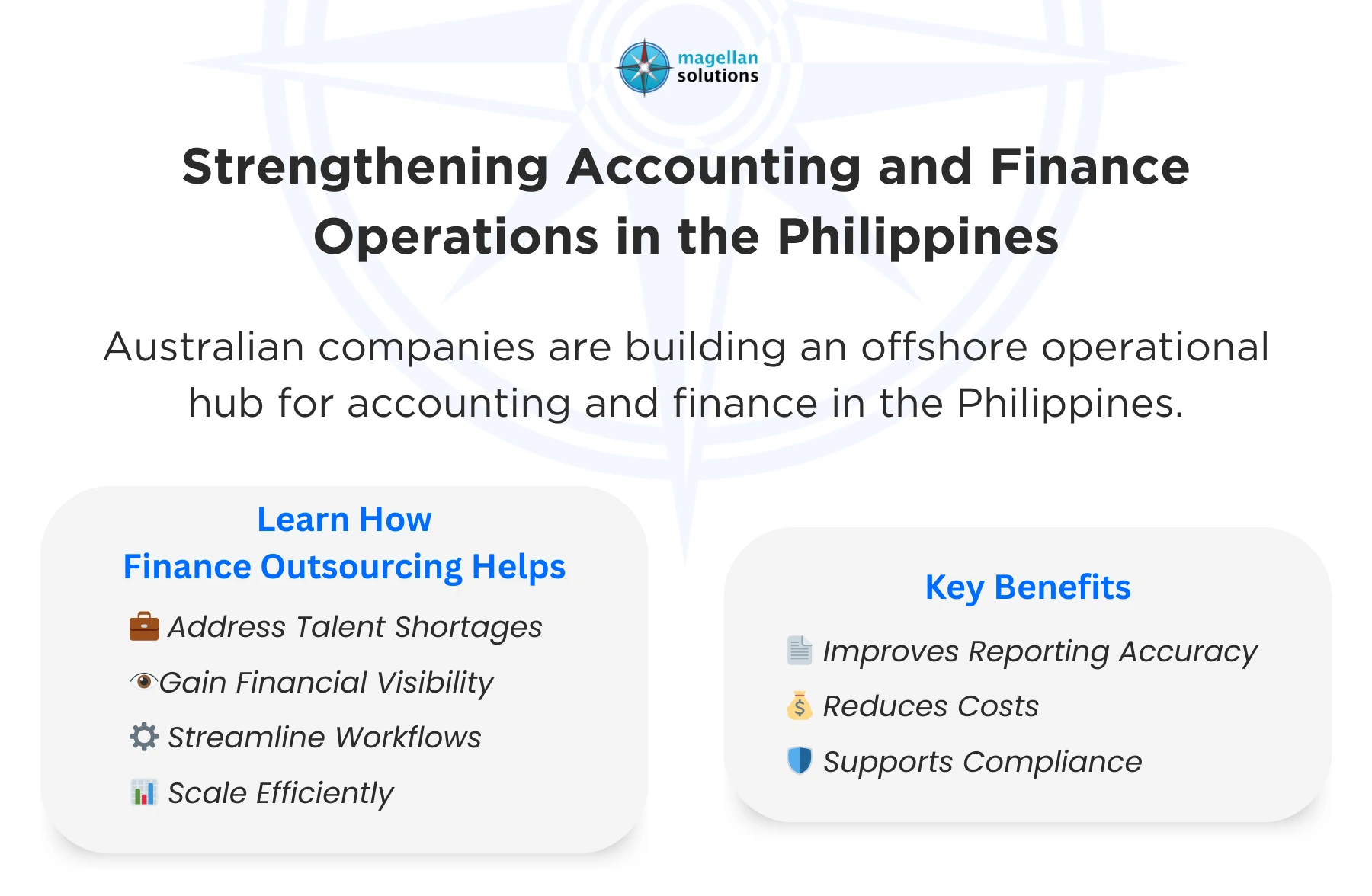
How Offshore Accounting and Finance Operations Address These Challenges
Outsourcing accounting and finance operations to the Philippines provides a structured solution to these pain points while maintaining operational control.
Dedicated Offshore Finance Teams
Australian companies gain access to full time professionals who work as an extension of internal finance departments. These teams follow Australian accounting standards and internal policies.
Cost Efficient Scalability
Offshore models allow businesses to scale resources without the overhead of local hiring. This supports growth, acquisitions, and seasonal reporting demands.
Process Optimization
Offshore finance teams are often embedded into standardized workflows, improving consistency across bookkeeping, reporting, and reconciliation processes.
Focus on Core Business
With routine finance tasks handled offshore, local leadership can focus on strategy, forecasting, and business growth.
Key Benefits of Accounting and Finance Operations from the Philippines
Australian companies that establish offshore finance operations experience measurable advantages.
Improved Reporting Accuracy
Dedicated teams follow structured processes, reducing errors and improving audit readiness.
Faster Turnaround Times
Time zone alignment enables overnight processing of reconciliations, reports, and transaction updates.
Operational Cost Savings
Outsourcing reduces recruitment, infrastructure, and training expenses without compromising quality.
Enhanced Compliance Support
Offshore professionals are trained to meet Australian regulatory requirements and internal governance standards.
Business Continuity and Scalability
Offshore teams provide flexibility to scale up or down as business needs evolve.
These benefits collectively strengthen the finance function as a strategic business asset.
Tools, Processes, and Implementation Steps
Successful offshore accounting and finance operations rely on clear structure and governance.
Step 1: Process Mapping and Role Definition
Organizations begin by identifying finance tasks suitable for offshoring such as accounts payable, accounts receivable, general ledger, and reporting support.
Step 2: System Integration
Offshore teams are integrated into existing accounting systems such as Xero, MYOB, NetSuite, or SAP, ensuring seamless data flow.
Step 3: Standard Operating Procedures
Clear documentation, reporting schedules, and approval workflows are established to maintain consistency and control.
Step 4: Performance Monitoring
Key performance indicators such as turnaround time, accuracy rates, and compliance benchmarks are tracked regularly.
Step 5: Continuous Improvement
Regular reviews ensure processes evolve alongside regulatory updates and business growth.
This structured approach transforms offshore teams into a reliable operational hub for accounting and finance.
Common Mistakes to Avoid When Outsourcing Finance Operations
Despite its advantages, outsourcing can fail without proper planning.
Treating Offshore Teams as Vendors Only
Successful models position offshore professionals as integrated team members rather than transactional service providers.
Lack of Clear Documentation
Incomplete process documentation leads to errors and inefficiencies. Clear guidelines are essential.
Weak Communication Frameworks
Regular check ins, reporting structures, and escalation paths are critical to maintaining alignment.
Ignoring Compliance Training
Offshore teams must receive continuous training on Australian accounting standards and regulatory updates.
Avoiding these pitfalls ensures long term success and operational stability.
Real World Use Cases for Australian Companies
Insurance Providers
Insurance firms use offshore accounting teams to manage premium reconciliation, claims accounting, and regulatory reporting while maintaining audit readiness.
Accounting Firms
Australian accounting practices leverage offshore support for bookkeeping, BAS preparation, and financial reporting, allowing local accountants to focus on advisory services.
Growing Enterprises
Mid sized businesses establish offshore finance teams to support expansion without overburdening internal staff.
These use cases demonstrate how offshore finance operations align with different business models and growth stages.
Future Trends in Accounting and Finance Operations
The future of accounting and finance operations is increasingly global and technology driven.
Automation and AI are enhancing transactional processing, while offshore teams focus on analysis, reporting, and compliance support. Australian companies are also moving toward centralized finance hubs that combine onshore leadership with offshore execution.
The Philippines continues to strengthen its position as a preferred destination due to its skilled workforce, cultural alignment, and mature outsourcing ecosystem.
Organizations that invest early in scalable finance models will be better positioned to adapt to regulatory changes and economic uncertainty.
Conclusion
Building a strong operational hub for accounting and finance is no longer optional for Australian companies seeking efficiency, accuracy, and growth. By outsourcing accounting and finance operations to the Philippines, businesses gain access to skilled professionals, improved reporting capabilities, and scalable cost structures.
This approach allows Australian firms to strengthen compliance, streamline workflows, and focus on strategic decision making while maintaining full operational control.
A Practical Next Step
For Australian companies exploring offshore finance solutions, providers such as Magellan Solutions support the design and management of structured accounting and finance operations tailored to business needs. Learn more about how offshore finance teams can support long term performance at https://www.magellan-solutions.com.