



Looking for an accurate quote for your outsourcing needs?
Schedule a FREE call with our outsourcing expert now and get a precise quotation that meets your requirements. Don't wait - get started today!
1. Introduction
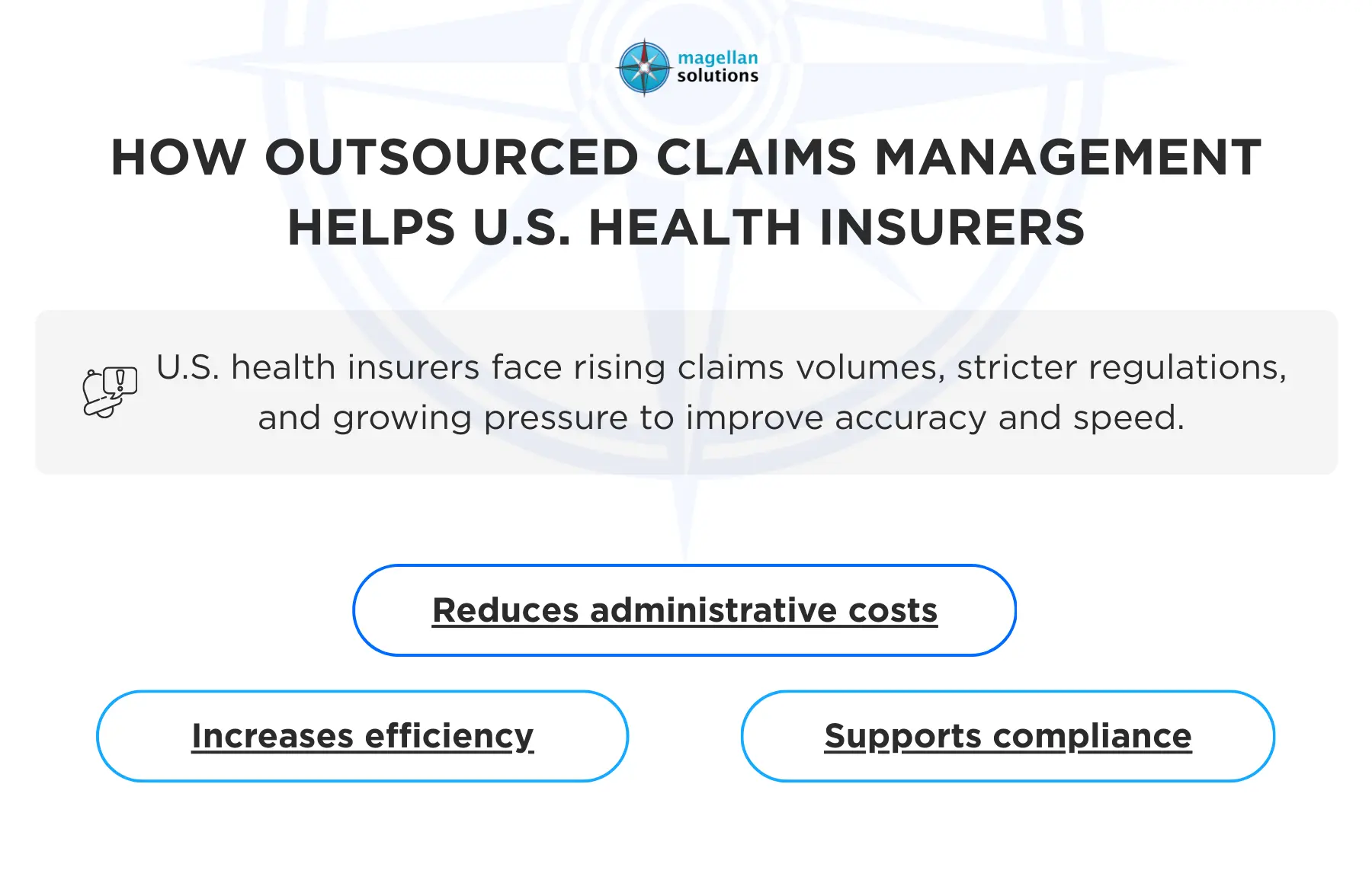
U.S. health insurance companies are under increasing pressure to deliver fast, accurate, and compliant claims processing. With rising volumes, evolving regulations, and higher customer expectations, many firms now choose to outsource claims workflow to specialized teams that can support efficiency and accuracy at scale. This article explains how outsource claims management helps insurers reduce administrative burdens, improve turnaround time, and achieve consistent operational performance.
This blog will explore what outsource claims management is, why it matters to the U.S. health insurance industry, and how strategic outsourcing supports cost control, faster processing, and better member experiences. The goal is to provide clear, informational insights designed for insurance leaders evaluating operational support options.
2. What Is Outsource Claims Management
Outsource claims management refers to the practice of delegating specific claims related tasks to a qualified external service provider. These tasks may include claims intake, validation, adjudication support, data entry, provider verification, data accuracy checks, and customer coordination.
This approach works by assigning trained specialists, supported by established workflow systems, to manage routine or high volume claims processes. It has become essential for U.S. health insurance companies because it eliminates bottlenecks, enhances operational capacity, and maintains compliance in a continuously changing regulatory landscape.
Many insurers adopt outsourced teams to increase claims throughput without raising internal labor costs. The model also provides flexibility, allowing insurers to scale resources depending on seasonal spikes, policy changes, or unexpected surges in claims submissions.
3. Key Benefits of Outsource Claims Management
Below are several major advantages U.S. health insurers gain by investing in outsourced claims support. Each benefit includes clear examples that reflect measurable operational value.
1. Improved Claims Accuracy and Reduced Errors
Outsourced teams follow verified workflows and quality control processes. Insurers often experience fewer manual mistakes, fewer reworks, and fewer compliance related issues. Improved accuracy leads to fewer disputes and faster payouts.
2. Faster Processing and Higher Productivity
Specialized teams handle repetitive tasks at a consistently high volume. This results in shorter claims cycles and better end user experiences. Insurers can meet turnaround commitments, even during peak periods such as open enrollment or natural disaster claims surges.
3. Significant Operational Cost Savings
Outsourcing eliminates the need for additional full time staff, extensive training programs, or expanded office infrastructure. Many insurers reduce processing costs by as much as 40 percent because external teams operate with optimized labor structures and advanced workflow tools.
4. Enhanced Compliance and Documentation Standards
Healthcare regulations require strict accuracy and reporting. Outsourced teams follow standardized processes that help insurers remain aligned with HIPAA, CMS rules, and other regulatory requirements. Proper documentation also helps during internal audits.
5. Scalable Workforce to Match Claims Volume
Underwriters and insurance administrators often face unpredictable spikes. Outsourcing provides immediate workforce flexibility. Teams can scale up or down depending on volume demands without disrupting internal operations.
6. Better Allocation of Internal Resources
When administrative tasks are delegated, internal teams can focus on member engagement, provider relations, and strategic initiatives. This shift results in stronger business development outcomes and improved customer satisfaction.
4. Common Challenges and Solutions
Even with its advantages, outsource claims management requires thoughtful planning. Below are common challenges insurers face, with practical solutions that resolve each concern.
Challenge 1: Limited Visibility into Outsourced Processes
Outsourcing can raise concerns about real time visibility into claims progress.
Solution:
Choose providers that offer transparent dashboard systems, regular reporting, and shared workflow tracking. Daily status updates and integrated communication tools keep teams aligned and informed.
Challenge 2: Integration with Internal Claims Systems
Many insurers worry that external teams may not align with internal platforms or proprietary systems.
Solution:
Work with outsourcing partners that can adapt to your existing technology. API integration, secure remote access, and cross training ensure smooth operational transitions.
Challenge 3: Data Security and Compliance Concerns
Handling health insurance claims means handling sensitive member data.
Solution:
Select partners with HIPAA compliance, secure data transfer protocols, and multi layer cybersecurity. Conduct periodic audits and request updated compliance certificates.
Challenge 4: Maintaining Quality Standards
Some insurers fear inconsistent quality or variations in claims handling.
Solution:
Request documented SOPs, QA programs, and internal review mechanisms. A provider with structured quality checks ensures consistent workflows and error free submissions.
5. Best Practices and Strategies for Successful Outsource Claims Management
U.S. health insurance companies can maximize results by applying the following strategies.
1. Set Clear Performance Metrics
Establish KPIs such as accuracy rate, turnaround time, rework percentage, and compliance score. Measurable goals align both teams toward shared expectations.
2. Implement Strong Onboarding and Knowledge Transfer
Provide detailed training materials, policy guidelines, and documented workflows. The clearer the onboarding, the faster the outsourced team can perform consistently.
3. Maintain Ongoing Communication Cadence
Weekly meetings, shared tools, and consistent feedback loops help refine processes and prevent misunderstandings. Strong communication also improves collaboration.
4. Use Phased Transitions for Large Scale Workflows
Start with smaller work batches before shifting full claims responsibility. This phased approach ensures a smoother adaptation period.
5. Review and Update Processes Regularly
Healthcare regulations and claims parameters change frequently. Quarterly reviews help teams stay compliant and aligned with updated rules.
6. Why Now Is the Best Time to Invest in Outsource Claims Management
The U.S. health insurance landscape is evolving rapidly. Claims volumes continue to rise, regulatory demands are increasingly complex, and insurers face pressure to maintain affordability while improving customer experience. Outsourced claims management offers a practical response to these industry conditions.
Recent industry reports show a significant increase in administrative spending among health insurers, and a growing number of companies now use external processing teams to manage workload and maintain compliance. Automation, AI supported adjudication, and improved workflow tools create even greater opportunities for insurers to streamline operations.
With competition increasing in the U.S. health insurance marketplace, companies that adopt outsourced support gain stronger agility, lower administrative costs, and improved service delivery. This makes it the ideal time to invest in scalable and expert driven claims management solutions.
7. Conclusion
Outsource claims management provides U.S. health insurance companies with the operational support needed to reduce costs, improve accuracy, and deliver faster member experiences. As the industry becomes more complex, partnering with specialized teams allows insurers to manage high volume claims processing without sacrificing quality or compliance.
Interested in outsource claims management?
Magellan Solutions offers professional outsourced claims support for U.S. health insurance companies. With more than 18 years of industry experience, secure data protocols, and trained multi agent teams, Magellan Solutions delivers reliable, accurate, and compliant workflow management. The company supports claims intake, validation, data entry, adjudication assistance, and end to end administrative processing, ensuring insurers meet performance requirements at optimal cost.
Visit their website to learn more and request a free consultation.