


Looking for an accurate quote for your outsourcing needs?
Schedule a FREE call with our outsourcing expert now and get a precise quotation that meets your requirements. Don't wait - get started today!
If your SaaS platform is handling more support tickets than your team can manage, AI support automation can change the game. From speeding up responses to reducing repetitive workloads, AI for customer service process automation streamlines your support operations while letting human agents focus on the problems that truly matter. For U.S. SaaS companies aiming to scale, it’s a practical way to improve efficiency without inflating staffing costs.
AI for customer service automation brings together intelligent tools that understand customer queries, route tickets correctly, and even respond automatically to simple issues. This kind of automation gives teams a chance to work smarter, not harder, while ensuring that customers get fast, reliable answers anytime they need them.
What AI for Customer Service Process Automation Actually Means
When we talk about AI for customer service automation, we’re talking about more than just chatbots. It’s a system that reads, understands, and acts on customer inquiries with minimal human intervention. Machine learning, natural language processing (NLP), and smart workflow logic all work together to take over repetitive tasks like ticket triage, FAQ responses, or routing to the right department.
The beauty of AI here is that it doesn’t just handle volume; it learns from past interactions, making responses smarter over time. That means less guesswork, fewer back-and-forth emails, and smoother interactions for your customers.
Why U.S. SaaS Platforms Need AI Support Automation Now
Support teams face mounting pressure. Customers expect rapid answers across multiple channels—email, chat, social, in-app messages—and as user bases grow, so does the volume of tickets. Adding more agents is expensive, and scaling manually can introduce delays or errors.
AI support automation handles routine tasks and scales effortlessly. It reduces operational bottlenecks while keeping your team focused on solving complex issues that require human judgment. Companies that implement AI for customer service process automation see faster resolutions, happier customers, and more predictable support metrics.
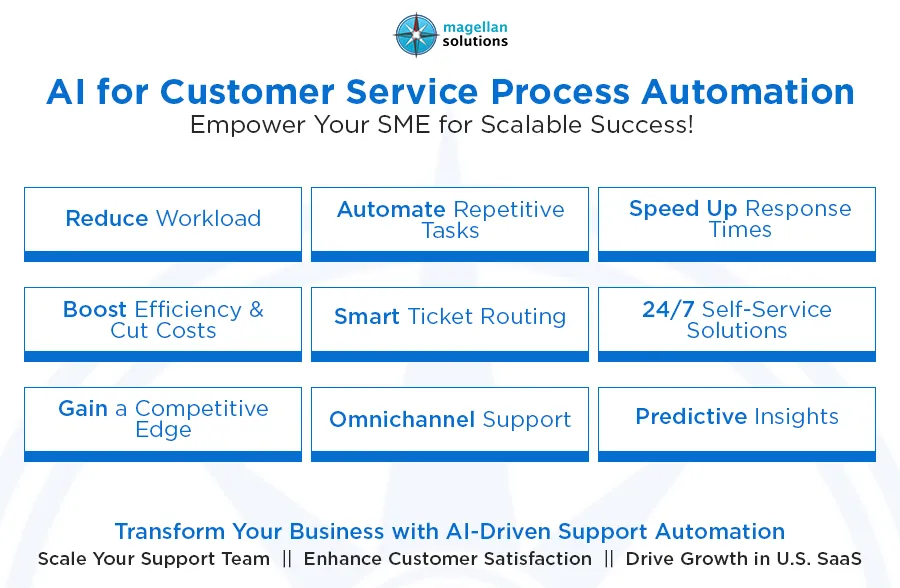
Key Benefits of AI for Customer Service Process Automation
1. Quicker Responses, Happier Customers
Automated systems can instantly classify tickets, find solutions, and deliver answers. Customers don’t have to wait, and agents spend less time on repetitive requests. Faster resolution keeps users engaged and reduces churn, which is critical for SaaS platforms operating in competitive markets.
2. Smart Routing and Workload Balance
AI routes inquiries based on topic, complexity, and agent availability. That means urgent tickets reach experts immediately while routine issues get automated responses. Teams aren’t bogged down with low-value work, and customer experiences stay smooth across the board.
3. Better Self-Service Options
AI can power knowledge bases, FAQs, and virtual assistants that guide customers to solutions without agent intervention. Self-service reduces incoming tickets, gives users answers 24/7, and frees human agents for more critical tasks.
4. Actionable Insights From Data
Automation generates valuable analytics, from identifying trending issues to highlighting gaps in knowledge base content. Support managers can use these insights to refine workflows, improve AI accuracy, and make informed decisions about staffing and process improvements.
Real-World Use Cases That Make a Difference
Here’s how AI for customer service process shows up in day-to-day operations:
Automated Ticket Classification
AI reads incoming messages and tags them correctly. Urgent issues get immediate attention, while common questions get automated solutions. It eliminates manual sorting, saving precious time.
Response Suggestion Engines
Instead of drafting replies from scratch, agents get AI-generated recommendations that match customer intent. This keeps communications fast, accurate, and personalized without repetitive typing.
24/7 Virtual Assistants
Virtual agents can answer common questions anytime, escalate more complex problems, and guide users through step-by-step solutions. Customers get support around the clock, and your team avoids unnecessary night shifts.
Omnichannel Automation
AI keeps track of interactions across email, chat, social media, and in-app support. Customers experience consistent service, and teams gain a single view of all touchpoints for better management and reporting.
How to Implement AI for Customer Service Process Automation Successfully
Rolling out AI effectively requires thoughtful planning. Here’s what works:
Clean, Organized Data
AI learns from past interactions. High-quality, standardized ticket data and knowledge base content help automation deliver accurate results.
Align Automation With Your Processes
Your AI workflows should follow your company’s service rules. Clear escalation paths and defined thresholds ensure smooth operations and consistent outcomes.
Iterate and Improve
Automation isn’t “set and forget.” Continuous monitoring, agent feedback, and regular updates make the system smarter and more reliable over time.
Balance AI With Human Expertise
AI handles routine queries, but human agents tackle complex or sensitive issues. The combination keeps quality high without overloading your team.
Prepare Your Team
Support staff need to understand how to work with AI effectively. Training and change management build confidence and maximize the benefits of automation.
Tangible Business Outcomes
Companies implementing AI for customer service process automation notice measurable gains:
-
Faster resolution times for tickets across channels
-
Higher customer satisfaction from timely, accurate support
-
Reduced operational costs thanks to automated handling of common inquiries
-
Greater agent efficiency, with staff freed from repetitive work
-
Predictive insights for better planning and resource allocation
These results directly impact revenue and retention, making AI adoption a strategic move for growing SaaS companies.
Essential Technology for Automation Success
For AI to deliver real value, SaaS platforms often deploy a layered technology stack:
-
NLP Engines: Interpret customer intent from messages across channels.
-
AI-Powered Knowledge Management: Quick access to solutions reduces resolution time.
-
Workflow Orchestration Platforms: Connect AI with ticketing, CRM, and communication tools.
-
Analytics and Monitoring Tools: Track performance and optimize automation continuously.
Addressing Common Adoption Challenges
Even with benefits, AI adoption has hurdles:
-
Data quality: Poor or inconsistent data undermines AI accuracy. Centralization and standardization are essential.
-
Team buy-in: Communicate that AI empowers agents rather than replaces them.
-
Integration complexity: Plan deployments carefully to avoid disruption and ensure compatibility with existing systems.
With proper planning and management, these challenges can be turned into opportunities for stronger, more intelligent support operations.
Conclusion: Scale Smarter With AI and Multi-Agent Teams
AI for customer service process automation gives U.S. SaaS platforms the agility to scale support efficiently. By combining AI with a professional, multi-agent team, companies reduce repetitive workload, improve response times, and elevate customer experiences consistently.
Magellan Solutions delivers scalable, AI-driven customer support with multi-seated teams that integrate seamlessly into your existing operations. Our approach ensures businesses get measurable efficiency gains while maintaining high-quality service.
Take the Leap: Transform Your Support With Magellan Solutions
Stop letting repetitive support tasks drain your team. Let Magellan Solutions help your SaaS platform harness AI for smarter, faster customer service. Explore our tailored, multi-agent solutions today at Magellan-Solutions.com and start scaling support without compromise.