

Small businesses can’t always have someone ready to answer the phone around the clock. Calls can come in after office hours, on weekends, or when the team is already busy with customers.
24/7 telephone answering solutions give SMEs a way to stay reachable without asking employees to work around the clock. But choosing a 24 hour live answering service takes more than checking whether a provider is available 24/7. SMEs also need to know how calls are handled, how agents are trained, and whether the service fits their day-to-day needs.
Start With the Calls You Receive
Before comparing providers, look at the types of calls your business gets most often. Customers might ask about products, request an appointment, check an order, ask for an employee, or report a problem.
Knowing these common requests helps you decide what the provider needs to handle. Some businesses may only need call answering and message taking, while others may need appointment scheduling, call transfers, customer information, or help with urgent calls.
The right 24 hour live answering service should fit your actual call volume and requirements instead of forcing your business into a standard process.
Don’t Judge a Provider by 24/7 Availability Alone
A provider can answer your calls day and night, but that doesn’t automatically mean callers will receive good service.
Ask how agents are trained, what information they can provide, and when they transfer or escalate a call. You should also find out whether agents can have a natural conversation or simply follow a fixed script.
These details matter because callers are still interacting with your business, even when your employees aren’t there. A reliable 24 hour live answering service should give agents enough information to handle common questions and know when an issue needs your team’s attention.
Check How Quickly Customers Expect a Response
Customers don’t always want to wait for an answer, especially for a simple question or an order issue.
Research found that 66% of consumers expect a customer service response within five minutes or less. The finding comes from HubSpot’s research into consumer expectations around customer service.
For SMEs, that expectation makes after-hours coverage worth considering. If a customer calls when nobody is available, the next option may be voicemail, a delayed callback, or no response at all.
A 24 hour live answering service gives customers another option: speaking with a real person when your regular team isn’t available.
Find Out What Happens After Hours
Don’t just ask whether a provider is available 24/7. Ask what actually happens when someone calls outside your normal business hours. Can the agent answer common questions? Can they take a detailed message? Can they transfer urgent calls? How quickly will your team receive the information?
Ask the provider to explain the full process from the first ring to the follow-up. You’ll get a much clearer picture of what you’re paying for. A 24 hour live answering service should have clear instructions for routine calls, urgent issues, and situations that require someone from your team.
See How Well They Learn Your Business
Agents don’t need to know every detail your employees know, but they should understand your business well enough to give callers accurate information.
Ask how the provider handles training and how you can provide FAQs, business hours, call scripts, escalation rules, and other instructions. You should also ask how quickly updates are made. If your business changes its hours, adds a service, or changes its procedures, the answering team needs that information too.
Ask How Transfers and Escalations Work
Not every call should be handled the same way. A customer asking a basic question may only need a quick answer. An urgent issue may need to reach an employee immediately.
Before choosing a 24 hour live answering service, ask how the provider decides which calls to transfer and where those calls go. Find out whether you can set your own rules for urgent situations and specific departments.
The goal is to make sure important calls reach the right person without sending every caller straight to your internal team.
Know What Your Team Receives After a Call
Once a call ends, your employees may still need to act on it. The provider should capture the information your team needs, such as the caller’s name, contact details, reason for calling, and any requested follow-up.
Ask how those details are delivered and how quickly your team receives them. A good 24 hour live answering service should make follow-up simple rather than leave employees searching through messages.
The more clearly you understand the process, the easier it becomes to tell whether a provider is actually suited to your business.
Compare Providers on What Actually Matters
Once you know what your business needs, compare providers based on what affects your customers and your team.
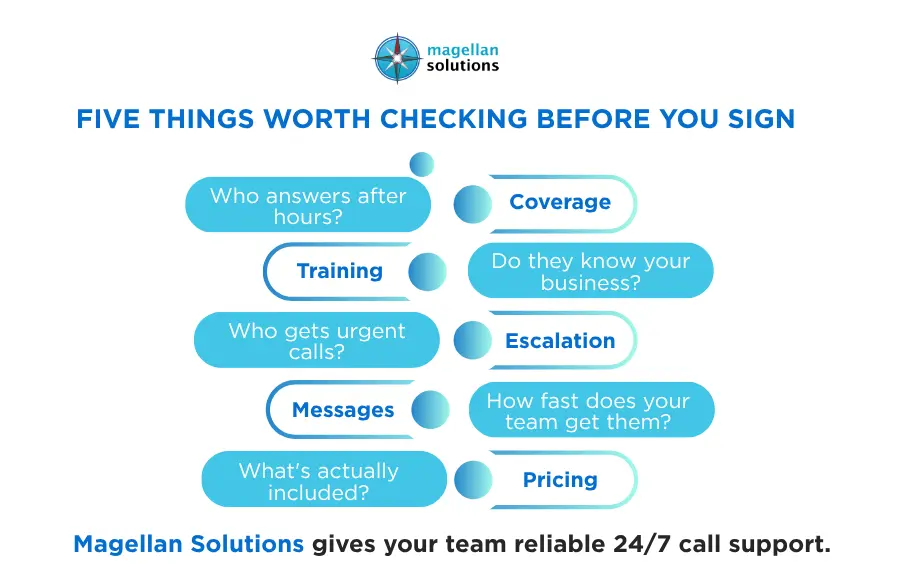
Look at:
- Coverage: Is someone available 24/7, including weekends and holidays?
- Training: How do agents learn your business and call procedures?
- Escalation: How are urgent calls sent to your team?
- Reporting: What call information can you see?
- Scalability: Can coverage change when your call volume changes?
- Pricing: What is included, and what costs extra?
Don’t let a low monthly rate drive the decision. A cheaper service may not include the features your business actually needs.
Test the Service Before You Commit
If a provider offers a trial or onboarding period, use it. Call the number yourself. Ask a normal customer question. Try reaching someone after hours. See how the agent handles the conversation and whether the process feels natural.
You can learn more from one real call than from a long sales presentation.
Check How Information Gets Back to Your Team
Your answering provider may collect names, messages, appointment details, and requests that need follow-up. Ask exactly how that information reaches your employees. Email, text notifications, CRM updates, or another system may work depending on your business.
The key is that your team can get the information quickly and know what to do next.
Ask About Data Protection
Your answering team may handle customer names, phone numbers, account details, or other private information.
Ask how the provider protects customer data, controls access, and handles information after a call. If your industry has specific privacy or compliance requirements, discuss those before signing an agreement.
Clear answers matter here. Don’t assume every provider follows the same practices.
Read the Contract Carefully
Before committing, check the details that are easy to overlook. Look at the contract length, cancellation terms, pricing changes, minimum call volumes, setup fees, and charges for additional services.
Also check what happens if you need more coverage later. You don’t want a contract that makes a simple change unnecessarily difficult.
Choose a Team You Can Trust
The right 24 hour live answering service should give your customers a real person to talk to, follow your instructions, handle routine calls, and know when an issue needs your team.
Magellan Solutions provides trained 24/7 answering support that can handle customer inquiries, take accurate messages, route calls, and follow your escalation rules. This gives SMEs reliable call coverage without tying up internal employees.
When your customers need someone, they shouldn’t have to wonder if anyone will answer.
Stay Reachable Without Keeping Your Team on Call
Your team doesn’t have to answer every call themselves. The right 24 hour live answering service keeps customers connected after hours, during busy periods, and when your staff can’t get to the phone.
Give your customers someone to reach when they need help. Let’s find a call support setup that fits your business and keeps your team focused on the work that matters.