
Managing high-volume transportation customer service is one of the biggest challenges for fast-growing rideshare and mobility apps. For example, when an app expands into a new city, ride numbers jump quickly. Soon after, the volume of customer complaints and help requests spikes as well. If a company is unprepared, response times drag out, riders get frustrated, and drivers log off. Because of this pressure, scaling mobility platforms turn to specialized transportation support services to handle routine message floods while protecting revenue and customer trust.
Delivering reliable transportation customer service is unique because apps serve two distinct groups of users at the same time:
Riders: First, passengers expect rapid answers, fair pricing, and immediate credits for bad trips.
Drivers: Second, independent contractors depend on accurate, on-time weekly earnings and fast account verification.
If an in-house team tries to field every incoming question, operational costs surge and internal teams burn out. On the other hand, sending critical incidents to an outside team without clear guardrails creates dangerous compliance and safety risks. Therefore, the best solution is a structured three-queue workflow: route repetitive rider tickets to an external team, support driver earnings with dedicated frontline agents, and keep urgent safety emergencies strictly in-house.
Structuring Transportation Customer Service: The Three Core Queues
Mobility apps operate on the move. For instance, a passenger files a complaint while walking into work. Meanwhile, a driver calls while stopped on a busy curb. Because of these distinct environments, mixing both groups into a single support inbox leads to slow replies, wrong answers, and customer churn. Setting up modern transportation customer service requires clear separation between different user journeys.
Consequently, a successful operational blueprint divides support into three clear queues:
- Rider Support (High-Volume, Rule-Based): Straightforward solutions for common issues like route detours, fare questions, and small refunds.
- Driver Support (High-Touch, Financial): Practical assistance with weekly pay, document uploads, and account configurations.
- Safety and Incident Response (High-Risk, In-House): Severe situations like collisions, altercations, threats, and official police requests.
In fact, research highlighted in the McKinsey Customer Care Journey Redesign Study shows that redesigning customer care into clear, specialized tiers can resolve up to 75% of routine requests faster while reducing overall operating costs.
Queue 1: Rider Tasks in Transportation Customer Service
In daily transportation customer service, rider messages make up the largest share of help requests. Specifically, most inquiries relate to straightforward situations like GPS route deviations, small delays, or items left behind in a vehicle. Because these issues follow clear rules, an external support partner can resolve them quickly and cost-effectively.
1. Fare Adjustments, Route Reviews, and Quick Refunds
Riders frequently dispute charges when prices surge unexpectedly, when navigation maps recommend poor detours, or when a driver makes a wrong turn. Therefore, external teams managing day-to-day transportation customer service handle these disputes efficiently using clear operating boundaries:
- Reviewing Trip Telemetry: First, agents examine GPS logs to verify whether a driver took an unreasonable detour.
- Defined Refund Authority: In addition, frontline agents are granted clear thresholds to issue immediate partial refunds or app credits (such as up to ten or twenty dollars) without manager approval. For instance, for guidance on transparent billing and consumer remedies, mobile apps follow standards outlined by the Federal Trade Commission Consumer Refund Guidelines.
- Evaluating Cancellation Fees: Furthermore, agents confirm whether the driver was moving toward the pickup point on schedule before deciding whether to waive a cancellation fee.
2. Returning Lost Items
Leaving personal belongings in a vehicle happens daily. Passengers find this stressful, but having full-time corporate staff track down misplaced keys or sunglasses takes focus away from strategic operations. Instead, outside support teams handle the entire coordination workflow:
- First, keeping phone numbers private through in-app masked calling tools.
- Next, contacting the driver to confirm the item is safe.
- Finally, crediting a standard lost-item return fee directly to the driver once the item is returned.
3. Login Support and Promo Code Glitches
When an app launches marketing discounts to acquire new riders, users often experience technical friction. As a result, frontline agents help riders recover their passwords, troubleshoot promotional codes, and issue replacement vouchers when promotions fail to apply.
Queue 2: Driver Inquiries in Transportation Customer Service
Managing driver inquiries requires a specialized branch of transportation customer service. After all, drivers are independent business partners. Their primary connection to the app centers on their earnings. Consequently, if a driver experiences payment confusion or account delays, a delayed or scripted response leads to immediate frustration.
However, external teams can handle high-volume driver requests when equipped with specialized workflows and direct systems access.
| Delegate to External Support Team | Retain with Internal Core Team |
|---|---|
| Routine license expirations | Permanent account bans and appeals |
| Bank account and routing updates | Complex weekly bonus disputes |
| Missing road toll reimbursements | Regulatory licensing issues |
| Standard vehicle inspection review | Identity theft investigations |
1. Pay Inquiries and Direct Deposit Troubleshooting
Delayed payments frequently drive driver churn. Therefore, trained agents resolve common financial tickets every day:
- For example, confirming bank details and resolving instant cash-out holds.
- In addition, crediting missed electronic road tolls to driver balances after reviewing route logs.
- Furthermore, explaining how peak-hour surge bonuses, airport pickup fees, and weekly incentives work.
2. Reviewing Driver Licenses and Vehicle Records
New drivers cannot generate revenue if onboarding paperwork sits untouched in an unread queue. However, an external partner can verify submitted documentation around the clock:
- Specifically, driver licenses, background check confirmations, and motor vehicle records.
- In addition, vehicle registrations, insurance policies, and annual mechanical inspection forms.
- Finally, profile photos to ensure the driver matches their account credentials.
3. Updating Fleet and Vehicle Details
When a driver upgrades their car or adds accessibility equipment for wheelchairs, fleet details must change. Therefore, frontline support agents verify the vehicle specifications and update vehicle tiers in the dispatch system.
Queue 3: Why Critical Safety Incidents Stay In-House
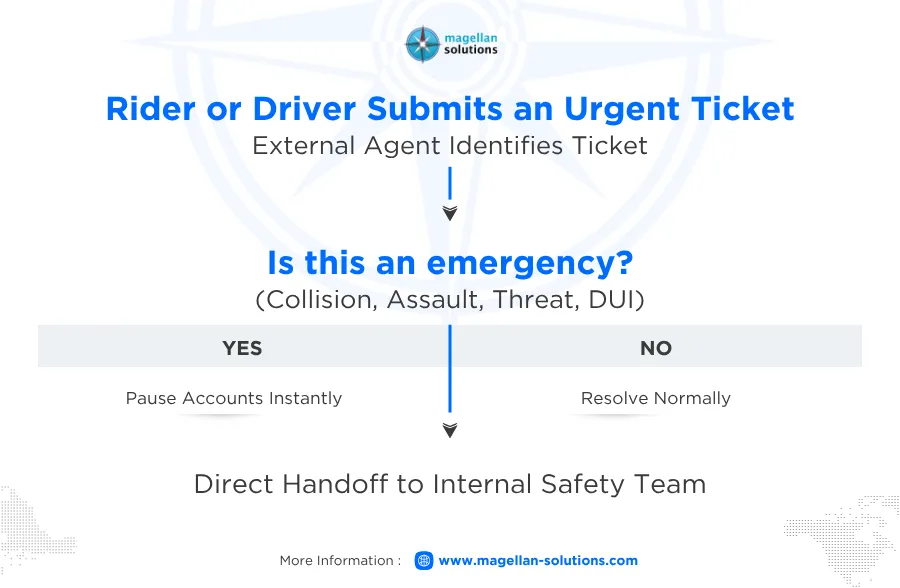
While routine transportation customer service belongs with external teams, severe safety events require strict internal governance. In fact, if an outside team handles serious collisions, physical altercations, or criminal complaints without internal control, the company takes on substantial legal and brand risk. For this reason, high-stakes incidents are treated separately from standard transportation customer service queues.
Consequently, every mobility platform must retain an internal trust and safety team to handle dangerous events.
1. Collisions and Bodily Injury
When a vehicle is involved in a crash during an active trip, commercial insurance carriers and municipal regulators step in immediately. Therefore, frontline external agents should only collect initial statements, verify that local emergency responders were notified, and temporarily pause active accounts.
Meanwhile, coordinating with insurance claims adjusters and complying with federal vehicle incident standards, such as the NHTSA Standing General Order on Crash Reporting, must remain in the hands of internal risk directors.
2. Physical Threats, Harassment, and Impaired Driving
Reports of violence, verbal harassment, or driving under the influence demand immediate operational containment. For this reason, outside teams should not make permanent decisions regarding account deactivations. Instead, their role is early triage:
- First, flag the ticket as an urgent incident within 60 seconds.
- Next, place a temporary safety lock on the reported account to prevent immediate harm.
- Finally, transmit all telematics logs, driver details, and passenger messages directly to the internal safety manager.
3. Law Enforcement Inquiries
When police departments or government regulators submit formal subpoenas for trip history, vehicle GPS records, or driver identification, outside agents must never respond directly. Instead, these requests must pass straight to the company legal team.
Practical Rules for Scaling Transportation Customer Service
To scale your transportation customer service smoothly without quality dips, establish concrete operational standards with your outsourcing partner:
Establish Clear Refund Discretion Limits
First, provide frontline agents with specific refund tiers. For example, authorize agents to release credits up to ten dollars independently, require senior agent review for credits between ten and twenty-five dollars, and escalate amounts over twenty-five dollars to an internal supervisor. As a result, this protects overall profitability while maintaining reliable transportation customer service standards.
Enforce Role-Based Data Protection
In addition, protect user privacy by hiding sensitive information. Outside agents need access to trip routes, fare calculations, and vehicle descriptions. However, full payment card numbers and unmasked phone numbers should remain completely hidden in accordance with consumer data standards.
Schedule Joint Quality Reviews
Finally, audit customer interactions alongside your service partner every week. Reviewing voice recordings and chat transcripts together ensures that outside agents represent your brand tone accurately and adhere strictly to escalation procedures.
Moreover, according to the Deloitte Global Outsourcing Survey, organizations that combine clear operational frameworks with outsourced support teams typically achieve contact center cost reductions of 50% to 70% while improving operational flexibility.
Operational Division: Who Handles What?
| Ticket Category | Operating Team | Primary Responsibilities | Target Benchmark |
|---|---|---|---|
| Rider Inquiries | External Support Team | Fare refunds, lost items, voucher fixes, app help | Speed to answer under 4 minutes |
| Driver Inquiries | Specialized External Team | Direct deposit checks, paper audits, toll fees | First-contact resolution over 85% |
| Safety Emergencies | In-House Safety Team | Collisions, physical threats, subpoenas, account bans | Emergency handoff under 60 seconds |
Maintaining balance across these three distinct tiers ensures responsive, compliant transportation customer service as trip numbers expand. Building a dependable support operation requires the right operational partner. At Magellan Solutions, we deliver scalable call center operations and dedicated technical support designed for fast-moving platforms. Therefore, if you are preparing to scale your support capacity across multiple cities, contact our team today to design a customized operational workflow.
Frequently Asked Questions
What communication channels work best for transportation customer service?
In-app messaging and automated chat tools work best for passengers because riders can read responses on mobile screens without interrupting their day. In contrast, for active drivers, live phone support and high-priority chat are more effective because drivers require quick assistance while operating on the road.
How do platforms prevent agents from issuing excessive refunds?
Platforms enforce programmatic limits inside their ticketing software. For example, system administrators can cap the maximum refund allowable per transaction, establish daily agent concession budgets, and flag customer profiles that exhibit abusive refund patterns.
What system permissions does an outside support partner need?
External agents need access to customer support consoles, GPS trip replay tools, and payment confirmation screens. However, sensitive records, including full bank account numbers, physical home addresses, and unmasked phone numbers, should remain restricted behind permission-based firewalls.
When should a mobility platform transition transportation customer service to an external team?
A platform should consider outsourcing transportation customer service when in-house staff spend more than 30% of their working hours answering repetitive inquiries about lost items, receipts, and passwords. In addition, outsourcing becomes essential when expanding across time zones demands round-the-clock coverage.