




Understand how appointment scheduling in healthcare strengthens patient engagement, supports better calendar management, and reduces administrative workload for medical teams. Discover how we offer scalable scheduling solutions tailored for healthcare providers.
Patients rarely think about scheduling until it becomes a problem.
A missed call, a delayed confirmation, or a long wait on the phone often defines the entire experience before a patient even sees a doctor. In specialty clinics, these moments add up quickly and affect how smoothly daily operations run.
That’s why many providers now rely on 24/7 medical appointment scheduling to maintain consistent patient coordination and reduce pressure on internal teams.
In healthcare environments where schedules shift constantly and patient demand keeps rising, appointment scheduling in healthcare plays a direct role in how efficiently clinics operate. It influences how staff manage time, how patients move through care, and how reliably information flows between systems.
When Scheduling Breaks, Everything Slows Down
Most scheduling issues don’t stem from a single major failure. They build up through small inefficiencies that compound over time.
Front-desk teams handle calls, cancellations, rescheduling, insurance coordination, and provider availability all at once. When those tasks rely on manual processes, delays start showing up across the clinic.
Appointment scheduling in healthcare often becomes the pressure point when:
- Patient calls take too long to resolve
- Calendars get double-booked or misaligned
- Follow-ups get delayed or missed
- Staff spend more time fixing schedules than managing patients
These issues don’t stay isolated. They affect workflow speed, staff workload, and patient satisfaction simultaneously.
What Efficient Scheduling Actually Changes In Daily Operations
Appointment scheduling in healthcare improves more than calendar management. It directly affects how smoothly a clinic runs hour by hour.
With structured scheduling systems in place, clinics handle:
- Faster appointment confirmations
- Fewer scheduling conflicts
- Clearer provider availability
- Smoother patient flow throughout the day
- Reduced back-and-forth between staff and patients
Instead of reacting to constant changes, teams operate with more control over their schedules. That shift alone reduces a significant amount of daily operational strain.
Administrative Work Is Quietly Draining Healthcare Teams
Deloitte Insights reports that healthcare technologies designed to streamline administrative and scheduling tasks can reduce time spent on these activities by up to 38%–47%, saving approximately 700–870 hours per scheduler each year.
That level of time loss quickly shows up in delays, longer patient wait times, and overloaded staff. Appointment scheduling in healthcare becomes one of the main pressure points in daily operations.
Why Healthcare Teams Struggle Without Structured Scheduling
Healthcare doesn’t operate on predictable patterns. Patient needs change daily, provider availability shifts, and urgent cases often disrupt planned schedules.
Without structured appointment scheduling in healthcare, teams deal with:
- Scattered communication across phone calls and notes
- Inconsistent appointment records
- Manual updates across multiple systems
- Repeated follow-ups for basic scheduling tasks
That workload diverts attention from patient care and increases the risk of avoidable coordination errors.
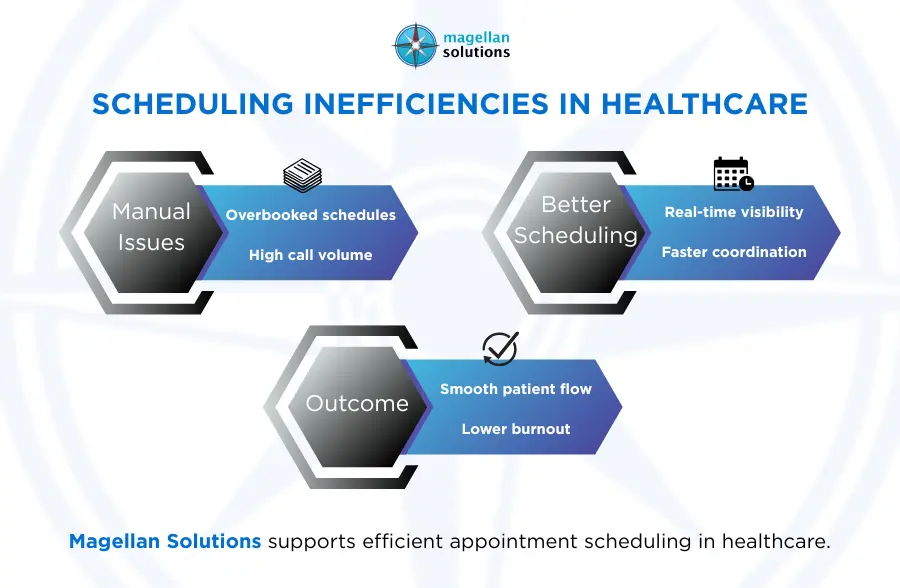
Why Specialty Clinics Feel Scheduling Pressure More Intensely
Specialty clinics manage more complex scheduling needs than general practices.
Patients often require:
- Recurring visits
- Coordinated specialist schedules
- Follow-up procedures
- Time-sensitive appointments
Without reliable appointment scheduling in healthcare, these layers create bottlenecks that slow down both clinical and administrative work.
Clinics in cardiology, orthopedics, dermatology, behavioral health, oncology, and diagnostics often feel this strain first because even a single scheduling delay can affect multiple downstream appointments.
How Technology Reshapes Scheduling Without Replacing Human Support
Modern scheduling systems don’t remove human involvement from healthcare. They reduce repetitive workload so staff can focus on higher-value tasks.
Appointment scheduling in healthcare now often includes:
- Automated reminders and confirmations
- Centralized scheduling systems
- Outsourced scheduling support
- AI-assisted coordination tools
These systems handle routine tasks while staff manage exceptions, patient concerns, and complex scheduling needs.
Why Scheduling Efficiency Connects Directly To Patient Experience
Long hold times, unclear appointment details, or repeated rescheduling issues create frustration that carries into the overall perception of care.
Strong appointment scheduling in healthcare improves:
- Response time for patient requests
- Clarity in appointment details
- Consistency in follow-ups
- Ease of rescheduling
When scheduling runs smoothly, patients experience fewer friction points before their visit even begins.
Building Scalable Operations Starts With Scheduling
Without structured systems, growth creates more administrative pressure rather than greater efficiency. Staff spend more time managing calendars than supporting patient care.
Appointment scheduling in healthcare supports scalability by:
- Reducing manual scheduling workload
- Improving coordination across departments
- Stabilizing daily clinic flow
- Supporting higher patient volumes without added strain
For growing clinics, scheduling efficiency is often one of the first operational upgrades that directly impacts performance.
Why Scheduling Quietly Shapes Clinic Performance
Healthcare teams manage more complexity every year, and scheduling sits at the center of that workload. Appointment scheduling in healthcare influences how efficiently clinics operate, how patients experience care, and how effectively staff manage daily demands.
Magellan Solutions supports healthcare providers with scalable operational services that improve scheduling coordination and streamline patient management without overloading internal teams.
If your clinic needs a more structured approach to patient coordination, reach out through our contact us to explore how scheduling support can improve your operational efficiency.