


Looking for an accurate quote for your outsourcing needs?
Schedule a FREE call with our outsourcing expert now and get a precise quotation that meets your requirements. Don't wait - get started today!
In the subscription economy, loyalty determines profitability. As a result, customer support services directly influence how long customers stay, how deeply they adopt your software, and how confidently they recommend it to others. For global SaaS providers, structured user support services create stability across time zones, industries, and user segments. When support operations function smoothly, retention strengthens, churn declines, and recurring revenue becomes more predictable.
At the same time, customer expectations continue to rise. Therefore, SaaS companies must ensure that every interaction reflects speed, clarity, and expertise. Well-organized user support services make that possible.
Why User Support Services Shape the SaaS Customer Journey
To begin with, SaaS revenue depends on recurring subscriptions. Consequently, retention becomes a strategic priority rather than a secondary metric. Because of this, user support services sit at the center of long-term growth strategies.
Whenever customers face onboarding friction or technical challenges, they evaluate the reliability of your platform. If support responses arrive quickly and solutions resolve the issue on the first attempt, confidence grows. Conversely, delays and inconsistent communication weaken trust. Therefore, structured support services directly influence customer sentiment.
Moreover, effective support teams drive measurable results:
-
Faster activation during onboarding
-
Higher feature adoption rates
-
Reduced churn percentages
-
Increased customer lifetime value
-
Stronger brand advocacy
In other words, every resolved ticket reinforces the relationship. Over time, consistent performance compounds into sustainable growth.
Global SaaS Pressures That Require Strong User Support Services
As SaaS platforms expand internationally, operational complexity increases. For this reason, scalable user support become essential.
Continuous Time Zone Coverage
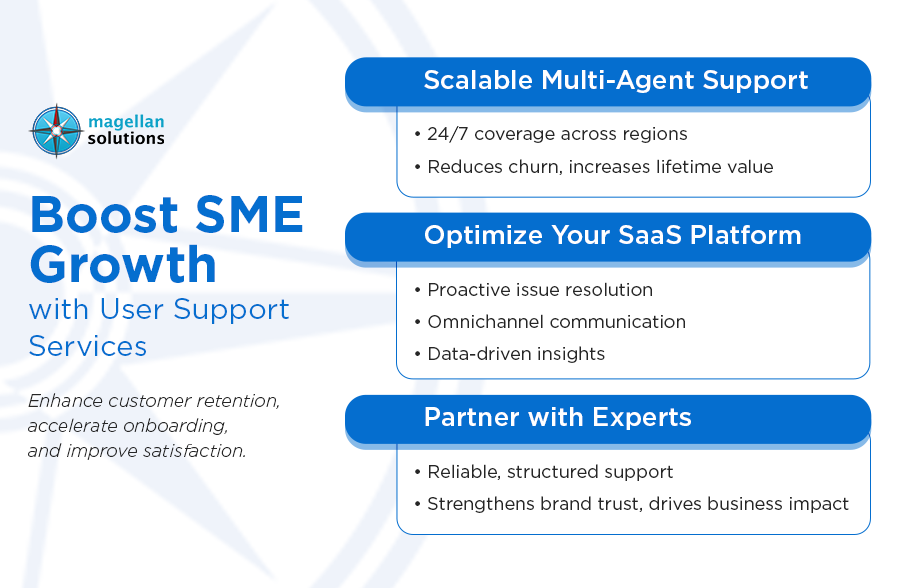
First, customers operate in different regions. Therefore, delayed responses create frustration. With structured 24/7 support services, SaaS companies maintain responsiveness across North America, Europe, and Asia-Pacific. As a result, customers receive assistance during their own business hours.
Technical Product Complexity
Second, enterprise SaaS platforms include APIs, automation workflows, and advanced integrations. Accordingly, support agents must possess technical fluency. Well-trained user support reduce repeat tickets because agents provide precise troubleshooting steps from the outset.
Multilingual and Cultural Expectations
Furthermore, language clarity strengthens trust. Multilingual user support prevent miscommunication and accelerate resolution. In addition, cultural awareness improves rapport, especially in global B2B environments.
Rapid Growth Cycles
Finally, SaaS businesses often experience sudden user spikes during funding rounds or product launches. In such cases, a multi-FTE support structure absorbs ticket surges efficiently. Consequently, service levels remain stable even during expansion.
How User Support Services Improve Retention and Adoption
Customer experience develops across multiple stages. Therefore, consistent user support must support each phase of the lifecycle.
Structured Onboarding
Initially, new customers require guidance. For that reason, onboarding specialists within user support services provide walkthroughs, configuration assistance, and integration support. As a result, users reach value milestones faster.
Omnichannel Consistency
Meanwhile, customers move between chat, email, voice, and helpdesk portals. Integrated user support services centralize communication history. Consequently, users avoid repeating details, and agents respond with full context.
Proactive Resolution Strategies
In addition, ticket data reveals patterns. By analyzing recurring issues, support teams refine documentation and alert product teams about usability gaps. Therefore, proactive outreach reduces dissatisfaction before it escalates.
Data-Driven Optimization
Equally important, performance metrics guide improvement. First Response Time, Resolution Time, and Customer Satisfaction Scores reveal operational health. Through structured dashboards and QA monitoring, user support services maintain accountability and continuous refinement.
The Operational Framework Behind Effective User Support Services
Behind every reliable support system lies structured architecture. Specifically, high-performing user support services rely on defined roles, workflows, and governance.
Tiered Escalation Model
To ensure efficiency, Tier 1 handles general inquiries and common troubleshooting. Subsequently, Tier 2 manages configuration challenges. Finally, Tier 3 specialists resolve complex technical concerns. Because of this layered approach, resolution times decrease and expertise aligns with issue complexity.
Knowledge Management Systems
Additionally, centralized documentation empowers agents with updated workflows and scripts. Consequently, customers receive consistent guidance regardless of which agent responds.
Workforce Planning and Quality Assurance
Moreover, multi-agent environments allow peer reviews and performance benchmarking. QA analysts evaluate interactions regularly. As a result, service standards remain stable across shifts.
Through structured governance, user support services maintain reliability at scale.
The Strategic Benefits of Outsourcing User Support Services
While in-house expansion demands capital and recruitment cycles, outsourcing provides operational flexibility. Therefore, many SaaS platforms leverage outsourced user support services to maintain agility.
Scalable Multi-Agent Infrastructure
A multi-seated delivery hub supports shift-based 24/7 operations. Consequently, SaaS companies scale capacity based on demand fluctuations. During peak periods, additional seats activate quickly. During steady phases, workforce levels optimize accordingly.
Access to Specialized Talent
Furthermore, established outsourcing providers recruit agents with SaaS experience and multilingual capabilities. As a result, first-contact resolution improves, and customer satisfaction rises.
Performance Transparency
In addition, structured reporting frameworks ensure KPI alignment. Weekly dashboards, QA audits, and training cycles reinforce accountability within outsourced user support services.
Therefore, outsourcing strengthens scalability while preserving performance control.
Aligning User Support Services with Product Development
Support teams collect valuable operational insight. For this reason, collaboration between user support services and product teams accelerates improvement cycles.
For example, recurring feature confusion highlights UX friction. Similarly, integration challenges signal documentation gaps. When support data flows directly to product managers, prioritization becomes clearer. Consequently, engineering teams address systemic issues faster.
This cross-functional loop strengthens the entire SaaS ecosystem.
Security and Compliance in User Support Services
Because SaaS platforms manage sensitive data, security protocols must remain strict. Structured user support services enforce role-based access, encrypted systems, and documented compliance processes.
Additionally, secure ticket management platforms restrict unauthorized access. Regular audits reinforce data protection standards. Therefore, customers maintain confidence in the platform’s integrity.
Measuring ROI from User Support Services
Executive teams evaluate impact through quantifiable metrics. Retention rates, churn reduction, and customer lifetime value demonstrate financial performance. Accordingly, efficient user support services contribute directly to revenue stability.
Furthermore, high satisfaction increases upsell opportunities. Over time, predictable service quality lowers replacement acquisition costs. Therefore, support operations become a strategic revenue safeguard.
Scalable User Support Services for Enterprise SaaS Growth
As SaaS companies expand, infrastructure must evolve. Multi-FTE teams, structured team leads, and real-time dashboards create resilience. Because of shift-based scheduling, continuous coverage becomes standard.
Moreover, workforce forecasting anticipates seasonal spikes. Consequently, service levels remain consistent even under pressure. With disciplined planning, user support services transform into a growth enabler.
Why Global SaaS Companies Choose Magellan Solutions
Magellan Solutions delivers structured user support services tailored for global SaaS environments. Through a multi-agent, multi-seated hub model, the company supports international coverage and scalable expansion.
Dedicated teams align with brand voice and product requirements. In addition, multichannel customer support services integrate seamlessly with existing CRM systems. Performance governance frameworks ensure measurable accountability.
As a result, SaaS companies gain operational stability, workforce scalability, and consistent service standards.
Strengthen Retention with Scalable User Support Services
Ultimately, dependable user support services reinforce customer trust, protect recurring revenue, and support international growth. SaaS platforms that invest in structured, KPI-driven support frameworks secure a long-term competitive advantage.
Magellan Solutions provides multi-FTE support teams operating within secure, analytics-driven environments. Visit Magellan-Solutions.com today to explore how scalable user support services can enhance customer experience and strengthen global SaaS retention strategies.