


Most businesses don’t realize their operations are slowing down until the delays start affecting customers, reporting, and daily productivity. Teams update spreadsheets manually, departments store files across disconnected platforms, and employees spend valuable hours searching for information instead of acting on it.
As businesses handle larger volumes of customer records, financial reports, and operational data, outdated workflows become harder to manage. That’s why many organizations now rely on AI-powered data management services to organize information faster, reduce repetitive work, and improve operational efficiency across departments.
Modern enterprises need more than data storage. They need systems that keep information accurate, accessible, and easy to manage as operations continue growing. This is where automated data management helps businesses move faster without adding unnecessary operational complexity.
Why Data Processing Becomes Harder as Businesses Grow
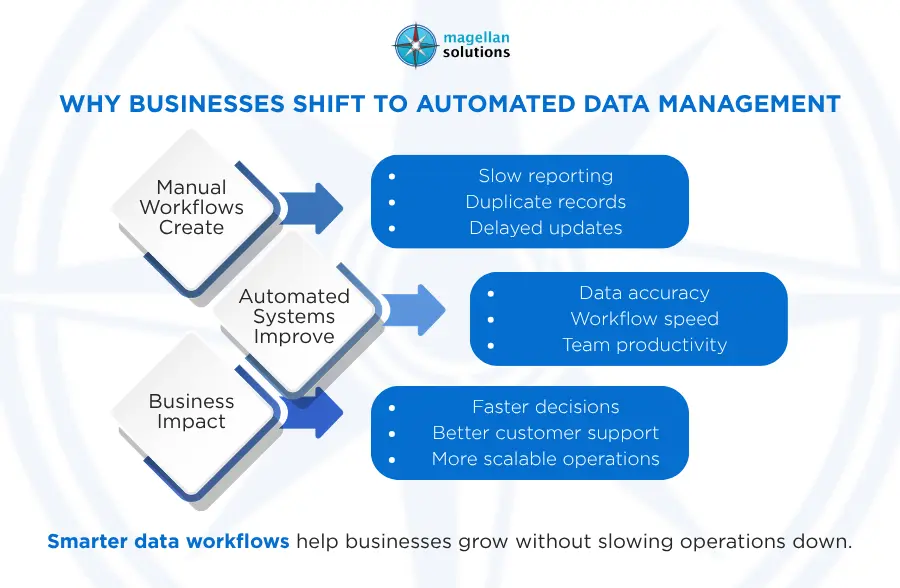
A business that once handled a manageable number of records now handles thousands of customer interactions, internal reports, support tickets, invoices, and operational updates every day. Different departments often adopt different systems over time, which creates gaps in communication and reporting.
The result usually looks familiar:
- duplicate records
- delayed updates
- inconsistent reporting
- missing files
- slow internal coordination
These issues don’t always appear dramatic at first. But over time, they slow productivity, create unnecessary operational costs, and frustrate employees trying to work efficiently. For SMEs entering growth stages, these operational problems can quietly limit scalability before leadership teams fully recognize what’s happening.
How Automated Data Management Improves Daily Operations
Many businesses still rely heavily on manual processes to organize and update information. Employees transfer files between systems, manually validate records, and spend hours preparing reports that should already be accessible.
Automated data management helps businesses streamline repetitive processes by reducing manual intervention across workflows. Instead of relying entirely on employees to organize information, automation tools can process, validate, categorize, and synchronize data much faster.
This often includes:
- Organizing incoming records automatically
- Syncing updates across platforms
- Flagging incomplete entries
- Reducing duplicate files
- Speeding up report generation
- Improving search and retrieval processes
The operational impact becomes noticeable quickly. Teams spend less time handling repetitive administrative tasks and more time focusing on customer support, strategy, and business performance.
Faster Reporting Helps Businesses Move Faster
When managers wait too long for operational updates, customer insights, or financial reports, businesses lose the ability to respond quickly to problems and opportunities.
Automated data management shortens that delay by helping enterprises centralize and process information more efficiently. Instead of manually pulling reports from multiple departments, teams can access up-to-date information faster and with fewer inconsistencies.
According to a survey, organizations adopting intelligent automation expect to achieve an average cost reduction of 31% over the next three years by improving productivity, accuracy, and operational efficiency across business functions.
That matters even more for SMEs competing in fast-moving industries. Smaller companies rarely have the luxury of wasting time on slow internal processes.
Faster access to reliable information allows leadership teams to:
- Respond quicker to customer needs
- Monitor operational performance more accurately
- Identify workflow bottlenecks earlier
- Improve planning and resource allocation
In many cases, speed becomes a competitive advantage.
Manual Errors Create Bigger Operational Problems Over Time
Small mistakes create larger operational issues when businesses process high volumes of information daily.
A duplicated customer profile may seem minor initially. The same goes for incomplete records, outdated files, or inconsistent formatting. But as those issues accumulate, they begin to affect reporting accuracy, customer interactions, and internal coordination.
Industries like healthcare, finance, logistics, and legal services feel these problems even more because accuracy directly affects compliance and customer trust.
Automated data management helps reduce these risks by creating more consistent workflows. Systems can flag missing information immediately, synchronize updates across departments, and reduce unnecessary manual handling that often leads to human error.
AI Supports Smarter Data Management
Businesses don’t need automation just to appear modern. They need practical systems that solve operational problems. That’s why many enterprises now combine AI tools with automated data management to improve efficiency without disrupting existing workflows.
AI-supported systems can help businesses:
- categorize documents faster
- detect inconsistencies in records
- organize large datasets
- improve search accuracy
- process repetitive tasks more efficiently
Human oversight still matters. Teams continue to make decisions, review sensitive information, and handle complex situations that require judgment and context. The difference is that employees no longer waste unnecessary time on repetitive administrative work that automation can already handle more efficiently.
Better Data Management Improves Customer Experience Too
Most customers never see the systems operating behind a business. But they immediately notice when operations feel disorganized. Slow response times, inconsistent updates, inaccurate information, and delayed support interactions often trace back to poor internal data handling.
Automated data management helps businesses create smoother internal workflows, which often leads to faster communication, better coordination, and more reliable customer support.
For SMEs competing against larger companies, operational efficiency often shapes how customers perceive the business overall.
Building More Efficient Enterprise Operations
Modern enterprises generate more information than ever before. Businesses that continue relying heavily on fragmented manual processes often struggle to maintain efficiency as operations grow.
Automated data management helps organizations simplify workflows, reduce operational bottlenecks, and improve information flow across departments. For SMEs preparing for long-term growth, building efficient systems early can prevent larger operational problems later.
Magellan Solutions enables businesses to gain access to reliable support solutions that improve enterprise workflows through scalable, AI-supported operational services. If your organization wants to improve how it manages growing volumes of business data, now is the time to strengthen your operational foundation.
Connect with our team via our Contact Us page to explore how smarter data management can support faster, more efficient business operations.