



Looking for an accurate quote for your outsourcing needs?
Schedule a FREE call with our outsourcing expert now and get a precise quotation that meets your requirements. Don't wait - get started today!
Organizations that depend on high-volume information flows need AI data processing to maintain accuracy, speed, and consistency. Large datasets often come from multiple sources such as invoices, customer forms, logistics systems, and digital platforms. Each data point influences reporting, forecasting, and compliance. When errors accumulate, decisions suffer.
AI-driven data entry systems process and validate data in real time. They reduce human error, standardize formats, and create a reliable foundation for analytics. This article explains how these systems work, why they improve precision, and how businesses can apply them effectively at scale.
Can AI Agents Do Data Entry?
Yes, AI agents handle data entry tasks across structured and unstructured formats. They extract, interpret, and input data into business systems using trained models and predefined rules.
What AI agents actually do
- Capture data from PDFs, emails, spreadsheets, and scanned documents
- Interpret text using natural language processing
- Convert images into editable data through OCR (optical character recognition)
- Validate entries against rules and historical datasets
- Flag inconsistencies for human review
Where AI agents perform best
| Use Case | AI Capability | Business Outcome |
|---|---|---|
| Invoice processing | Extracts line items and totals | Faster billing cycles |
| CRM data entry | Captures customer details from forms | Cleaner customer records |
| Healthcare records | Structures patient data | Improved compliance accuracy |
| Logistics documentation | Updates shipment details | Real-time tracking visibility |
AI agents follow logic-based workflows. They learn from repeated patterns, which helps them handle variations in document formats over time. Human teams remain involved in edge cases and quality checks, ensuring the final output meets business standards.
Businesses using ai-powered data entry report measurable gains in processing speed and accuracy, especially in high-volume environments.
How AI-Powered Data Entry Improves Data Accuracy
Automated Data Capture Reduces Manual Errors
Manual data entry often leads to typos, missing fields, and duplicated records. AI removes these risks by capturing data directly from source files.
For example, OCR tools convert scanned invoices into structured data fields. Natural language processing then identifies key elements such as dates, totals, and vendor names. This layered approach ensures that data is both captured and understood correctly.
Real-Time Validation Strengthens Data Integrity
AI systems validate entries as they are processed. Instead of waiting for batch reviews, errors are flagged instantly.
Common validation checks include:
- Format verification such as date and currency standards
- Duplicate detection across datasets
- Range checks for numerical values
- Cross-referencing with existing records
This process improves data reliability and reduces downstream corrections.
Machine Learning Improves Over Time
AI models adapt based on feedback and historical data. If a system encounters a new document format, it learns how to process it more accurately in future instances.
That means accuracy doesn’t stay static. It improves as the system processes more data. Organizations using ai-powered data entry benefit from continuous refinement without increasing manual workload.
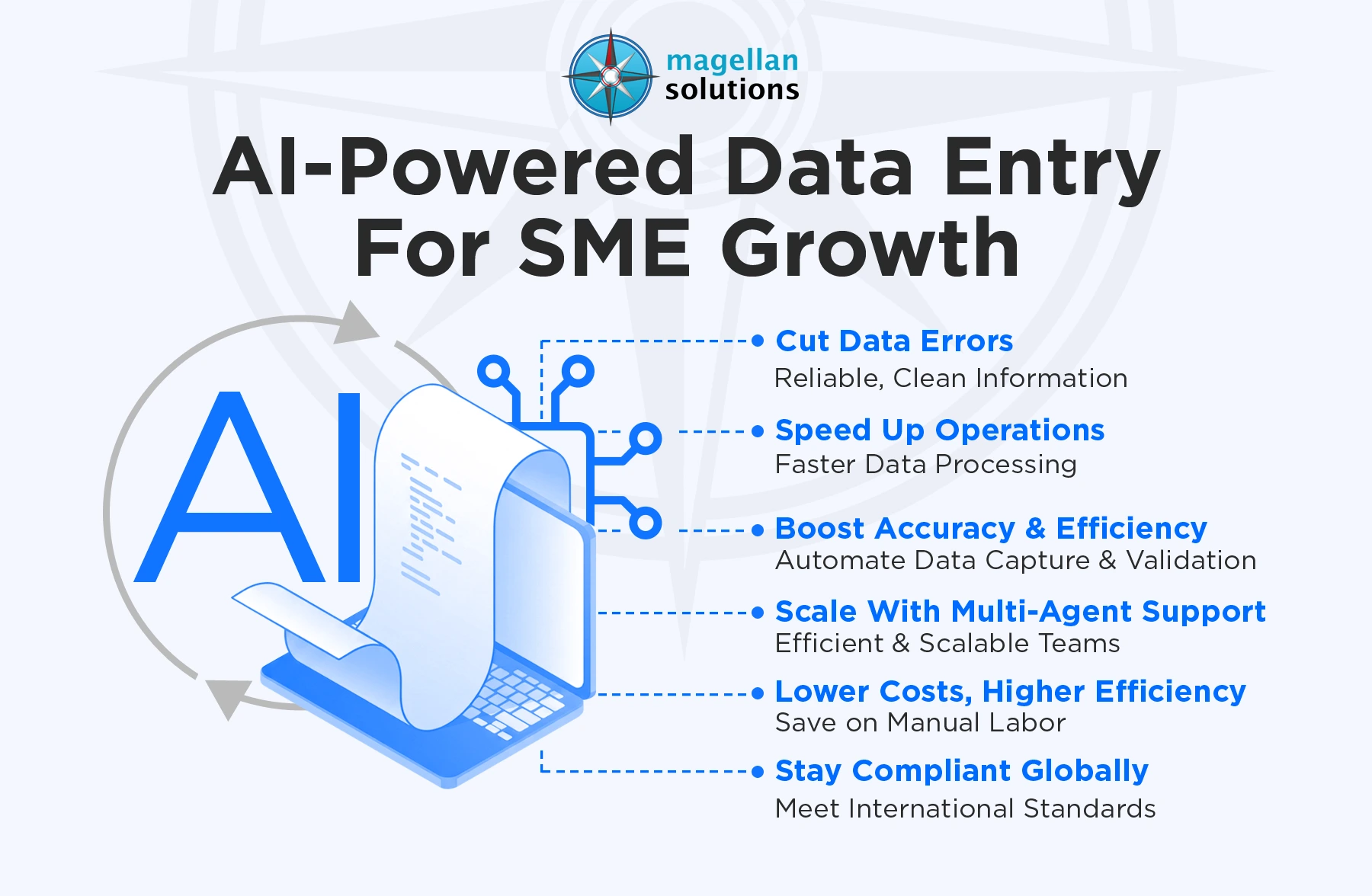
Key Benefits of AI-Powered Data Entry for Large-Scale Datasets
1. High-Volume Scalability
AI systems process thousands of records simultaneously. This makes them ideal for enterprises handling large datasets across multiple regions.
2. Faster Turnaround Times
Tasks that once took hours can now be completed in minutes. Faster processing supports real-time reporting and quicker decision-making.
3. Consistent Data Formatting
AI applies standardized rules across all entries. This consistency improves data quality and simplifies analytics.
4. Reduced Operational Costs
Automation lowers the need for repetitive manual work. Teams can focus on analysis, strategy, and customer engagement instead.
5. Improved Compliance Readiness
Accurate data supports regulatory requirements in industries such as healthcare and finance. AI ensures records are complete and properly formatted.
Practical Applications of AI-Powered Data Entry
Different industries apply ai-powered data entry in ways that align with their operational needs.
Healthcare
- Digitizes patient records
- Structures insurance claims
- Maintains accurate medical histories
Finance
- Processes invoices and expense reports
- Validates transaction records
- Supports audit-ready documentation
Logistics
- Tracks shipments in real time
- Updates inventory systems
- Maintains delivery records
E-commerce
- Manages product listings
- Updates customer data
- Processes order information
Each use case highlights a simple outcome. Better data leads to better decisions.
Steps to Implement AI-Powered Data Entry Successfully
A structured approach helps businesses get the most value from AI systems.
Step 1: Assess Data Sources
Identify where your data comes from. This includes documents, emails, and digital platforms. Understanding input sources helps define processing requirements.
Step 2: Define Data Standards
Set clear rules for formatting, validation, and storage. These standards guide how AI systems process information.
Step 3: Integrate with Existing Systems
Connect AI tools with CRM, ERP, and other platforms. Seamless integration ensures data flows across departments without friction.
Step 4: Train and Optimize Models
Provide sample datasets and feedback to improve system performance. Regular updates keep accuracy levels high.
Step 5: Combine AI with Human Oversight
AI handles repetitive tasks. Human teams manage exceptions and quality assurance. This balance ensures reliable outputs.
AI SEO Perspective: Why Structured Data Entry Matters
From an AI SEO standpoint, structured and accurate data improves how systems interpret and rank information. Search engines and AI models rely on clean datasets to understand context and relevance.
Key SEO-related outcomes
- Improved data consistency: Clean data supports better indexing and retrieval
- Enhanced semantic clarity: Structured entries help AI connect related concepts
- Faster data processing: Real-time updates improve content freshness signals
For example, consistent product data across platforms ensures that search engines display accurate details. Inconsistent data creates confusion, which can affect visibility.
Businesses that invest in ai-powered data entry strengthen their digital presence by maintaining reliable and structured datasets.
Comparison: Manual vs AI-Powered Data Entry
| Factor | Manual Data Entry | AI-Powered Data Entry |
|---|---|---|
| Speed | Slow | High-speed processing |
| Accuracy | Prone to human error | High precision with validation |
| Scalability | Limited | Easily scalable |
| Cost Efficiency | Labor-intensive | Optimized operational cost |
| Data Consistency | Variable | Standardized output |
This comparison shows why many enterprises are shifting toward AI-driven solutions.
Scale Data Operations with a Multi-Agent Approach
Large datasets require more than just technology. They need a structured operational model. A multi-agent, multi-seated setup allows businesses to process data at scale while maintaining accuracy.
This approach includes:
- Parallel processing across multiple teams
- Dedicated quality assurance layers
- Continuous workflow monitoring
- Flexible resource allocation based on demand
Magellan Solutions supports ai-powered data entry through a multi-FTE delivery model. This structure ensures that enterprises receive consistent, high-quality data processing without bottlenecks.
Turn Data Accuracy Into a Competitive Advantage
Accurate data supports every part of a business, from reporting to customer experience. ai-powered data entry provides the speed, consistency, and scalability needed to manage large datasets effectively.
Magellan Solutions delivers outsourced data services that combine AI technology with experienced data professionals. Businesses gain access to a multi-agent operational hub designed for high-volume processing and precision.
Ready to improve your data accuracy at scale?
Visit https://www.magellan-solutions.com/bpo-solutions/data-entry/ to explore how Magellan Solutions can support your data operations with reliable, AI-driven workflows.