


Deploying a professional telecommunications call center service is the most reliable way for broadband providers to protect subscriber margins during critical account transitions. In modern telecommunications, the speed and competence of your telecom customer support directly dictate subscriber retention.
Internet service providers (ISPs) and mobile carriers operate in an intensely competitive environment. Indeed, subscriber attrition data evaluated in CustomerGauge Telecom Retention Benchmarks reveals that customer churn in telecommunications averages between 20% and 50% annually . In addition, research published in the Harvard Business Review Study on Customer Retention Value confirms that acquiring a replacement subscriber costs five to seven times more than retaining an existing account . Consequently, customer lifecycle management has become the primary operational battleground.
Two specific touchpoints determine whether a subscriber stays for years or cancels within months. These touchpoints are new-customer onboarding and cancellation-saving calls. Therefore, regional fiber operators and merged internet providers must structure their frontline workflows carefully. Successful operators do not force internal technical teams to field repetitive billing calls. Instead, they deploy specialized outsourced teams to handle routine onboarding and first-tier saves while preserving clean escalation pathways for complex technical disputes.
Outsourced support teams can successfully manage up to 75% of routine subscriber onboarding and first-tier cancellation inquiries, as detailed in the McKinsey Customer Care Journey Redesign Study. Specifically, external agents excel at equipment self-installation guidance, first-bill shock explanations, and scripted retention save offers. However, carriers must establish strict handoff boundaries. Complex line degradation, disputed disconnect fees, and high-value commercial accounts must escalate to internal specialists immediately.
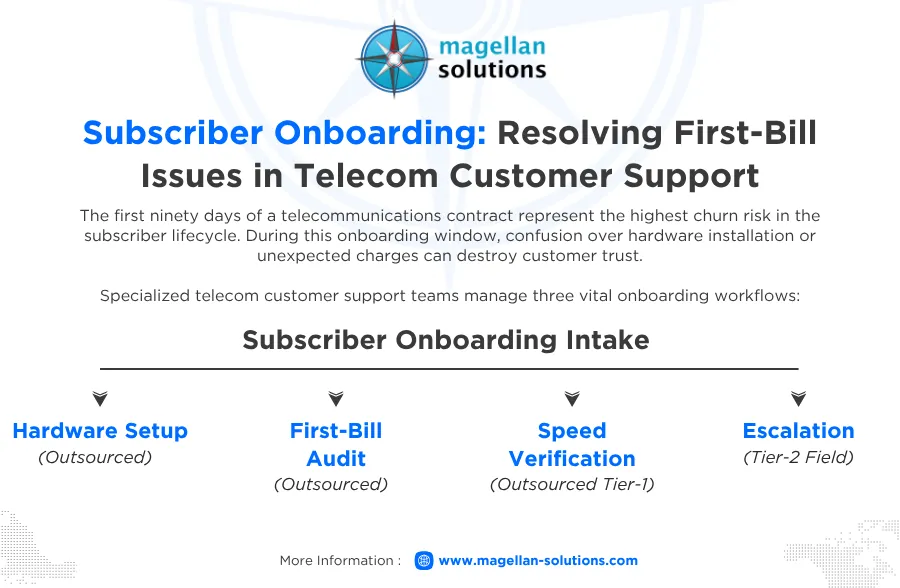
1. Self-Installation and Hardware Provisioning
Broadband providers increasingly ship self-install gateway kits to avoid expensive technician truck rolls. However, non-technical subscribers frequently struggle with optical network terminals (ONTs), coaxial connections, or Wi-Fi router placement.
Outsourced agents guide subscribers through standard setup steps using verified troubleshooting workflows:
- Verifying physical cable seating and gateway LED indicator sequences.
- Guiding users through mobile network application downloads and SSID naming.
- Executing remote modem signal pings and provisioning resets inside provider management consoles.
2. Defusing First-Bill Shock
First-bill inquiries generate massive call volumes for regional internet providers. Subscribers expect a flat monthly rate but open an initial invoice containing prorated service days, one-time activation charges, and advance monthly fees.
Frontline agents defuse frustration by walking through itemized charges line by line. Specifically, agents verify promotional discounts, explain billing cycles, and confirm automated payment configurations. Proactive billing transparency directly prevents premature subscriber cancellations. For broader consumer protection guidelines on billing practices, providers regularly consult the Federal Communications Commission Broadband and Telecom Consumer Guides.
3. Early Speed and Latency Verification
When subscribers sign up for gigabit fiber, they immediately run third-party speed tests. Uninformed customers often run tests over outdated Wi-Fi bands, producing disappointing results that prompt cancellation threats.
External tier-1 agents clarify the difference between hardwired gateway throughput and local wireless interference. In addition, agents help optimize frequency bands before customer dissatisfaction turns into an official complaint.
Cancellation-Saving Calls: Structuring Retention Offers in Telecom Customer Support
When an existing subscriber calls to cancel, your frontline team faces an urgent financial crisis. An unmanaged cancellation queue results in massive revenue attrition. Conversely, a rigid script alienates frustrated customers.
1. Price Sensitivity and Competitor Promotions
Subscribers often call to cancel because a local competitor launched a promotional teaser rate. Outsourced agents review the customer account tenure and payment history within carrier billing platforms.
If the subscriber maintains a good payment record, the agent applies an authorized retention credit. Alternatively, the agent transitions the subscriber to an unadvertised loyalty tier. This immediate intervention protects core subscription revenue without requiring domestic supervisory approval.
2. Relocation and Move Retentions
Subscribers frequently request cancellation due to home relocation. Rather than processing an immediate disconnect, trained agents cross-reference the customer’s new address against the provider’s active network coverage map.
If service is available at the new residence, the agent schedules a transfer of service and waives the new installation fee. Consequently, the carrier retains the account without paying new customer acquisition costs.
3. Equipment Fee Adjustments
Customers often express irritation over recurring hardware rental charges. Frontline outsourced agents can be empowered to waive router lease fees for twelve months. In exchange, the subscriber agrees to a new annual contract term.
Clear Boundaries: Escalation Rules for Telecom Customer Support Teams
While outsourced teams resolve high-volume inquiries efficiently, telecom providers must enforce clear escalation boundaries. Forcing general agents to handle edge cases damages customer experience and inflates average handle times.
Specialized telecom customer support architectures mandate immediate handoffs under three specific conditions:
1. Physical Line Degradation and Technician Dispatch
If remote diagnostic pings reveal high packet loss, light level anomalies on optical lines, or severed physical drops, phone support has reached its operational limit. Tier-1 outsourced agents collect basic telemetry data, log an audit ticket, and route the case directly to internal network operations centers (NOC) or local field dispatch teams.
2. Unresolved Billing Disputes and Chargebacks
When a customer disputes past-due charges exceeding authorized credit thresholds, frontline teams must not negotiate custom financial settlements. Such accounts escalate to internal revenue assurance or Tier-2 billing managers who hold authority to audit formal contracts.
3. High-Value Commercial and Multi-Line Accounts
Enterprise broadband subscribers and multi-line business accounts generate substantial recurring margins. If a commercial client requests cancellation, outsourced teams must never issue standard residential concessions. Instead, agents execute a warm transfer directly to executive account managers.
Quantifying the ROI of Telecom Customer Support Outsourcing
Deploying dedicated telecom customer support teams delivers substantial financial and operational returns. Carriers protect operating margins while sustaining rapid subscriber growth.
Industry benchmarks confirm the measurable impact of specialized telecom outsourcing partnerships:
- Lower Operating Expenses: According to the Deloitte Global Outsourcing Survey, shifting customer operations to specialized external teams cuts contact center labor expenses by 50% to 70% .
- Reduced Call Volume: Comprehensive research detailed in the McKinsey Customer Care Redesign Study shows that optimizing support journeys reduces call volumes by up to 75% in targeted categories while capturing millions in annualized operating savings.
- Proactive Churn Prevention: Strategic operational analyses in the McKinsey Telecom CX Transformation Report demonstrate that structured frontline execution elevates customer satisfaction and minimizes costly downstream truck rolls.
- Customer Lifetime Value: Independent churn metrics published in Qualtrics Customer Churn Research highlight that a modest 5% reduction in customer attrition can boost overall organizational profits by 25% to 95% .
Prospective Customer Scenario: The Merged Fiber Provider
Consider two regional fiber internet service providers that recently merged to serve 120,000 residential subscribers. The consolidation created massive operational friction. Incompatible legacy billing cycles and unified service rebrandings triggered severe call spikes. First-bill confusion overwhelmed internal staff, driving average hold times past 45 minutes. Consequently, customer churn climbed to 28%.
The merged ISP partnered with an external contact center to stabilize telecom customer support. An outsourced team of twenty dedicated agents took over all inbound onboarding workflows and first-tier cancellation calls. Agents walked new subscribers through prorated billing adjustments and resolved router installation snags.
Within four months, average speed-to-answer dropped under 45 seconds. Furthermore, the outsourced team achieved a 42% first-contact save rate on residential cancellation requests. Overall customer churn dropped back to 14%, preserving over $1.8 million in annual recurring subscription revenue.
5-Point Operational Governance Checklist for Telecom BPO Deployments
Broadband operators must implement strict governance when integrating outsourced contact center teams:
- Define Explicit Save Authority Limits: Establish precise dollar thresholds for one-time credits and plan downgrades so external staff know their exact decision boundaries.
- Standardize Self-Install Knowledge Bases: Provide step-by-step interactive visual guides for every deployed modem, router, and set-top model.
- Integrate Directly with OSS and BSS Platforms: Connect external agents securely to your billing and operational support systems via role-based permissions.
- Enforce First-Call Resolution Benchmarks: Monitor first-contact resolution metrics continuously, ensuring agents solve installation issues without initiating unnecessary callbacks.
- Conduct Weekly Call Calibration Audits: Review recorded onboarding and cancellation calls jointly with your outsourced partner to maintain brand tone and policy compliance.
Elevate Your Subscriber Experience with Magellan Solutions
Scaling telecom operations while maintaining high subscriber retention requires an experienced, highly vetted contact center partner. At Magellan Solutions, we deliver enterprise-grade call center outsourcing, technical triage, and specialized telecom customer support designed for fast-growing broadband providers.
Our ISO-certified delivery centers provide vetted professionals who understand the complexities of provisioning, modem configuration, and subscriber retention. Agents handle billing disputes, self-install setups, and retention save offers across voice, email, and live chat channels. Do not let customer onboarding friction or unmanaged cancellation spikes damage your recurring revenue. Please contact us to inquire about our services today to build a scalable, cost-effective support model for your network.
Frequently Asked Questions About Telecom Customer Support
What percentage of cancellation calls can an outsourced team save?
A well-trained outsourced team operating with clear incentive matrices typically achieves a 35% to 45% save rate on price-sensitive residential cancellation calls, as supported by performance figures in CustomerGauge Churn Reduction Strategies.
How do outsourced agents defuse first-bill shock effectively?
Agents access itemized billing statements directly inside your subscriber management software. They explain prorated calendar days, equipment deposits, and promotional offsets before confirming future recurring payment totals.
Can an external contact center integrate with proprietary billing systems?
Yes. Professional telecom contact centers connect directly to proprietary or commercial billing platforms (such as CSG, Netcracker, Amdocs, or custom web portals) through secure virtual private networks.
What technical troubleshooting can tier-1 outsourced agents perform?
Tier-1 agents perform remote modem reboots, verify cable configurations, review gateway error codes, and check local outage maps before escalating unresolved issues to field engineering.