
Modern ecommerce support services face a constant operational challenge when shoppers report missing or damaged deliveries. A customer opens an order ticket on your Shopify store with a familiar complaint: “My package arrived, but the box was empty. I need an immediate refund.”
For high-growth direct-to-consumer (D2C) brands, customer satisfaction is the foundation of customer lifetime value (LTV). Consequently, many online merchants train their support desks to operate under a simple principle: issue instant, no-questions-asked replacements and refunds. After all, nobody wants to frustrate a loyal shopper over a missing item.
However, organized refund syndicates and opportunistic shoppers exploit this exact generosity every single day.
What begins as a buyer-friendly policy quietly morphs into a severe profitability leak known as friendly fraud. According to research from the National Retail Federation (NRF) Retail Returns Landscape, return fraud represents roughly 9% of all retail returns, costing online merchants tens of billions of dollars each year. When automated bots and dishonest buyers realize your support desk refunds orders without checking package details, your brand becomes a recurring target.
Deploying professional online retail customer service workflows bridges the gap between generous customer care and rigorous asset protection.
This guide details how modern ecommerce support services stop friendly fraud at the frontline helpdesk. It lays out clear verification standard operating procedures (SOPs), customer velocity rules, non-accusatory agent macros, and a structured dollar-tier escalation matrix.
The Hidden Drain: How Lenient Policies Invite Refund Syndicates
Fast-growing D2C merchants face intense competition. To drive conversion rates, brands promote frictionless guarantees, such as “100% Happiness Guaranteed” or “Instant Reshipments.”
Unfortunately, refund syndicates on messaging apps actively monitor fast-growing e-commerce stores. These syndicates recruit everyday consumers, offering to obtain full refunds while letting the consumer keep the merchandise in exchange for a percentage fee.
The schemes typically take three predictable forms:
- The Empty Box Scheme: The buyer claims the courier delivered an unsealed, empty shipping carton.
- The Missing Item Scheme: The buyer orders five expensive items, claims only four arrived, and demands a partial refund.
- The Wardrobing Scheme: The buyer wears apparel for an event, takes photos, and initiates a return with tags tucked inside.
If your frontline team treats every inquiry as an isolated innocent mistake, chargebacks increase and inventory counts fail to match financial records.
Therefore, high-performing online merchants equip their ecommerce support services with objective verification workflows.
Frontline SOPs: 3 Verification Checks Every Support Desk Needs
Stopping friendly fraud does not require treating shoppers like criminals. Instead, it requires replacing blind assumptions with objective data checks.
When a customer reports an empty box or missing item, frontline ecommerce support services execute three standard verification checks before releasing funds:
1. Carrier Weight Verification Checks
Couriers record dimensional and physical package weights at multiple automated scan points along the delivery route.
When a customer claims that an expensive jacket or electronics accessory was missing from a sealed box, agents cross-reference the carrier billable scan weight against the SKU master weight record.
For example, if the master inventory record confirms the product weighs 2.4 pounds, but the final carrier delivery hub scan logged the parcel at 2.45 pounds, the item was inside the package when the driver delivered it. Frontline agents log this data point into the ticket before reviewing next steps.
2. Delivery Metadata and Photo Verification
Couriers increasingly capture photographic proof of delivery and precise GPS coordinates at the moment of drop-off.
Before issuing an instant refund for a non-receipt claim, support agents check the courier tracking portal for delivery metadata:
- Geotagged Delivery Photos: Does the photo show the package placed inside a secure porch or apartment mailroom?
- Signature Confirmation: Did an adult resident sign for the parcel at the registered delivery address?
- Safe-Place Delivery Notes: Did the driver note that the package was handed directly to a resident?
If the delivery photo shows a pristine, factory-taped carton on the buyer doorstep, the claim shifts from a simple delivery loss to potential package tampering or a false claim.
3. Customer Velocity Flags in Helpdesk CRMs
First-time customers with legitimate delivery issues deserve fast resolutions. In contrast, repeat claimants warrant immediate investigation.
High-growth brands configure automated customer velocity tags inside support platforms like Zendesk or Gorgias:
| Customer Velocity Tag | Trigger Condition | Automated Helpdesk Action |
|---|---|---|
| Normal Tier | 0 to 1 replacement or refund in trailing 12 months | Standard frontline resolution pathway |
| Velocity Watch | 2 refund requests within a trailing 90-day window | Route ticket to senior agent review queue |
| High-Risk Hold | 3 or more claims or mismatched shipping and billing profiles | Lock instant refund macros; mandate supervisor sign-off |
By flagging velocity automatically, support teams spot organized bad actors while keeping legitimate first-time buyers on a fast track.
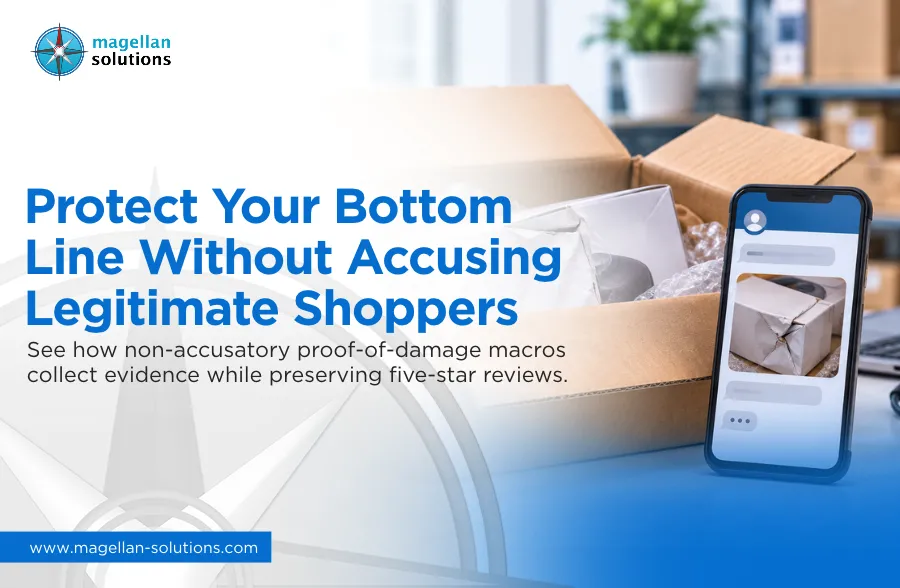
Non-Accusatory Macros: Collecting Proof Without Driving Bad Reviews
The greatest danger when auditing return claims is alienating honest customers. If an agent sounds defensive, an honest customer will leave an angry one-star review or dispute the charge with their bank.
Under consumer protection guidelines, including the Federal Trade Commission (FTC) Consumer Refund Rules, merchants have the legal right to establish clear return conditions, provided those policies are disclosed transparently.
Professional ecommerce support services use neutral, customer-focused macros that position evidence collection as a quality control process:
Macro 1: Proof of Damage or Item Defect
“Thank you for reaching out to us, Sarah! I am so sorry to hear your order arrived in less than perfect condition. We take product quality seriously and want to make this right immediately.
To help us file an incident report with our warehouse packaging team and process your replacement, could you please reply with two quick photos?
- A clear photo showing the damaged item and its serial or care tag.
- A photo of the outer shipping box showing the carrier shipping label.
As soon as we review these details, we will get your resolution moving forward right away.”
Macro 2: Missing Item Investigation Request
“Hi David, thank you for contacting our support team. I am very sorry to hear that your parcel arrived without the ceramic cookware piece inside.
Because all orders pass through automated weight checks at our fulfillment center, we are opening a formal inquiry with our carrier partner to check transit logs.
Could you please confirm if the outer tape on the box appeared intact or retaped upon delivery? If possible, a quick photo of the box helps our logistics team pinpoint where the package was compromised so we can resolve this for you.”
Notice the tone. The agent never says “We think you are lying” or “You must prove this.” Instead, the request frames the inquiry around warehouse quality and courier accountability, keeping the customer cooperative.
The Dollar Cut-Off Matrix: Structuring Support Desk Authority
Frontline support agents should never guess whether an order qualifies for an immediate refund. Guesswork inflates average handle time and creates inconsistent customer experiences.
To protect operating margins, brands equip their ecommerce support services with a three-tier financial cut-off matrix:
| Claim Value Tier | Frontline Verification Protocol | Resolution Pathway |
|---|---|---|
| Claims Under $30 | Check account velocity tag for repeat claim history | Instant automated reshipment or store credit |
| Claims $30 to $200 | Audit carrier scan weight, check delivery photo, and require damage macro photos | Standard agent review and approved resolution |
| Claims Over $200 | Audit serial number, verify signature records, and file carrier loss report | Mandatory escalation to brand logistics or fraud lead |
1. Claims Under $30: Instant Resolution
For items under thirty dollars, the labor cost of having an agent spend fifteen minutes checking courier scans exceeds the product margin. Therefore, if the customer maintains a clean account velocity, the system issues an instant replacement or store credit automatically.
2. Claims Between $30 and $200: Standard Operational Verification
This middle tier represents the bulk of D2C order values. Frontline agents check carrier delivery photos, confirm package weights, and require basic photo documentation before approving a reshipment or refund.
3. Claims Over $200: Mandatory Escalation
High-ticket orders, such as designer apparel, luxury consumer goods, and premium electronics, require formal fraud controls. Frontline agents collect initial customer statements but cannot issue blind refunds. Instead, the ticket escalates directly to the brand logistics or fraud lead, who verifies serial numbers and files a formal carrier investigation.
Scaling an online brand while preserving gross margins requires balanced customer care. At Magellan Solutions, we deliver specialized online retail customer service designed for high-growth e-commerce brands and multi-channel retailers.
Our trained e-commerce agents manage frontline ticket queues, verify shipping metadata, enforce return policies, and defuse customer friction with professional empathy. By integrating structured fraud SOPs directly into daily helpdesk workflows, our ecommerce support services help your business protect profitability, reduce friendly fraud, and deliver five-star service to honest shoppers.
If your e-commerce brand wants to safeguard its margins while maintaining responsive support, contact our team today to design a customized customer service workflow.
Frequently Asked Questions
What is friendly fraud in e-commerce customer support?
Friendly fraud occurs when a genuine consumer makes a legitimate purchase online but later claims the item never arrived, was damaged, or was missing from the box to obtain a refund while keeping the product.
How do ecommerce support services verify package weight mismatches?
Support agents access courier tracking portals or fulfillment software to inspect the recorded package weight during transit scans. They compare that scan weight to the SKU master weight record to confirm whether the merchandise was present at the time of delivery.
Why shouldn’t an e-commerce brand investigate claims under $30?
Investigating low-dollar claims is counterproductive because agent labor costs and delayed customer resolution often exceed the cost of goods sold. Automating resolutions for minor amounts preserves valuable agent focus for high-value claims.
How do non-accusatory macros protect customer relationships?
Non-accusatory macros frame photo and information requests around packaging quality improvements and courier investigations. This approach gathers necessary evidence while assuring the customer that the brand is actively resolving their issue.