
For non-profit health systems, early-out vendor oversight is no longer just a checkbox on an operational audit—it is a fundamental tax-exempt compliance necessity. When patient accounts shift to an external revenue cycle management (RCM) partner, tiny oversight gaps in Financial Assistance Policy (FAP) screenings, premature credit reporting, or unauthorized collection actions can spark severe regulatory penalties under Internal Revenue Code Section 501(r).
As financial pressures mount across the healthcare sector, non-profit hospitals frequently rely on specialized hospital early-out collection services to manage self-pay accounts and accelerate cash flow. However, handing over patient communications and billing workflows does not absolve your institution of legal accountability. If an early-out vendor jumps the gun and launches aggressive collection tactics before fully satisfying 501(r) screening rules, your hospital remains directly exposed to IRS audits, corrective excise taxes, and—in cases of systemic or uncorrected violations—the potential loss of tax-exempt status.
Safeguarding your tax exemption while keeping patient billing compassionate requires hospital leadership to embed rigorous compliance safeguards, operational checkpoints, and explicit risk-mitigation terms straight into vendor contracts.
The Core Risk: How Early-Out Vendors Trigger Section 501(r) Exposure
Under IRS Section 501(r)(6), non-profit hospitals are barred from executing Extraordinary Collection Actions (ECAs)—such as reporting delinquent debt to credit bureaus, garnishing wages, placing liens on primary residences, or pursuing legal action—without first making genuine, documented efforts to determine if a patient qualifies for financial assistance.
It is critical to distinguish between standard early-out collections (such as sending regular bills or making phone calls to resolve accounts) and ECAs. While standard billing is permitted early in the cycle, vendor-driven compliance slip-ups usually trace back to three major workflow breakdowns:
- Jumping the Gun on ECAs: Early-out vendors pushing unpaid balances to credit reporting bureaus or handing accounts off to secondary collection agencies before the mandatory 120-day notification clock runs out, or without providing the required 30-day written notice of intent to initiate ECAs.
- Skipping FAP Screenings: Vendor customer service representatives failing to proactively offer financial assistance paperwork or misinterpreting income guidelines during routine patient calls.
- Disconnected Data Systems: A lack of real-time integration between your hospital’s Electronic Health Record (EHR) platform and the vendor’s billing software, meaning active financial aid applications get buried while automated collection queues keep firing.
Contractual Safeguards: Mandatory Provisions for Healthcare Collections Outsourcing
When drafting or renewing healthcare collections outsourcing agreements, hospital legal teams and revenue cycle directors need non-negotiable clauses that tie vendor operations directly to internal 501(r) compliance standards.
| Contractual Clause | Operational Objective | Compliance Function |
| FAP Alignment Mandate | Strict Policy Adherence | Requires vendor staff to follow the hospital’s exact Financial Assistance Policy rules without modification. |
| ECA Approval Lockout | Pre-Action Authorization | Prohibits the vendor from taking any Extraordinary Collection Action (ECA) without explicit, documented written approval from the hospital. |
| 120-Day Notification Gate | ECA Restriction Window | Mandates a minimum 120-day window from the first post-discharge billing statement before any ECA escalation can occur. |
| Real-Time Data Sync | Account Review Pause | Requires an immediate suspension of active collection queues on an account the moment a patient submits a financial aid application. |
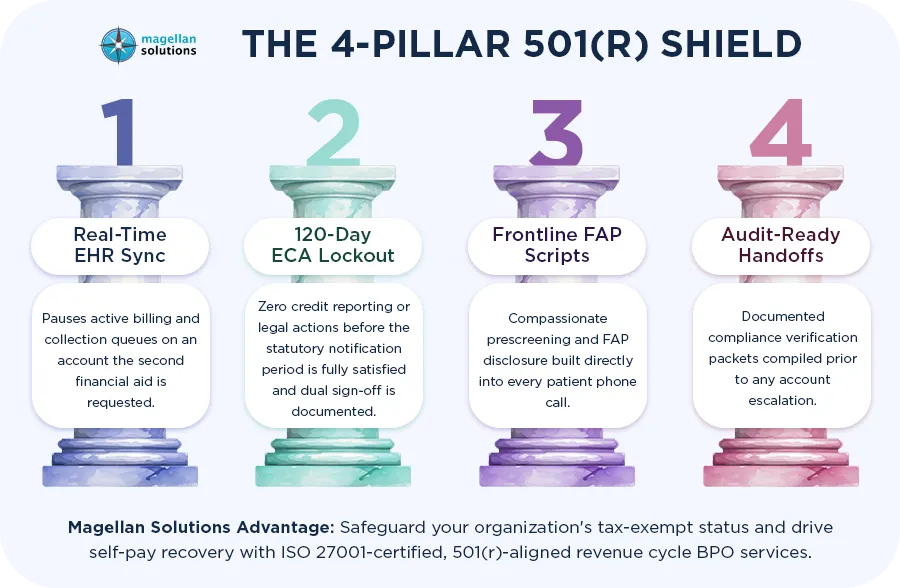
Operational Governance: The 4-Pillar Vulnerability Shield
To prevent regulatory breaches, healthcare executives must establish a structural defense framework across all outsourced patient accounts:
Certified Compliance and Data Security Standards
When partnering with a revenue cycle management provider, nonprofit health systems cannot afford compromises in data security or regulatory compliance. Verifiable credentials provide the structural assurance needed to protect both patient privacy and institutional standing:
- HIPAA Compliance: Strict alignment with US healthcare privacy mandates to prevent data breaches during patient outreach and financial profiling.
- ISO 27001 Certification: Globally recognized standards for information security management systems (ISMS), ensuring robust protection of sensitive Protected Health Information (PHI) across all operational workflows.
- GDPR & PCI-DSS Standards: Global frameworks that demonstrate Magellan’s elite security posture, including secure processing environments for handling patient credit card payments and international-grade data privacy controls.
The Measurable Value of Specialized Early-Out Support
Partnering with an experienced revenue cycle provider does more than just shield your organization from regulatory missteps—it fundamentally transforms financial performance. As of June 2023, about 15 million Americans—roughly 5% of the U.S. population—still had medical bills on their credit reports, collectively carrying more than $49 billion in medical debt in collections.
When self-pay accounts carry this level of financial friction, hospitals need more than aggressive collection tactics; they need structured, compassionate early-out support. By blending empathetic patient outreach with airtight compliance frameworks, health systems can accelerate cash flow, drastically reduce administrative friction, and protect their bottom lines without risking their tax-exempt status.
Elevate Your Revenue Cycle Compliance with Magellan Solutions
Balancing faster cash recovery with strict regulatory compliance takes a patient-first philosophy, seamless technology integration, and uncompromising oversight.
Magellan Solutions provides specialized healthcare BPO and early-out revenue cycle support tailored to protect your hospital’s reputation and compliance standing. Backed by rigorous data security protocols and trained patient-care specialists, our team mirrors your internal policies to drive self-pay recovery while safeguarding your 501(r) standing.
Ready to optimize patient billing operations without the compliance headaches? Reach out to our healthcare BPO specialists today to design a secure, customized early-out support strategy for your health system.
Frequently Asked Questions About 501(r) Vendor Compliance
What is Section 501(r) compliance in healthcare collections?
Section 501(r) of the Internal Revenue Code sets explicit guidelines for non-profit, tax-exempt hospitals. It requires maintaining a written financial assistance policy, capping charges for eligible individuals, and following strict billing and notification restrictions before starting any Extraordinary Collection Actions (ECAs).
Can a hospital be held liable for an early-out vendor’s collection errors?
Yes. The IRS holds non-profit hospitals legally accountable for the actions of third-party vendors working on their behalf. If an outside partner violates 501(r) rules—such as executing an ECA prematurely—the hospital faces severe regulatory scrutiny, potential excise taxes, and could risk its tax-exempt status if systemic violations are found.
How can non-profit hospitals ensure vendors follow financial assistance guidelines?
Hospitals must bake compliance requirements into vendor contracts, run regular call and account audits, require written authorization before any ECA execution, and maintain real-time data integrations to pause active collection queues whenever a patient files for financial aid.
Key Takeaways
- Outsourcing Doesn’t Shift Liability: Non-profit hospitals remain entirely responsible under the law for how third-party vendors handle IRS Section 501(r) compliance.
- Lock Down Contract Terms: Add clauses that explicitly ban unauthorized ECAs, require explicit hospital approvals, and mandate active FAP screening.
- Automate Account Pauses: Set up data links so active collections pause as soon as a patient applies for financial assistance.
- Audit Before Escalation: Require vendors to submit documented compliance packets for review before taking any aggressive debt-recovery steps.