


Engineering and architectural firms often turn to external support to manage peak drafting workloads, speed up turnaround times, and keep core design talent focused on high-value billable tasks. However, the success of an offshore collaboration depends entirely on the clarity of the initial scope and the rigor of the quality check.
Research projects roughly 14,400 annual drafter openings through 2035—driven primarily by worker retirements and occupational transitions—so engineering, architecture, and construction firms need a repeatable way to bring external CAD support into their workflow without losing control of standards, quality, or review cycles.
Without clear guidelines, minor miscommunications in layer conventions, missing title block details, or vague redlines can snowball into costly project delays and unexpected revisions.
To maximize efficiency and protect project profitability, engineering leaders must implement structured protocols for delegating tasks and reviewing deliverables when leveraging offshore CAD drafting services.
What to Send: Building a Complete CAD Handoff Package
Handing off a drafting package requires more than emailing a PDF sketch. To ensure the offshore team executes the drawing correctly on the first pass, provide a standardized input folder containing three core elements:
- Source Files & PDF Markups: Clean, legible redlines, field sketches, or point cloud data with explicit revision notes and dimension callouts.
- CAD Standards & Templates: Your firm’s template files, layer naming conventions, plot styles, dimension styles, and block libraries.
- Project Specifications: Title block attributes, sheet sizes, scale requirements, and any client-specific drafting guidelines.
Expanding Beyond CAD: Dedicated Architectural Design Support
While technical drafting handles precise documentation and redlines, complex building projects often require broader visual and conceptual execution. To keep architectural leads focused on principal design decisions, firms often integrate specialized offshore teams to handle building information modeling (BIM), 3D visualization, and schematic development.
Leveraging specialized architectural design solutions alongside core CAD support allows practices to scale full-phase drawing production—from preliminary design concepts to final construction documents—without inflating local overhead or burning out key design staff.
The 3-Step Review Cycle for Offshore CAD Deliverables
A structured quality assurance process prevents minor errors from reaching the end client. Establishing a predictable review cadence keeps project momentum strong and maintains drafting consistency across all drawing sets.
| Review Phase | Key Focus | Operational Checklist |
| 1. Ingest & Pre-Check | File Integrity & Setup | Verify template usage, correct sheet setup, title block attributes, and scale accuracy. |
| 2. Technical Quality Check | Compliance & Precision | Audit redlines line-by-line, check dimension callouts, and verify layer control and xref paths. |
| 3. Final Sign-Off | Plot & Client Readiness | Perform a print-preview audit, confirm PDF export resolution, and archive final source files. |
Supporting Your Engineering Team with Dedicated CAD Capacity
Outsourcing technical drawings should simplify project delivery, not add management overhead. Magellan Solutions provides dedicated, highly skilled CAD operators and drafters who integrate seamlessly into your software ecosystem and mirror your firm’s exact drafting standards from day one.
Ready to scale your drafting capacity without the recruitment friction? Reach out to our technical BPO specialists today to design a custom CAD support strategy tailored to your firm’s goals.
Frequently Asked Questions About Outsourced CAD Drafting
1. What CAD software can offshore teams work with?
Offshore drafters work with major design programs like AutoCAD, Revit, SolidWorks, Civil 3D, and MicroStation, matching whatever system your team uses.
2. How do offshore drafters learn our firm’s specific drawing style?
You share your standard drawing templates, color rules, and sample completed drawings during kickoff. The team uses these guidelines so every finished sheet looks like your in-house work.
3. How fast can an offshore drafting team return marked-up drawings?
Standard drawing edits and redline updates are usually completed overnight due to time-zone differences, so your team has fresh drawings ready every morning.
4. Is our project data and client information safe with an offshore team?
Yes. Reputable partners use secure encrypted networks, restricted VPN access, non-disclosure agreements (NDAs), and system controls that prevent downloading files onto personal devices.
5. What is the easiest way to send edits and markups to an offshore team?
Use simple digital markup programs like Bluebeam or Adobe Acrobat. Adding visual notes, clouds, and text callouts directly on the PDF prevents miscommunication.
6. Do we have to buy new software licenses for the offshore drafters?
In most cases, no. External CAD partners maintain their own software licenses, saving your firm money on extra subscriptions and hardware upgrades.
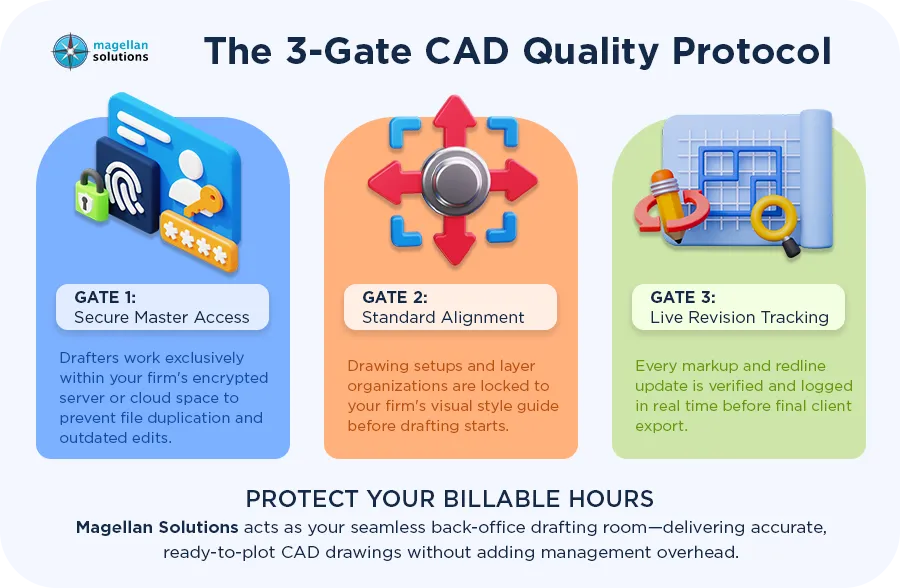
7. How do we keep control over drawing versions and avoid edits getting lost?
Drafters work directly inside your cloud folder or secure server. This ensures everyone edits the master file and prevents multiple conflicting versions.
Key Takeaways
- Standardize Inputs: Complete template packages, layer guides, and legible markups eliminate guesswork and reduce revision cycles.
- Enforce a Formal Review: A structured 3-step QA process catches drafting discrepancies early before drawings go to clients or job sites.
- Maintain Version Control: Requiring drafters to work directly within your secure environment prevents file duplication and lost revisions.
- Leverage Time-Zone Advantages: Structured daily handoffs let offshore teams complete markups overnight, accelerating overall project schedules.