



Healthcare groups operating across multiple sites — and often multiple APAC markets — face a billing problem a single clinic never encounters: keeping coding accuracy, claim quality, and compliance consistent when the volume is spread across locations, payer systems, and national regulations. Medical billing and coding at that scale isn’t just more of the same work; it’s a coordination problem, and it’s where in-house teams and single-vendor setups tend to break down.
This is the case for outsourced billing and coding built for scale — delivered by governed, multi-team operations that hold quality steady as volume and complexity grow.
Why billing gets harder as a healthcare group grows
A single site can run billing on one or two people who know the local payers. A multi-site group can’t — each location adds volume, and often a different payer mix, coding nuance, or regulatory wrinkle. When that’s handled ad hoc, site by site, the result is inconsistent coding, uneven denial rates, and no clear view of revenue performance across the group.
The cost compounds with size. A coding pattern that causes denials at one site, repeated across ten, is ten times the leaked revenue — and ten times harder to spot without central oversight. Scale turns small inconsistencies into structural ones.
Coding accuracy and compliance across markets
For a group operating across APAC, coding has to be correct against the standard each market actually uses — ICD-10-AM and ACHI in Australia, ICD-10 or ICD-11 elsewhere in the region — not one scheme applied everywhere. Medical coding delivered by certified teams who track code updates and payer policies per market keeps compliance consistent across the group and lowers audit exposure everywhere at once, rather than one site at a time.
Consistent claims and denial management at volume
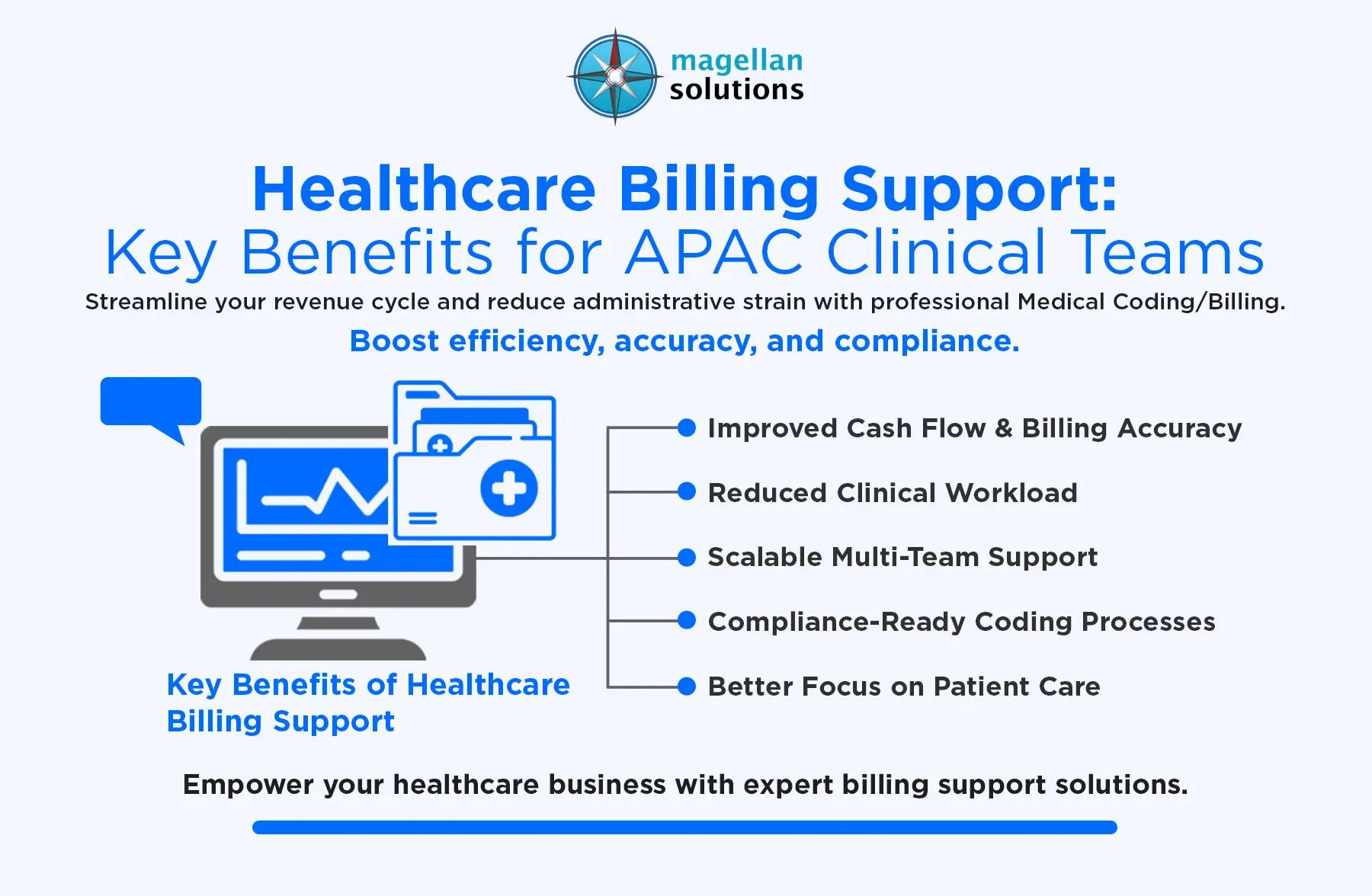
Coding sets up the claim; billing gets it paid. Medical billing services apply payer-specific validation before submission, so claims move faster and denials drop — and the denials that do come back get worked and appealed rather than abandoned, which is where most recoverable revenue quietly leaks. Handing this to a dedicated team also pulls billing follow-up off clinicians’ desks.
Stronger Revenue Cycles, Less Administrative Strain
Coding and billing are two stages of one flow, and managed together they stabilize it. Revenue cycle outsourcing shortens accounts-receivable cycles, improves revenue predictability, and reduces the overhead of a large in-house billing team — while giving finance leaders clearer visibility into performance. The operational result is the one clinical teams feel: less administrative drag, more time for care.
Why multi-team delivery is what scale actually requires
A single-resource setup can’t support a multi-site group — it has no redundancy and no room to grow. Multi-agent, multi-FTE delivery is what keeps billing uninterrupted through peak periods, staffing changes, and expansion, while central governance keeps every team working to one standard. That combination — distributed capacity under unified oversight — is the operational answer to the consistency problem that defines billing at scale, and it’s what lets a group add sites without rebuilding its billing every time.
Delivery also runs on secure, access-controlled, audit-ready infrastructure aligned to regional privacy obligations — the compliance floor for handling patient data across markets.
Working with Magellan Solutions
Magellan Solutions has delivered offshore healthcare support since 2005, including for APAC providers, through multi-team delivery hubs under structured governance. For a multi-site group, that means billing and coding aligned to each market’s standards, held to one consistent quality bar across every location, with the reporting visibility to manage revenue performance across the group.
If billing consistency across your sites has become the constraint on growth, let’s talk about what a scaled billing operation would look like.