
When customers book travel, they frequently share payment details over the phone. Booking a luxury cruise, reserving a boutique hotel, coordinating a corporate retreat, or rearranging a flight during weather disruptions often requires direct human assistance. For travel agencies, tour operators, and hospitality management firms, these telephone interactions are classified as card-not-present (CNP) transactions. Because agents share payment data verbally, each call must strictly adhere to the Payment Card Industry Data Security Standard (PCI DSS).
To scale operations, lower overhead, and provide continuous coverage across multiple time zones, many travel brands seek PCI DSS-compliant travel booking solutions through third-party business process outsourcing (BPO) partners.
A common misconception among business leaders is that outsourcing reservation calls completely transfers compliance liabilities to the vendor. In practice, outsourcing changes your operational workflows, but it does not remove your ultimate regulatory accountability. If an outsourced partner handles your transactions, your brand remains responsible for verifying that it protects customer data throughout the booking cycle.
Understanding how PCI DSS applies to an external reservations team is critical to protecting your revenue, maintaining customer trust, and avoiding severe non-compliance penalties.
What Is PCI DSS v4.0.1 and Why It Governs Voice Bookings
Think of PCI DSS as a set of commonsense security rules designed to protect credit card users. The current standard is PCI DSS v4.0.1, and it applies whether a customer inputs their card on a website or reads it aloud to an agent providing phone-based travel reservation services.
When a traveler speaks their credit card details to an agent, those numbers travel through your phone lines and active systems. This means your communications setup, your partner’s workspace, and your call recording systems are all part of the compliance evaluation.
To keep things simple, the standard divides credit card information into two distinct groups:
- Cardholder Data: This is the basic information on the front of the card, such as the cardholder’s name, the long card number, and the expiration date. You are allowed to store this data if you have a valid business reason—like managing booking modifications—but it must be encrypted or tokenized to keep it safe from prying eyes.
- Sensitive Authentication Data: This is the three-digit or four-digit CVV security code on the back of the card. Under PCI DSS rules, you must never save this code after the transaction is authorized. It doesn’t matter whether your system is encrypted or password-protected; saving a CVV code in an email, a database, or an agent’s paper notes is a direct compliance violation.
If your outsourced agents write security codes down or type them into general text fields in your reservation software, your organization faces unnecessary security risks.
Technical Vulnerabilities of Spoken Payment Transactions
Verbal transactions naturally spread sensitive data across a contact center’s systems, turning compliance into an operational challenge.
Telephony and VoIP Exposure
When a customer reads their card details to an agent, that voice data travels over telephone lines or Voice-over-IP networks. If agents use desktop softphones, the card data enters the computer’s active memory and travels through local network switches. Unless the network is thoroughly isolated, every workstation, server, and router on that office floor can fall within the scope of a PCI DSS assessment.
Voice Recordings and Screen Captures
Most reservation teams record customer calls for quality assurance, dispute resolution, and training. If a call is recorded while a customer reads their credit card number and security code, that data is written directly to media storage servers. Standard recording platforms rarely meet PCI DSS encryption benchmarks, and saving a spoken CVV violates core standards. Screen-recording software that captures desktop screens during payment entry creates the same vulnerability.
Workstation Security
In an unmonitored contact center, an agent could write down credit card numbers on paper, photograph their screen or paste billing details into unsecured chat applications. Maintaining strict physical control over the work environment is just as vital as managing digital firewalls.
This is about far more than passing an annual security check; it is about protecting your business from major financial losses. According to a report, the average cost of a data breach has climbed to an all-time high of $4.88 million. For a growing travel brand, a single payment security lapse can trigger severe financial penalties, operational interruptions, and lasting damage to customer loyalty. Partnering with an outsourced team means their internal controls directly shape your overall risk.
Technical Strategies for Removing Card Data from Call Centers
The most practical way to handle compliance is to ensure your outsourced agents never touch raw payment data. If card numbers never enter the call center, your audit scope shrinks significantly.
Dual-Tone Multi-Frequency (DTMF) Masking
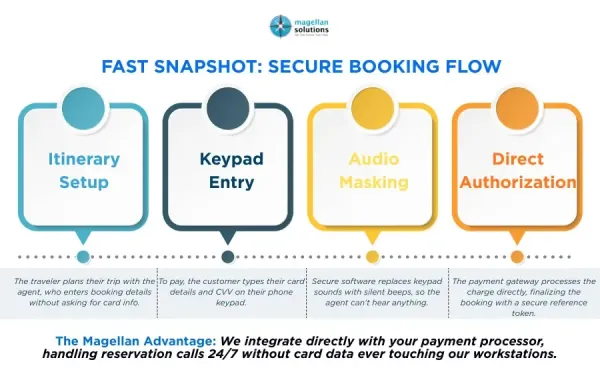
DTMF masking represents the industry standard for telephone payment security. Instead of reading card details to the reservation agent, the caller enters the numbers on their phone keypad. The software intercepts the frequencies and replaces them with uniform audio tones.
The agent hears only identical tones, and their desktop screen displays masked asterisks. The real payment information routes straight to the payment processor. This technology keeps the agent headset, computer monitor, local network, and call recording platform entirely out of PCI DSS scope.
Automated IVR Payment Processing
With an interactive voice response workflow, the agent finalizes the travel itinerary and then transfers the customer to an automated voice system. The IVR securely collects the card number and security code, communicates directly with the payment gateway, and routes the caller back to the agent once the transaction is complete. The agent never interacts with the customer’s financial details.
Automated Pause-and-Resume Controls
If your operational setup requires callers to speak their card numbers, your partner must use automated pause-and-resume software. This tool integrates with your booking system to pause audio and screen recordings when an agent enters a billing screen, resuming only when the charge is submitted.
While pause-and-resume helps keep payment details out of recording archives, it remains an administrative control, not a full scope-elimination tool. If an integration fails or an agent mistypes details into an unmonitored field, sensitive payment data can still be recorded and compromise your security posture.
The Shared Responsibility Model: Who Protects What?
Under PCI DSS Requirement 12.8, travel providers utilizing third-party travel reservation services must actively manage vendor compliance. You must maintain a formal document that defines which party manages each specific compliance requirement:
| Entity | Primary PCI DSS Responsibility |
| Travel Merchant | Retains ultimate legal accountability, manages merchant accounts, conducts annual vendor oversight, and secures internal booking databases. |
| Outsourced BPO | Enforces physical contact center security, applies clean-desk policies, performs staff checks, and supplies an annual Attestation of Compliance. |
| Payment Gateway | Converts card numbers into secure tokens, holds data inside a certified vault, and settles transactions directly. |
| Telephony / Tech Vendor | Supplies DTMF suppression tools, offers pause-and-resume interfaces, and ensures logs never record cardholder data. |
Essential Due Diligence for Travel Providers
Before partnering with a BPO vendor for travel reservation services, evaluate their security standards with these practical questions:
- Can you provide a current Attestation of Compliance? Make sure their compliance documentation is current and covers the specific facility, network, and technology stack used for your reservation calls. An ISO 27001 certificate confirms broad information security management, but it does not replace a PCI DSS Attestation of Compliance.
- Do agents hear or view raw payment card details? Clarify whether they use DTMF masking tools or rely on spoken card numbers during reservations.
- How do you keep card security codes out of recordings? Confirm whether they use automated pause-and-resume tools or if they expect agents to pause call recordings manually.
- What physical protections are in place on the call center floor? Ensure the provider enforces clean-desk policies that ban mobile phones, pens, paper, and recording devices from workstations.
- How are agent permissions controlled? Check that the provider assigns access based on minimum operational needs, uses multi-factor authentication, and revokes system access immediately when staff depart.
Balancing Guest Experience with Data Protection
Outsourcing phone bookings should enhance your operational capacity without exposing your brand to security risks.
At Magellan Solutions, we configure customer support and travel reservation services to match your exact operational and compliance requirements. With extensive business process outsourcing and back-office experience, we help global travel operators, boutique hospitality firms, and travel agencies deliver exceptional customer experiences around the clock.
Our operations are backed by an ISO 27001-certified information security management system. Our reservation specialists work directly inside your existing tools, whether you use Saber, Amadeus, Travelport, Cloudbeds, or customized CRM platforms.
Instead of storing customers’ payment information on local systems, we design workflows that connect directly to your existing payment gateways, DTMF masking solutions, and tokenized billing portals. This approach keeps your customer transactions secure, supports your compliance goals, and provides travelers with professional, uninterrupted phone booking support.
Secure Your Travel Reservation Operations
Protecting payment card data during phone transactions is vital to safeguard customer relationships and avoid costly compliance penalties. If you want 24/7 coverage, need to manage peak travel seasons, or want to add multilingual booking agents without increasing your internal compliance burden, our team can help.
Magellan Solutions provides reliable, security-focused reservation support built around your preferred booking software.
Contact us to design a secure, customized travel reservation process for your business.
Frequently Asked Questions About PCI DSS in Travel Reservations
What should we do if a customer emails or chats their credit card number?
Delete the message permanently so it is cleared from your systems and backups. Never type or copy card details into chat or email. Instead, ask the customer to complete their purchase through a secure payment link or by using their phone keypad during a call.
Is ISO 27001 certification the same as being PCI compliant?
No. ISO 27001 shows a company has strong overall security practices, but it is not a substitute for PCI compliance. PCI DSS is a specific checklist of strict technical rules you must follow if you handle credit cards. Your partner must have a valid PCI Attestation of Compliance (AOC).
What is credit card tokenization?
Tokenization swaps actual credit card numbers with randomized ID codes (tokens) that cannot be reverse-engineered. The real card details are stored safely in an off-site digital vault. Because tokens are useless to hackers, storing them instead of real card numbers dramatically lowers your security risks.
Key Takeaways
- Compliance Accountability Remains With You: Handing off phone bookings to a third-party reservations provider does not transfer your regulatory obligations. The travel brand remains responsible for reviewing vendor controls and documenting oversight.
- Card Security Codes Must Never Be Retained: Never save CVV, CVC, or CID numbers after transaction authorization. Storing these codes in call recordings, screen captures, CRM records, or system notes constitutes a direct compliance violation.
- Scope Reduction Shields Your Operations: Adopting technologies such as DTMF masking or automated voice transfers prevents card details from entering the contact center network, keeping agent headsets, computers, and call recording tools out of your annual audit.
- Always Demand Verified Documentation: Avoid relying on verbal assurances or generic security claims. Require your outsourced travel partner to provide an annual Attestation of Compliance that covers the exact physical facilities and network systems supporting your bookings.