


Launching an official forum, user community, or interactive comments section gives your audience a dedicated place to connect, troubleshoot products together, and share ideas. However, opening a public digital space also invites serious operational headaches: spam bots, off-topic arguments, malicious links, and scam content.
Without moderation, the online environment sours quickly. But overly aggressive oversight can silence community members and stop them from posting altogether.
To maintain brand safety while keeping discussions lively, growing organizations rely on professional content moderation services to establish clear boundaries, catch bad actors early, and keep conversations flowing naturally.
To explore how to balance security with genuine user engagement, let’s examine an operational framework using financial media platforms as a practical example—an industry where community risks are exceptionally high. Financial forums routinely deal with crypto scams, fake expert accounts, pump-and-dump stock hype, and off-limits personal advice.
What Are Community Moderation Services?
Community moderation services combine trained human specialists with automated software tools to monitor, review, and manage user-generated content across online forums, social channels, and comment sections.
Their primary function is to enforce community guidelines, block automated spam, remove unsafe content, protect brand reputation, and foster a welcoming space for active user engagement.
Core Community Risks: A Financial Media Example
When a financial news portal, media company, or publishing platform opens a public comment section, high-risk user submissions generally fall into four main categories:
- Scams and External Redirects: Automated bot comments promoting deceptive schemes (e.g., “Contact Master Trades on Telegram to double your crypto investment overnight”).
- Account Impersonation: Fake accounts utilizing author photos or official brand logos to trick community members into paying for unverified trading signals.
- Pump-and-Dump Hype: Coordinated user networks spamming obscure micro-cap stocks or tokens to artificially inflate asset prices before selling off their positions.
- Off-Limits Personal Advice: Unverified users dispensing specific financial, tax, or investment directives, creating severe legal exposure and brand liability for the publisher.
Establishing a structured operational model prevents these threats without forcing your moderation team to delete legitimate, high-value user contributions.
Pre-Moderation vs. Post-Moderation: Strategic Workflows
When you inspect user submissions determines whether your community platform feels lively and responsive or slow and restrictive.
1. Pre-Moderation (Review First, Publish Second)
Every user contribution enters a moderation holding queue and remains hidden from the public until an automated rule or human moderator approves it.
- Pros: Guarantees complete brand safety; scams and abusive posts never reach the public feed.
- Cons: Introduces approval delays that stall spontaneous back-and-forth discussions.
- Best Used For: First-time contributors, unverified accounts, or sensitive discussion topics like crypto giveaways or micro-cap asset threads.
2. Post-Moderation (Publish First, Review Second)
User submissions go live instantly. Automated algorithms monitor the live feed continuously, while human reviewers evaluate flagged posts after publication.
- Pros: Preserves discussion momentum, supporting real-time user interaction.
- Cons: Leaves a narrow window of exposure where non-compliant content may be briefly visible.
- Best Used For: Established community members, verified profiles, and general product feedback boards.
The Hybrid Model
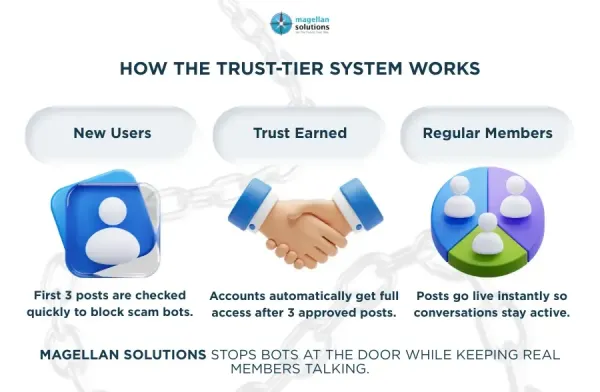
To maximize both safety and user participation, deploy a trust-tiered workflow: require pre-moderation for a user’s first three submissions to filter out automated accounts, then automatically promote verified profiles to post-moderation rules.
Response-Time Targets (Service Level Agreements)
Not all flagged content carries the same level of risk. Establishing clear response-time SLAs ensures moderation teams prioritize severe threats effectively:
- High-Risk Violations (Target: Under 15 Minutes): Scams, phishing links, account impersonation, and doxxing require immediate removal or hiding.
- Medium-Risk Violations (Target: Under 1 Hour): Unsubstantiated asset hype, aggressive arguments, and off-topic self-promotion.
- Low-Risk Flags (Target: Under 24 Hours): General user-flagged items, minor off-topic comments, or basic formatting fixes.
When to Hide, Remove, or Escalate Content
Moderation teams should avoid using hard deletion as a default action for every flagged item. Employing tiered moderation actions maintains platform safety without stifling open debate:
- Hide (Soft Moderate): Temporarily make a flagged post invisible to the public while moderators review context or request clarification from the author.
- Remove (Hard Delete): Permanently purge clear policy violations, including scam links, hate speech, impersonation, or explicit spam.
- Escalate: Route complex legal threats, corporate security concerns, or coordinated scam attacks directly to internal legal, PR, or IT leads.
How to Protect Community Activity Without Over-Moderating
Over-moderation alienates authentic contributors. When platforms delete constructive criticism or negative opinions, users migrate to third-party spaces like Reddit or X, where brand teams can’t participate or help.
Computational social science research shows why unmoderated platforms degrade quickly—and why heavy-handed tactics backfire. Findings from a social media engagement model suggest users engage with manipulative content or misinformation because of complex social validation dynamics. When platforms fail to actively manage abusive networks, bad actors quickly drown out normal discourse; conversely, over-cleansing authentic conversation removes the very social incentives that keep genuine users coming back.
To strike the proper balance, keep these principles in mind:
- Distinguish Critique from Abuse: A comment stating “I disagree with this financial breakdown; the math seems flawed” represents healthy engagement. A comment turning to personal insults or profanity constitutes an abuse violation.
- Educate First: For minor, non-malicious rule breaches (such as including an unapproved external link), send a polite private reminder citing community guidelines rather than issuing an immediate ban.
- Combine AI Filters with Skilled Human Review: Automated tools catch explicit keywords and spam patterns instantly, while human moderators evaluate sarcasm, cultural context, and user intent.
Elevate Your Digital Community with Magellan Solutions
Building a secure, active, and well-governed digital space requires round-the-clock monitoring, precise SLA execution, and expert operational management.
Magellan Solutions delivers comprehensive community moderation services that safeguard your brand reputation while keeping user engagement vibrant. Backed by ISO 27001-certified security management protocols, our dedicated moderation specialists provide continuous 24/7 oversight across digital forums, social channels, and customer platforms.
Ready to scale your online community safely? Contact us today to build a customized moderation framework tailored to your platform goals.
Frequently Asked Questions About Community Moderation
What are community moderation services?
Community moderation services blend trained human specialists and automated software to monitor, review, and manage user-generated content across forums, comment sections, and social media. They enforce community standards, block spam, remove harmful content, and maintain a safe digital environment.
Why shouldn’t a company pre-moderate every comment?
Pre-moderating every comment creates operational bottlenecks and delays that kill real-time discussion. Reserve pre-moderation for new accounts or high-risk topics, and allow post-moderation for trusted users to keep community spaces fast, active, and secure.
How do moderators manage negative feedback without censoring users?
Constructive criticism and negative product reviews should remain visible if they follow baseline community conduct rules. Moderators should respond professionally, address core concerns publicly, and direct complex troubleshooting issues to customer support teams to demonstrate transparency.
Key Takeaways
- Safety Enables Engagement: Users participate actively only when a digital platform feels safe, respectful, and free from malicious scams.
- Implement Hybrid Moderation: Combine pre-moderation for new user accounts with post-moderation for trusted members to balance security and speed.
- Enforce Strict Response SLAs: Target high-risk violations like scams and impersonation for review in under 15 minutes.
- Protect Honest Dialogue: Separate constructive disagreement from abusive behavior—never delete user posts simply because they contain negative feedback.
- Maintain Continuous 24/7 Oversight: Deploy round-the-clock moderation coverage to stop security threats early and sustain healthy community growth.