
When evaluating healthcare support outsourcing to optimize revenue cycles, providers must carefully assess how outsourced healthcare services handle protected health information (PHI) across international borders. Healthcare leaders almost immediately confront a critical compliance hurdle: can patient data legally leave the United States?
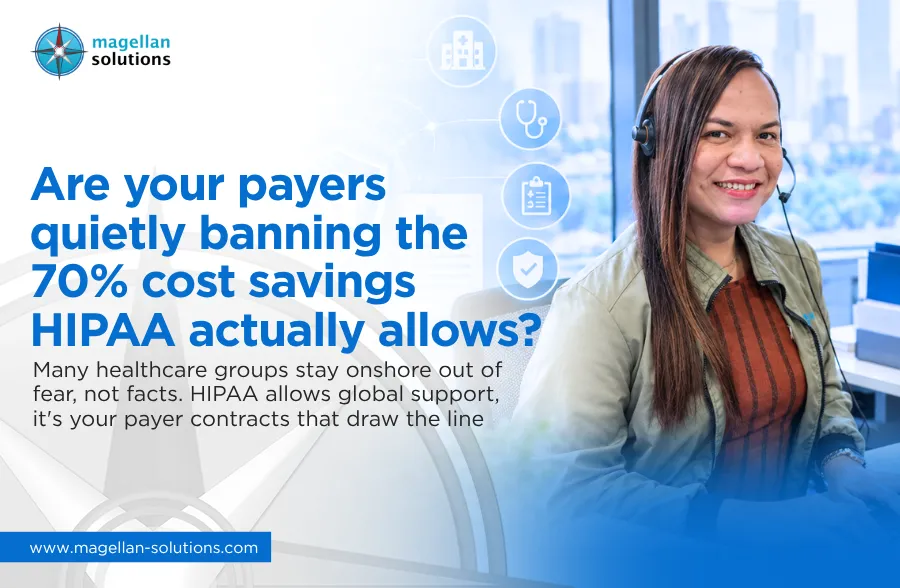
The short, definitive answer is yes. Nothing in federal law strictly bans handling United States patient data offshore. However, assuming that HIPAA compliance alone clears the path for global delivery is one of the most dangerous misconceptions in healthcare management.
While the Health Insurance Portability and Accountability Act (HIPAA) permits offshore data processing under strict safeguard standards, the true roadblocks rarely stem from federal privacy statutes. Instead, the legal and operational boundaries are drawn by Medicare Advantage reporting mandates, state Medicaid statutory bans, and private payer contractual restrictions. Navigating these realities requires both a rigorous legal analysis and a pragmatic operational architecture.
HIPAA allows offshore data handling if an unbroken chain of Business Associate Agreements (BAAs) and technical safeguards exist. However, CMS reporting rules for Medicare Advantage, outright data localization bans in states like Arizona and Texas for Medicaid programs, and specific commercial payer contracts dictate exactly which workflows can leave the country. Successful providers solve this through payer-segmented routing and zero-footprint technical controls.
What HIPAA Permits for Outsourced Healthcare Services
The Health Insurance Portability and Accountability Act does not contain a geographic boundary clause. The Department of Health and Human Services (HHS) Office for Civil Rights confirms that covered entities and domestic business associates may utilize offshore vendors to store, process, or transmit electronic protected health information (ePHI), provided that standard HIPAA Security, Privacy, and Breach Notification Rules are strictly observed.
Under the HIPAA Omnibus Rule, foreign subcontractors that touch patient records qualify as Business Associates. This status carries specific legal obligations:
- Unbroken BAA Chain: The covered entity must hold a compliant BAA with its primary partner, and that partner must execute enforceable downstream BAAs with every offshore subcontractor handling ePHI. In industry reviews, missing subcontractor agreements account for roughly 78% of documentation failures in global billing operations.
- Documented Security Risk Analysis: HHS regulations (45 CFR § 164.308(a)(1)) require organizations to specifically evaluate the unique operational and geopolitical risks of handling data abroad.
- Jurisdictional Realities: While offshore subcontractors bear direct regulatory duties, the HHS has limited legal reach to enforce civil monetary penalties or subpoena records in foreign jurisdictions. Consequently, U.S. covered entities and lead contractors shoulder ultimate accountability, facing federal violation penalties exceeding $70,000 per violation category.
HIPAA sets the technical floor for outsourced healthcare services, but federal and state contracts establish the practical ceiling.
Where Contracts Draw the Line for Outsourced Healthcare Services
To determine which patient accounts can be handled abroad, healthcare providers must look past standard HIPAA rules and examine their specific payer contracts.
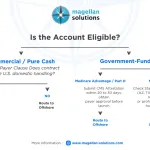
1. CMS Medicare Advantage and Part D Reporting
The Centers for Medicare & Medicaid Services (CMS) allows offshore subcontracting for Medicare Advantage Organizations (MAOs) and Part D Prescription Drug Plans (PDPs), but enforces strict transparency under 42 C.F.R. § 422.503 and § 423.504.
MAOs must submit formal attestations to CMS for every offshore first-tier, downstream, and related entity (FDR) that accesses, processes, or stores beneficiary PHI. The filing mandates:
- Detailed descriptions of the offshore vendor’s functions and the exact PHI accessed.
- Written policies demonstrating data security, auditing, and minimum necessary controls.
- Contractual clauses allowing immediate termination if a significant data breach occurs.
- Mandatory annual audits of the offshore partner.
Because MAOs carry direct audit liability, most health plans pass these requirements downstream. Many commercial MA contracts require medical groups and suppliers to provide prior written notice or secure explicit approval within 20 to 30 days of onboarding an offshore vendor.
2. State Medicaid Prohibitions and Data Localization
Unlike Medicare, state Medicaid programs operate under state procurement rules and executive orders that frequently mandate domestic data localization:
- Outright Offshore Bans: States including Arizona, Wisconsin, Alaska, and Ohio strictly prohibit public funds from being paid to offshore subcontractors for Medicaid data processing, customer contact centers, or claims adjudication. For example, Arizona’s AHCCCS Minimum Subcontract Provisions dictate that any service involving personal client data must be executed entirely within U.S. borders.
- Strict Storage Mandates: The Texas Uniform Managed Care Contract bars Managed Care Organizations (MCOs) and their vendors from moving confidential client data outside the U.S. at any time or for any duration.
- Statutory Guardrails: Florida’s Electronic Health Records Exchange Act (F.S. § 408.051) mandates that patient records in qualified electronic health record systems maintained offsite must reside physically within the continental United States, its territories, or Canada.
3. Commercial Payer Exclusion Clauses
Even when public programs are not involved, large commercial payers often include data sovereignty restrictions in network participation agreements. If a payer contract specifies that claims processing, member billing, or customer service must occur within domestic facilities, violating that clause can lead to contract cancellation or payment clawbacks.
The Operational Answer: Routing Outsourced Healthcare Services
Legal review establishes what rules apply, but the operational model determines whether an organization stays compliant. Healthcare organizations do not need to make an all-or-nothing choice between domestic and offshore teams. Instead, high-performing organizations use a dual-track strategy.
Payer-Based Workflow Segmentation
Compliance requires segregating accounts at the intake stage. Workflows tied to restrictive state Medicaid contracts or non-approving commercial payers remain with an onshore team. Conversely, commercial accounts with flexible terms, self-pay receivables, appointment scheduling, and approved Medicare Advantage workflows can be routed to vetted offshore specialists.
Zero-Footprint Technology Infrastructure
The most secure offshore arrangements do not export raw data across oceans. Instead of transmitting files or storing records locally, modern delivery centers rely on secure Virtual Desktop Infrastructure (VDI) hosted on domestic U.S. cloud servers:
- No Local Storage: Workstations operate in a thin-client environment where offshore staff view records via encrypted, read-only screen sessions.
- Hardened Endpoints: Local drive mapping, USB data ports, clipboard copy-pasting, external emailing, and local printing functions are completely disabled.
- Physical Clean Rooms: Accredited delivery centers enforce biometric access controls, clean-desk policies, continuous video surveillance, and ban mobile phones or paper notebooks from production floors.
Proven Benefits: Data and ROI for Outsourced Healthcare Services
Adopting a compliant global delivery model offers substantial financial and operational relief for healthcare organizations facing compressed margins, rising denial rates, and domestic staffing shortages.
Rigorous industry data demonstrates the practical impact of transitioning non-clinical administration to specialized partners:
| Operational Metric | In-House Baseline | Compliant Outsourced Model | Key Operational Driver |
|---|---|---|---|
| Administrative Operating Costs | Standard baseline | 30% to 70% reduction | Scalable labor arbitrage, reduced local payroll burdens, and zero capital investment in facilities. |
| First-Pass Clean Claim Rate | 75% to 85% industry avg. | 95% to 98% | Dedicated pre-submission scrubbing and specialty-certified billing personnel. |
| Days in Accounts Receivable (A/R) | 45 to 60+ days | 30% to 40% reduction | Continuous 24-hour follow-up on outstanding receivables and aging buckets. |
| Claim Denial Volume | 10% to 15%+ average | Up to 40% reduction | Immediate root-cause denial analysis, rapid appeals, and payer-specific claim rules. |
According to the official CAQH Index Report on Administrative Costs, administrative complexity across medical claims and coordination drains billions annually, with over $21 billion in direct cost savings attainable through streamlined administrative operations. Specialized outsourced healthcare services capture these efficiencies by replacing manual bottlenecks with standardized, compliant execution.
Prospective Customer Scenario: The Multi-Specialty Practice
Consider a prospective client: a mid-sized, 25-physician orthopedic and pain management group struggling with high local billing staff turnover, a 55-day A/R cycle, and a rising 14% claim denial rate. Recruiting credentialed in-house billers locally requires months of lead time and costly compensation packages that strain the clinic’s operating cash flow.
By deploying a dedicated offshore revenue cycle team for demographic entry, eligibility verification, and denial follow-up, while retaining restrictive Medicaid accounts on domestic soil, the practice transforms its balance sheet. Within six months of launch, clean claim submissions rise to 97%, days in A/R fall from 55 to 33, and recurring administrative overhead decreases by 52%, allowing physicians and clinical staff to focus completely on patient clinical outcomes.
Before signing any agreement with a global vendor, run through this practical risk filter:
- Audit Your Payer Roster: Map every active payer agreement. Identify all state Medicaid lives, Medicare Advantage plans, and private contracts containing explicit data residency clauses.
- Execute Downstream BAAs: Ensure that both the primary outsourcing partner and its offshore entities execute comprehensive BAAs that explicitly outline breach notification timelines and indemnity limits.
- Submit Timely CMS Attestations: If processing Medicare Advantage accounts, coordinate with health plan sponsors to submit required offshore subcontract attestations before live production begins.
- Inspect Endpoint Architecture: Confirm that the partner utilizes zero-download VDI environments so that patient data remains hosted strictly on U.S. servers.
- Verify Independent Accreditations: Demand proof of third-party security validations, including SOC 2 Type II reports, ISO 27001 certifications, and documented ongoing HIPAA training for all personnel.
Optimize Your Healthcare Operations with Magellan Solutions
Navigating the intersection of healthcare compliance and operational efficiency requires an experienced, highly vetted partner. At Magellan Solutions, we deliver enterprise-grade medical support, HIPAA-compliant patient coordination, and comprehensive revenue cycle management designed to meet the highest regulatory standards.
Our state-of-the-art delivery centers combine certified physical clean-room environments, rigorous role-based access protocols, and continuous quality monitoring to ensure your patient data remains secure at every step. Whether you need to streamline prior authorizations, accelerate claims reimbursement, or scale inbound patient scheduling, our dedicated specialists integrate seamlessly with your existing EHR workflows.
Ready to cut administrative overhead while maintaining absolute compliance? Please contact us to inquire about our services today and discover how our tailored solutions support your organization’s growth.
Frequently Asked Questions
Can foreign workers access U.S. patient records legally under HIPAA?
Yes. HIPAA does not restrict the physical location or nationality of individuals who access ePHI. As long as the covered entity executes a valid Business Associate Agreement and enforces technical, physical, and administrative safeguards that satisfy the HIPAA Security Rule, offshore personnel may access patient files to perform authorized administrative tasks.
Does Medicare Advantage require special approval for offshore subcontractors?
CMS requires Medicare Advantage Organizations and Part D Plan Sponsors to submit an offshore subcontracting attestation for any offshore vendor handling beneficiary PHI. While CMS does not require individual prior authorization for each vendor, many Medicare Advantage payers contractually require participating provider networks to give written notice or seek plan approval before routing member data abroad.
Which states ban offshore handling of Medicaid patient data?
Several states maintain restrictions or total prohibitions through Medicaid provider agreements, managed care contracts, or executive orders. Notable states include Arizona, Texas, Wisconsin, Ohio, Alaska, Georgia, and Missouri. Furthermore, Florida law mandates that qualified electronic health records stored offsite must remain physically in North America.
What happens if an offshore subcontractor causes a HIPAA data breach?
Under federal law, the domestic covered entity and domestic business associate remain directly responsible to the HHS Office for Civil Rights and affected patients. If a breach occurs abroad, the covered entity must issue breach notifications and faces statutory penalties. For this reason, domestic healthcare organizations must maintain comprehensive cyber liability insurance and enforceable indemnification agreements with their international partners.