

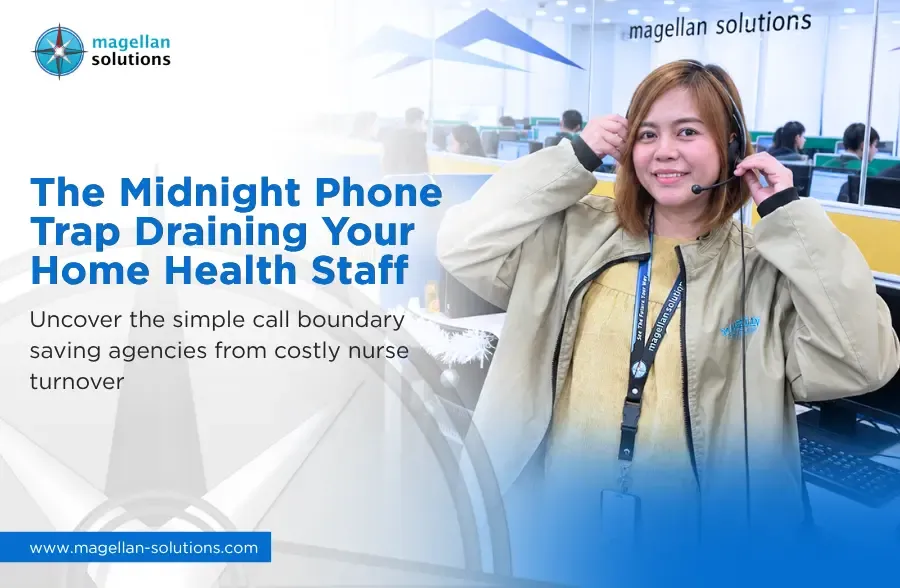
Home health directors face a constant, high-stakes balancing act every day: delivering responsive care to families while protecting on-call nurses from severe operational burnout. When a worried daughter calls at 2:00 AM about her mother’s care schedule, or a field caregiver gets stuck in heavy traffic between home visits, someone must answer the phone immediately.
At the same time, demand for home-based medical care continues to surge across the healthcare sector. As your organization hires more care professionals and manages higher volumes of daily communications, trying to handle every routine inquiry through your internal office staff puts unsustainable strain on your clinical operations.
Finding a practical solution for home care call handling means drawing a clear line between administrative logistics and clinical decision-making. Partnering with a specialized home health care answering service isn’t about handing over medical oversight; it is about shielding your skilled nurses from constant phone interruptions so they can focus on direct patient outcomes.
The Boundary Line: Non-Clinical vs. Clinical Tasks
Safely delegating phone support requires a firm, well-defined operational divide between administrative intake and licensed clinical judgment. Non-clinical agents act as a structured communication filter, taking down initial details and routing inquiries, while registered nurses retain full authority over care plans, symptom evaluations, and medical treatments.
Federal employment data projects an 18% growth rate for home health and personal care aides over the next decade—adding roughly 760,000 job openings each year. As agencies coordinate larger field teams and expanded patient caseloads, establishing clear operational boundaries helps your agency grow smoothly without compromising patient safety or care quality.
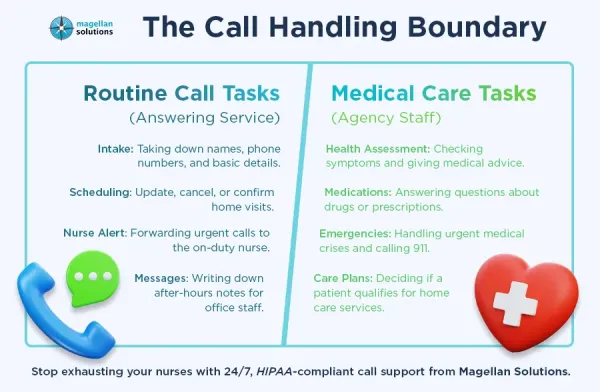
What an Answering Service CAN Handle
Offloading repetitive administrative calls reduces workplace distractions, preserving your clinical team’s time and energy for tasks that require a medical license. Studies show healthcare staff spend over 3 hours every day managing basic phone inquiries; routing these routine calls to a dedicated answering team lowers overtime expenses, prevents staff burnout, and significantly reduces costly employee turnover.
1. After-Hours and Urgent Call Intake
When patient families or caregivers call after standard office hours, an answering service answers within a few rings. Professionally trained representatives capture complete caller details, verify patient identities, and document precise notes using custom intake scripts built specifically for your agency’s operating procedures.
2. On-Call Nurse Escalation and Dispatch
Your field nurses shouldn’t be woken up at midnight just to confirm a visit address or answer a general billing question. Answering agents follow custom protocols to filter out routine inquiries and forward genuinely urgent situations—such as sudden symptom changes or immediate care concerns—directly to your on-call nurse via secure messaging apps, SMS, or live phone transfers.
3. Non-Clinical Visit Scheduling and Confirmations
Managing daily caregiver schedules requires continuous back-and-forth communication. External call representatives can handle routine appointment changes, log cancellations from family members, confirm upcoming visit windows, and keep your overall schedule updated in real time.
4. Field Staff Coordination and Support
Caregivers traveling between client homes frequently encounter delays, location questions, or schedule changes.
Operational Scope Matrix
| Functional Area | Handled by Answering Service | Retained by In-House / Clinical Team |
| Emergency Calls | Immediate transfer to 911 / Escalation to primary on-call nurse | Emergency clinical direction and medical intervention |
| Patient Intake | Recording basic demographics, contact info, and initial caller notes | Conducting full clinical assessments, care plan setup, and eligibility reviews |
| Scheduling | Routine appointment changes, confirmations, and logging cancellations | Adjusting plan-of-care frequency, clinical hours, or reassigning staff |
| Patient Updates | Relaying non-urgent family notes and logging administrative updates | Evaluating symptom changes, reviewing charts, or modifying medical orders |
| Billing Inquiries | Capturing insurance details and taking callback requests for office staff | Claims processing, payment arrangements, and insurance coverage verification |
What an Answering Service CAN’T Handle
Knowing where an external agent’s authority ends is vital for patient safety, legal protection, and regulatory compliance.
1. Clinical Triage and Medical Advice
Non-clinical operators must never evaluate medical symptoms, offer diagnostic advice, or interpret clinical chart notes.
2. Medication Instructions and Adjustments
Call representatives cannot answer questions regarding drug dosages, administration schedules, or treatment modifications. Every pharmacy call or medication-related inquiry must go directly to your licensed clinical team.
3. Patient Eligibility and Care Planning
While answering agents can record a prospective client’s contact information and basic care needs, determining whether a patient qualifies for home health care—or drafting their actual plan of care—requires licensed healthcare professionals.
4. Complex Family Complaints or Legal Issues
High-friction situations involving formal grievances about care quality, legal concerns, or disputed invoices require the authority, institutional knowledge, and delicate handling of your internal agency management.
Workflow Setup and HIPAA Compliance
Integrating an external answering service into your day-to-day operations requires strict privacy controls and clear communication channels.
- HIPAA Compliance and BAA Agreements: Any external service interacting with Protected Health Information (PHI) must sign a Business Associate Agreement (BAA). All communication systems—including web portals, mobile apps, and messaging tools—must strictly adhere to HIPAA security standards to ensure complete data privacy.
- Custom Call Trees and Escalation Rules: Operational success depends on clear escalation paths. Your agency defines exact conditions for what counts as a routine message versus an urgent event that requires immediately notifying an on-call nurse.
- Direct EHR/CRM System Logging: Modern medical answering services log call summaries directly into your existing electronic health record (EHR) software or CRM platform. This eliminates double data entry for your office staff and maintains an accurate, centralized audit trail for every patient contact.
Common Pitfalls to Avoid
Avoid these frequent operational mistakes when selecting an answering service partner:
- Choosing Generic Call Centers: Standard commercial call centers lack specialized healthcare training, medical terminology knowledge, and strict HIPAA protocols. Always partner with a service that specializes specifically in medical communications.
- Over-Complicating Intake Scripts: Overly complex flowcharts with dozens of decision branches cause unnecessary call delays. Keep intake scripts lean, direct, and easy for operators to execute under pressure.
- Neglecting Schedule Updates: On-call nursing shifts and staff directories change regularly. Failing to update your answering service partner about schedule changes leads to misrouted calls, delayed nurse escalations, and frustrated patients.
Frequently Asked Questions
How does an answering service integrate with our EHR software?
Agents log into your web-based EHR or CRM using secure, encrypted credentials. They enter caller details, timestamp requests, and update communication records directly in your platform, keeping your entire office team synchronized in real time.
What happens if a caller has a medical emergency?
Call operators follow strict emergency protocols. If a caller reports life-threatening symptoms, the representative immediately instructs them to dial 911 or performs a warm transfer to emergency services while notifying your on-call nurse according to your pre-set escalation rules.
How do we ensure caller data stays HIPAA compliant?
We maintain compliance through signed Business Associate Agreements (BAAs), end-to-end encrypted messaging platforms, strict role-based user permissions, and continuous HIPAA training for all call-handling representatives.
Streamline Your Agency’s Call Management
Magellan Solutions delivers HIPAA-compliant medical call handling designed around your home health agency’s specific workflows and protocols.
Protecting your staff from constant phone interruptions allows your nurses to focus on clinical care while ensuring every after-hours caller receives a prompt, professional response.
Ready to eliminate administrative fatigue and secure 24/7 call coverage? Claim your custom call flow consultation to see how seamlessly we integrate with your team.