



When high-growth specialty practices look to reduce administrative burnout and accelerate patient care, deploying professional healthcare prior authorization services is the fastest way to stabilize revenue cycle workflows. Securing pre-service approvals is an administrative task that has long been a source of immense friction for clinical teams, making the implementation of dedicated prior authorization support services a top operational priority. Research published by the American Medical Association (AMA) Physician Survey indicates that prior authorization tasks consume an average of 13 hours per week per physician, forcing clinical staff to spend valuable time chasing insurers rather than focusing on patient health outcomes.
The Centers for Medicare & Medicaid Services (CMS) has finalized sweeping regulatory changes under the CMS-0057-F Interoperability and Prior Authorization Final Rule, aiming to modernize these archaic workflows. By introducing standardized digital Application Programming Interfaces (APIs), the federal government is attempting to phase out the traditional, slow-moving rely-on-fax models.
However, many practice managers mistakenly assume that these digital mandates will completely eliminate the administrative burden of pre-service approvals. While technology will accelerate transaction speeds, the operational reality of managing specialty claims remains highly complex. Successfully navigating this regulatory transition requires a clear understanding of what these new rules actually automate, what remains strictly manual, and how outsourced support teams protect your practice’s bottom line.
While the CMS-0057-F mandate compresses decision timelines to 72 hours for urgent requests and 7 calendar days for standard requests, it does not eliminate the administrative work of prior authorization. Standardized FHIR APIs will streamline digital connections by 2027, but high-friction tasks, including chasing missing clinical documentation, scheduling peer-to-peer reviews, and handling complex appeal letters, remain entirely manual. To prevent severe revenue leaks, specialty practices must combine API-driven software with dedicated, outsourced support professionals.
The Regulatory Landscape: CMS-0057-F and the WISeR Model
Understanding the future of pre-service approvals requires evaluating two distinct federal initiatives targeting both government-regulated managed care and traditional fee-for-service Medicare:
1. The CMS-0057-F Mandate (Interoperability & Turnaround Times)
Effective since January 1, 2026, the CMS-0057-F final rule applies to Medicare Advantage organizations, Medicaid managed care plans, CHIP managed care entities, and federally facilitated ACA marketplace plans. The regulation enforces two major shifts:
- Compressed Timelines: Payers must decide expedited prior authorization requests within 72 hours and standard, non-urgent requests within 7 calendar days, cutting the previous standard in half.
- The 2027 API Mandate: By January 1, 2027, impacted payers must implement and maintain standardized Fast Healthcare Interoperability Resources (FHIR) APIs. These portals, including the Patient Access, Provider Access, and Prior Authorization APIs, will allow electronic health records (EHRs) to communicate directly with insurers to verify authorization requirements. Detailed timeline specifications are outlined in the official CMS-0057-F Interoperability Final Rule Fact Sheet.
2. The WISeR Pilot Program (Traditional Medicare Prior Auth)
In a historic policy shift, CMS launched the Wasteful and Inappropriate Service Reduction (WISeR) Model on January 1, 2026, introducing prior authorization into traditional fee-for-service Medicare for the first time. Operating as a six-year pilot program in six states (including Texas, Arizona, and New Jersey), the WISeR model targets high-cost, high-volume procedures prone to overuse, such as cervical fusions, skin substitutes, and nerve stimulator implants.
The program utilizes private contractors utilizing artificial intelligence to review the clinical necessity of selected services, requiring participating providers to secure prepayment approvals or face rigorous audits.
What Processes Stay Manual in Prior Authorization Support Services?
Many healthcare consultants present the 2027 API mandate as a magic wand that instantly resolves administrative delays. In reality, the FHIR APIs only handle the digital transmission of data: they do not gather the clinical evidence required to approve a claim.
Specialty clinics must recognize that high-volume prior authorization support services still require intensive manual coordination:
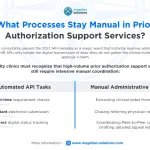
What Standardized APIs Will Automate:
- Requirement Discovery: The EHR communicates directly with the payer’s API to instantly determine if a specific CPT or HCPCS code requires prior authorization.
- Electronic Submission: Standardized data packets are transmitted instantly through the Prior Authorization API, eliminating the need to re-key patient info into separate payer portals.
- Status Tracking: Practices can monitor approval statuses directly inside their helpdesk or EHR without calling payers for updates.
What Remains Strictly Manual:
- Clinical Documentation Chasing: Payer rules require specific clinical evidence (such as conservative therapy logs, imaging reports, and precise lab values) to justify medical necessity. Retrieving these files from cluttered EHRs and chasing referring physicians for missing charts remains a highly manual, time-consuming process. The friction behind these collection steps is detailed in National Institutes of Health prior authorization burden studies, which show that documentation assembly remains the leading cause of treatment delays.
- Payer Phone Appeals: If a claim is denied, resolving the dispute requires calling the insurer’s utilization management department, waiting on hold, and clarifying clinical nuances with representatives.
- Coordinating Peer-to-Peer Reviews: When a payer demands a peer-to-peer discussion, scheduling the call between the clinical director and the insurance medical director requires persistent, manual coordination.
- Drafting Custom Appeals: Creating detailed appeal letters that directly address the specific clinical reasons for a denial cannot be handled by standard APIs.
Deploying Specialized Prior Authorization Support Services: The Operational Answer
To survive the compressed 72-hour turnaround windows of CMS-0057-F, specialty clinics cannot rely on distracted in-house staff who split their time between checking in patients and managing phone queues. Practices need a dedicated operational answer.
By partnering with an offshore team specializing in prior authorization support services, clinics can divide labor strategically to accelerate approvals:
- Instant Document Compilation: While your clinical staff focuses on patient care, the dedicated offshore support team acts as a fast-response desk. They pull chart notes, collect lab values, verify diagnostic history, and ensure the intake file is 100% complete and audit-ready before submission.
- Continuous Portal Monitoring: Offshore specialists actively manage payer portals, submit requests immediately through FHIR APIs, and track approval statuses in real-time to ensure no request sits pending.
- Rapid Denial Remediation: If a payer issues a denial, the support team immediately identifies the missing documentation, gathers the required clinical proofs, schedules peer-to-peer calls, and drafts appeal letters to overturn the decision before the patient’s treatment timeline is disrupted.
Proven Benefits: Data and ROI of Prior Authorization Support Services
Deploying dedicated prior authorization support services delivers massive financial and operational returns for clinics struggling with rising denial rates and heavy labor overhead.
Independent industry benchmarks illustrate the substantial benefits of utilizing specialized support partners:
- Slashed Operating Costs: Transitioning pre-service administrative tasks to a specialized offshore BPO provider reduces your direct prior authorization costs by up to 40%, eliminating the need for expensive domestic software licenses and localized overhead.
- Dramatic Denial Reductions: Establishing dedicated, specialty-specific support workflows and audit-ready documentation can reduce clinical denial rates by up to 70%, keeping more revenue inside your practice.
- Boosted Staff Productivity: Providing clinical teams with dedicated administrative support improves overall staff productivity by 39%, allowing doctors and clinical directors to focus entirely on patient care rather than administrative tasks.
Prospective Customer Scenario: The Specialty Orthopedic Group
Consider a high-volume, 10-physician multi-specialty orthopedic group located in a WISeR pilot state. Their in-house billing team is excellent but constantly overwhelmed by the rigorous medical necessity documentation required for advanced imaging, spinal injections, and joint replacements. Because their staff splits time between active patient check-ins and insurance paperwork, authorizations are often delayed, resulting in a 12% clinical denial rate, postponed surgeries, and frustrated patients.
By partnering with an outsourced provider to manage their prior authorization support services, they implement a specialized workflow. A dedicated offshore team handles the entire pre-submission process: they review charts, compile conservative therapy logs, submit authorizations instantly through secure portals, and track decisions 24/7.
Within four months of launch, their authorization turnaround time drops from 6 days to under 48 hours, their clinical denial rate plummets from 12% to 4.5%, and their physicians see an additional 36 patients per week, adding over $140,000 in incremental annual revenue.
Elevate Your Revenue Cycle with Magellan Solutions
Navigating the complex, fast-changing landscape of healthcare compliance and insurance rules requires an experienced, highly vetted partner. At Magellan Solutions, we deliver enterprise-grade medical billing support, HIPAA-compliant patient coordination, and comprehensive prior authorization support services designed to meet the highest regulatory standards.
Our ISO-certified, HIPAA-compliant delivery centers provide highly trained healthcare support specialists who understand the unique clinical documentation requirements of complex medical specialties. Whether you need to streamline pre-certifications for advanced imaging, manage specialty medication approvals, or coordinate appeals under new CMS-0057-F rules, our team integrates seamlessly with your existing EHR and billing platforms.
Do not let administrative delays, rising denials, or regulatory deadlines disrupt your patient care or drain your operational budget. Please contact us to inquire about our services today to learn how our scalable, cost-effective support solutions can secure rapid approvals, protect your cash flow, and support your practice’s growth.
Frequently Asked Questions About Prior Authorization Support Services
Does CMS-0057-F apply to all insurance plans?
No. The CMS-0057-F mandate applies specifically to government-regulated, public-program payers. This includes Medicare Advantage organizations, state Medicaid and CHIP fee-for-service programs, Medicaid managed care plans, CHIP managed care entities, and Qualified Health Plans (QHPs) offered through federally facilitated exchanges.
What is the WISeR pilot program, and which states participate?
The Wasteful and Inappropriate Service Reduction (WISeR) Model is a six-year pilot program launched by CMS on January 1, 2026. It introduces prior authorization into traditional fee-for-service Medicare for selected services prone to overuse, operating across six states: Texas, Arizona, New Jersey, Ohio, Oklahoma, and Washington.
Can an outsourced support team log into our existing EHR system?
Yes. Professional healthcare BPO providers operate directly inside your preferred, cloud-based EHR and practice management platforms (such as Epic, eClinicalWorks, Athenahealth, or Practice Fusion) via secure, HIPAA-compliant virtual connections.
What is the difference between a standard and expedited prior authorization request under the new rule?
Under CMS-0057-F, expedited (urgent) prior authorization requests must receive a decision from the payer within 72 hours, while standard (non-urgent) requests must receive a decision within 7 calendar days. An expedited request is defined as one where waiting the standard timeframe could seriously jeopardize the patient’s life, health, or ability to regain maximum function.