
Managing an insurance agency or brokerage requires a constant balancing act. Operational tasks like policy data entry, document processing, billing inquiries, and claims intake can quickly consume your workday. While transferring routine administrative duties to back-office or offshore support teams helps scale your capacity, insurance remains a strictly regulated industry.
State regulatory frameworks enforce clear legal boundaries between licensed producers and unlicensed administrative support. Partnering with insurance BPO services lets agencies expand operational capacity, but maintaining compliance requires a clear understanding of what unlicensed staff can and cannot legally manage day-to-day.
Why Regulatory Boundaries Matter for Insurance Operations
State insurance departments across the United States enforce producer licensing laws to protect policyholders. These regulations ensure that anyone offering coverage advice, recommending policy limits, or negotiating terms holds the required education and state authorization.
For agency owners, operations leaders, and compliance managers, crossing these regulatory lines carries serious operational risks:
- Regulatory Fines and Penalties: State insurance commissioners regularly levy financial penalties against agencies that allow unlicensed staff to perform licensed sales or advisory functions.
- License Suspension or Revocation: Agency principals face direct disciplinary action or loss of authority if compliance oversight fails.
- Errors and Omissions (E&O) Exposure: Actions taken by unlicensed personnel outside their permitted scope can void E&O coverage for specific claims, leaving the agency directly liable for damages.
What Unlicensed Insurance Support Staff Can Do
Unlicensed support personnel, whether working in your main office or as part of an offshore support team, can legally handle a wide variety of operational, administrative, and customer service tasks.
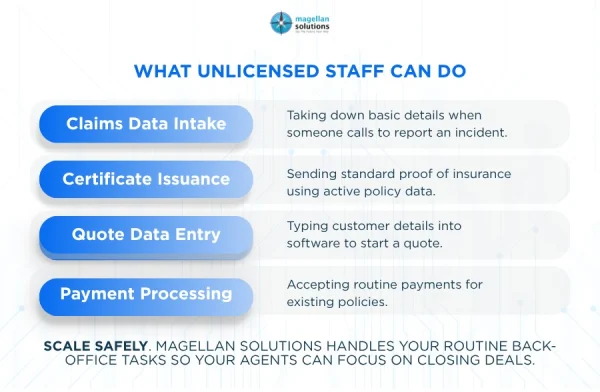
1. First Notice of Loss (FNOL) and Initial Claims Intake
Unlicensed support staff can receive incoming claims notifications and gather factual details about an incident.
Their scope includes collecting the date, time, location, parties involved, and a factual description of the event. They can record these details into the agency management system and route the file to a licensed adjuster or account manager. Dedicated claims processing support teams streamline this intake stage without assessing liability, advising an insured on whether they should file a claim, or interpreting policy coverage terms.
2. Customer Inquiries and Omnichannel Assistance
Frontline representatives handle high-volume inquiries regarding office hours, general account status, or document requests. Using structured customer support solutions lets your agency stay responsive 24/7 while keeping conversations strictly factual.
3. Processing Certificates of Insurance (COIs)
Certificate generation is a high-volume administrative task ideal for support teams. Unlicensed staff can generate and issue a COI that matches existing, active policy terms recorded in your management system. They cannot alter policy limits on the document, add custom endorsement wording without licensed approval, or confirm coverage that does not exist in the policy.
4. Gathering Information for Quotes
Support staff can assist during the pre-underwriting stage by collecting factual client information. They can collect contact details, property addresses, or vehicle identification numbers and input that data into rating tools or carrier portals. They must stop short of analyzing risk profiles, recommending coverage types, or presenting a rate as professional advice.
According to an industry benchmark report from McKinsey & Company, insurance carriers and agencies that digitize and delegate routine administrative workflows to specialized support staff reduce operational processing costs by up to 30% while improving processing speed. This efficiency translates directly into faster response times for clients without increasing compliance risk. When support teams handle raw data collection, your licensed agents spend less time typing and more time advising clients.
5. Billing, Collections, and Payment Processing
Administrative teams can handle standard financial tasks and payment inquiries. They can accept premium payments, share payment schedules, check account balances, and process basic reinstatements when terms remain unchanged. They cannot negotiate payment plans, waive carrier fees, or advise clients on how changing coverage might lower their bill.
6. Policy Administration and Document Management
Routine back office tasks keep agency operations organized and efficient. Unlicensed staff can index incoming carrier documents, update contact information in your system, issue standard policy forms, and send renewal reminders. They cannot review coverage adequacy during renewals or suggest modifications to existing policies.
What Unlicensed Insurance Support Staff Cannot Do?
The core restriction for unlicensed personnel revolves around selling, soliciting, negotiating, or advising on insurance coverage.
Unlicensed staff must immediately transfer a client to a licensed producer when questions touch on advisory decisions, such as:
- Is this coverage limit enough for my property?
- Should I raise my deductible to save money?
- Does my commercial policy cover water damage?
- Can you bind this coverage for me right now?
Soliciting involves encouraging a client to purchase a specific policy. Negotiating means discussing coverage terms, rates, or deductibles directly with a buyer to reach an agreement. Advising means recommending specific coverage options or deductible structures based on a client’s risk profile. All three functions belong exclusively to licensed agents.
What This Means for Offshore Support Teams
Offshore talent models provide operational flexibility and structural cost advantages for growing insurance agencies. Structuring an offshore team requires clear operational boundaries to ensure complete regulatory compliance.
1. Establish Clear Workflow Escalations
Offshore teams function best as a seamless extension of your licensed account managers and producers. Establish structured handoff protocols:
The offshore team member handles initial inquiry intake, factual data collection, and system lookup. If the conversation moves into coverage advice, policy interpretation, or binding, the representative transfers the client or routes the ticket to a licensed producer. After the licensed agent completes the advisory portion, they hand back administrative processing to the offshore team.
2. Standard Operating Procedures and Scripting
Offshore teams rely on clear SOPs to maintain service quality and compliance. Maintain written workflows that state exactly what information an unlicensed representative can share. Use call scripts for incoming inquiries so representatives provide clear, factual responses without offering unscripted guidance on coverage terms.
3. Rigorous Training on Local Regulations
While offshore staff do not need state insurance licenses for back-office functions, they must understand regulatory expectations. Onboarding programs should train staff to identify questions requiring a licensed response, recognize regulatory red flags, and navigate management software safely without editing restricted fields.
Frequently Asked Questions
Can an unlicensed team member take credit card payments over the phone?
Yes. Unlicensed staff can accept credit card or ACH payments for active policies as long as they process the transaction using established rates and don’t modify policy terms or coverage structures.
Can unlicensed staff run auto insurance quotes on a carrier portal?
Unlicensed staff may input client data into comparative raters to generate initial numbers. However, a licensed agent must present those quotes as coverage recommendations, explain options, or bind the policy.
How do state regulators view offshore administrative support for insurance agencies?
State regulators focus on the task performed, not the worker’s physical location. Unlicensed administrative tasks remain fully compliant whether they occur locally or offshore, as long as the individual does not sell, solicit, negotiate, or advise on coverage.
Key Takeaways
- Tasks Dictate Compliance, Not Location: Regulators focus strictly on activity. Unlicensed staff everywhere can gather factual details and process paperwork, but advising, negotiating, and binding belong strictly to licensed agents.
- Unlock 30% Efficiency: Delegating high-volume tasks like FNOL intake, COI generation, and billing allows licensed producers to devote 100% of their time to closing policies and driving revenue.
- Escalations Protect Your License: Bulletproof SOPs and strict handoff rules ensure support representatives escalate advisory questions before crossing compliance boundaries.