

Healthcare outsourcing services help clinics, hospitals and digital health platforms reduce administrative overhead. However, clinical directors and compliance managers often ask vendors one common question: “Is your company HIPAA certified?” When an outsourcing sales rep quickly says “Yes,” experienced leaders should pause. In reality, official HIPAA certification does not exist.
The U.S. Department of Health and Human Services (HHS) does not certify any company. Furthermore, the Office for Civil Rights (OCR) does not endorse compliance certificates. So a vendor advertising a “HIPAA certified” badge is showing a private marketing seal, not a government credential. In fact, these badges usually come from software vendors or paid consultants. Consequently, a website badge will not protect your practice from federal fines if a data breach occurs.
Instead of looking for a fake government certificate, healthcare leaders must evaluate actual operational safeguards. For this reason, you need to review verified audit reports and binding legal contracts. This guide explains why official certification is a myth. In addition, it provides a six-question framework to evaluate healthcare outsourcing services safely.
Why HIPAA Certification Doesn’t Exist
Under federal law, HIPAA establishes strict national standards to protect patient health data. However, the federal government does not run an inspection agency that issues compliance stamps.
In official guidance from the U.S. Department of Health and Human Services Office for Civil Rights, federal regulators warn providers against misleading vendor claims:
“HHS and OCR do not endorse any private consultants’ or education providers’ seminars, materials or systems, and do not certify any persons or products as ‘HIPAA compliant.'”
Because federal agencies do not issue certificates, commercial badges usually fall into three categories:
- Internal Self-Assessments: First, a vendor downloads a basic checklist. Next, they answer the questions internally without outside audits and create their own website badge.
- Staff Training Certificates: Second, support agents complete a brief video course on privacy basics. While employee training is mandatory under federal law, a certificate only shows that an agent watched a video. Therefore, it does not prove that the vendor uses enterprise-grade technical safeguards.
- Private Commercial Badges: Third, consulting firms sell proprietary review packages. Some reviews are thorough, but the resulting badge carries zero legal weight with federal regulators.
Consequently, evaluating healthcare outsourcing services requires looking past marketing seals to verify real security controls.
What a Business Associate Agreement Does
When a healthcare provider hires an external company for billing, intake, or prior authorizations, that vendor becomes a legal Business Associate.
Under federal privacy rules, covered healthcare entities cannot share patient records without a signed contract. As detailed in the HHS Model Business Associate Agreement Provisions, a Business Associate Agreement (BAA) establishes binding legal limits. Specifically, it dictates how the vendor accesses, uses, and discloses patient health data.
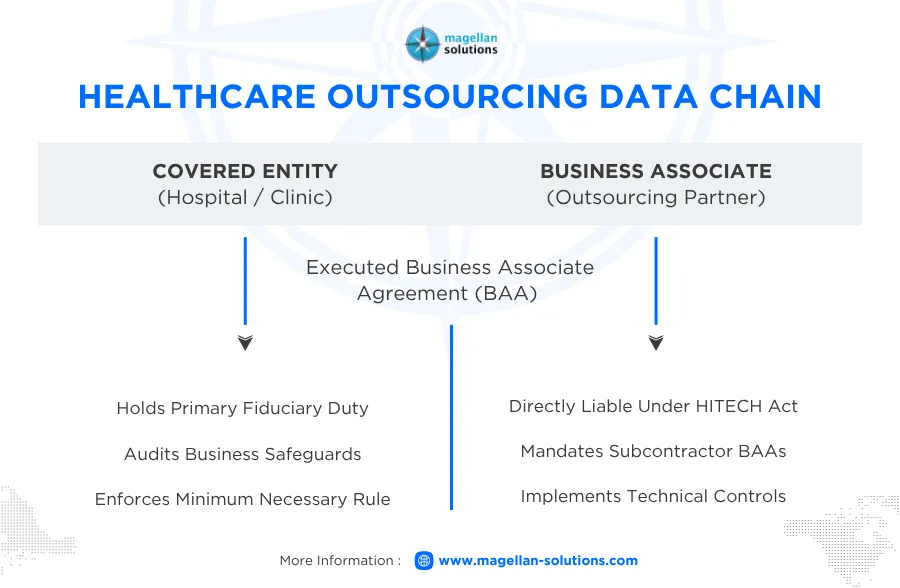
Furthermore, under the HITECH Act, business associates face direct statutory liability for HIPAA violations. For example, if an external billing team suffers a data breach, the vendor faces federal penalties alongside the clinic. Therefore, signing a comprehensive BAA is mandatory when contracting healthcare outsourcing services.
6 Questions to Ask a Vendor Instead
To conduct thorough due diligence, healthcare executives should replace generic certification questions with six precise operational checks.
1. Will You Sign Our BAA?
A vendor’s willingness to sign a comprehensive BAA tests their compliance maturity. Unprepared vendors often try to substitute generic service terms. Alternatively, they may attempt to cap data breach liability at low dollar amounts.
Therefore, your compliance team must insist that the vendor sign a strict BAA. Specifically, the agreement must clearly define permitted disclosures, mandate fast breach notices, and confirm site security.
2. When Did You Last Update Your Risk Analysis?
The HIPAA Security Rule requires business associates, as well as covered entities, to conduct an accurate and thorough risk analysis of the electronic patient data they handle, and to keep it current. It is not optional, and missing or incomplete risk analyses come up again and again in OCR’s enforcement actions.
For this reason, ask prospective partners for the executive summary of their latest risk assessment. The rule doesn’t set a fixed schedule. But if a vendor can’t produce a risk analysis at all, or its latest one predates major changes to its systems or sites, treat that as a red flag.
3. Which Independent Audits or Certifications Can You Show Us?
The federal government does not issue certificates. However, reputable global firms prove their cybersecurity posture through established, independent frameworks. Therefore, ask your vendor which of the following verifiable audit reports they maintain:
| Security Framework | What the Audit Evaluates | Value for Healthcare Providers |
|---|---|---|
| SOC 2 Type II | Operational controls over security and confidentiality tested over 6 to 12 months. | Verifies that technical safeguards work effectively over extended time periods. |
| ISO/IEC 27001 | Global standard for maintaining an Information Security Management System (ISMS). | Confirms systematic management of sensitive corporate and patient records. |
| HITRUST CSF | Comprehensive framework harmonizing HIPAA rules with NIST and ISO standards. | Built specifically for healthcare, and often requested by US health plans and large health systems. |
| PCI-DSS Level 1 | Strict data security rules governing credit card processing and transactions. | Essential if your outsourced staff process copays or patient balances. |
Consequently, these independent audit attestations provide verified evidence that an external organization protects sensitive data.
4. How Do You Control Access to Patient Data?
Frontline operations require strong physical and technical barriers to stop unauthorized data exposure. For example, when evaluating healthcare outsourcing services, examine their physical delivery centers and technical systems:
- Clean Desk Environments: First, verify that delivery centers enforce paperless operations. Staff should not have personal phones, cameras, or paper on the production floor.
- Zero-Download Terminals: Second, confirm that agents work on locked virtual desktops. Local hard drives, USB ports, personal email, and printing functions must be disabled.
- Role-Based Permissions: In addition, ensure that staff access records strictly under the minimum necessary rule. For instance, an agent scheduling appointments has no need to view full clinical histories.
- Multi-Factor Authentication: Finally, require multi-factor authentication (MFA) on all systems accessing provider databases, along with automatic inactivity logouts.
5. Do Your Subcontractors Sign BAAs Too?
Many outsourcing providers use third-party software, cloud storage, or telecom tools to deliver services. Under federal rules in HHS Guidance on Business Associates and Subcontractors, any subcontractor handling patient data must sign a downstream BAA.
Therefore, ask the vendor to list every third-party software or server tool used in your workflows. Furthermore, demand confirmation that valid subcontractor BAAs bind every single downstream provider.
6. How Fast Will You Tell Us About a Breach?
Under the Breach Notification Rule, a covered entity must notify affected patients without unreasonable delay and no later than 60 days after discovering a breach. HHS must also be notified, within the same 60 days if 500 or more people are affected, or in an annual report for smaller breaches. A business associate has up to 60 days to tell you, which leaves you no time at all if it uses them.
As a result, a reliable partner must maintain a clear incident response plan. That’s why many providers write a much shorter window into the BAA, often 24 to 72 hours from a suspected incident.
Vendor Due Diligence Checklist
Before approving a contract with a third-party healthcare vendor, review the following operational score card with your compliance team:
[ ] BAA EXECUTION:
* Direct signature on provider-approved Business Associate Agreement
* Liability and indemnity terms reviewed by your counsel
[ ] INDEPENDENT AUDIT VERIFICATION:
* Valid ISO 27001 or SOC 2 Type II audit report within the past 12 months
* Third-party attestation letters reviewed directly by IT security
* HITRUST certification, if your organization or payers require it
[ ] WORKFORCE COMPLIANCE CONTROLS:
* Documented background checks on all operational staff
* Mandatory annual privacy and security awareness training logs
* Clear disciplinary policies for workforce privacy violations
[ ] ACCESS AND TELEMETRY SAFEGUARDS:
* Enforced least-privilege, role-based database permissions
* Remote virtual desktop infrastructure (VDI) with local drives disabled
* Comprehensive audit logs of all record views, edits, and exports
[ ] INCIDENT RESPONSE READINESS:
* Documented breach escalation plan with designated privacy officers
* Contractual breach notification window within 24 to 72 hours
* Active cyber-liability insurance coverage with appropriate limits
Magellan Solutions holds ISO 27001 and PCI-DSS certification and operates HIPAA-aligned processes under a signed Business Associate Agreement on every US healthcare account. If you’re vetting healthcare BPO partners, start with our certifications, then ask us the six questions above.
Frequently Asked Questions
Can a vendor legally claim to be HIPAA certified?
No. The U.S. Department of Health and Human Services does not issue HIPAA certifications, so no vendor can truthfully claim one. In fact, vendors displaying certification seals are using private marketing badges that carry no legal standing with federal regulators.
What is the difference between HIPAA compliance and HIPAA certification?
HIPAA compliance is an active operational program consisting of risk assessments, technical safeguards, written policies, staff training, and binding contracts. In contrast, HIPAA certification is a commercial marketing term with no legal standing under federal law.
Can offshore healthcare outsourcing services handle U.S. patient data legally?
Yes. Federal HIPAA regulations permit offshore business process outsourcing. However, offshore vendors must implement the same administrative, physical, and technical safeguards as domestic firms. Furthermore, they must sign valid Business Associate Agreements and follow any additional rules set by state Medicaid programs or private insurers.
What should a clinic do if a prospective vendor refuses to sign a BAA?
If a prospective vendor refuses to sign a compliant Business Associate Agreement, do not disclose any patient data to that company. After all, sharing protected health information without a signed BAA violates the HIPAA Privacy Rule and exposes your clinic to severe federal penalties.