


Every practice manager, clinical coordinator, and billing director knows the sinking feeling of logging into a payer portal only to find a critical prior authorization stuck in “pending” status. While the request sits in administrative limbo, patients get bumped from the schedule, high-value clinical slots sit empty, and staff hours are swallowed by endless phone queues.
When a prior authorization stalls, it is rarely due to a single catastrophic mistake. Instead, it results from micro-breakdowns across a complex administrative pipeline. Treating every delay as an unavoidable insurance headache leads to reactive troubleshooting—leaving your highly paid clinical staff to chase faxes and format PDFs instead of focusing on patient care.
To reclaim your staff’s time and protect your practice revenue, treat prior authorization as a step-by-step assembly line. By diagnosing exactly where your pipeline leaks, you can plug the gaps with targeted support. For medical practices looking to clear backlogs, cut administrative costs, and protect staff time, structured legal prior authorization support services restore pipeline momentum and keep patient care moving forward.
Stage 1: Requirement Check & Eligibility Verification
A prior authorization request begins long before anyone logs into an insurance portal. It starts at the front desk when a patient checks in or when a doctor enters an order into the Electronic Health Record (EHR).
At this initial stage, requests usually stall because of basic verification oversights. Insurance portals use automated screening software to match submission data with active policy files. If a patient’s primary insurance plan changes or a procedure code doesn’t match the payer’s pre-certification list, the request is flagged or rejected immediately.
Common Intake Pitfalls
- Inaccurate Patient Details: Simple typos in names, dates of birth, or policy numbers that prevent automated portal matching.
- Unverified Coverage Rules: Submitting paperwork for procedures that no longer require prior authorization, or missing newly added plan requirements.
- Unmapped Order Codes: Entering a procedure under a generic internal clinic description rather than the exact Current Procedural Terminology (CPT) code required by the insurer.
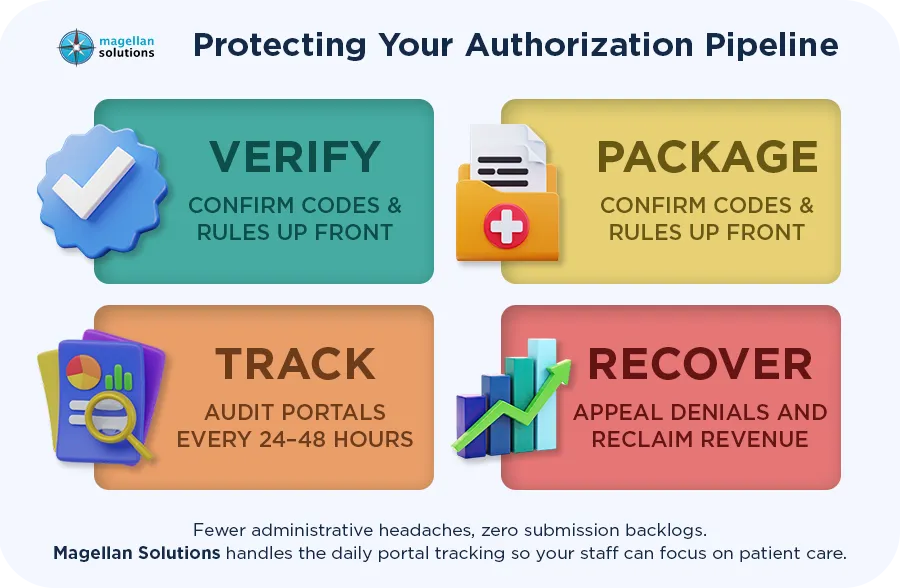
Operational Fix: Deploy dedicated pre-authorization verification workflows that cross-check patient insurance eligibility, active plan rules, and required CPT codes before paperwork is generated.
Stage 2: Clinical Packet Assembly
Once basic patient details pass initial portal checks, the request moves to clinical review. This is where most prior authorizations hit a complete wall.
Standardizing clinical documentation packages based on payer policies prevents these delays. When staff know exactly what clinical proof a plan requires, they assemble complete files on the first try.
Common Documentation Gaps & Fixes
- The Step-Therapy Black Hole: Insurers demand proof that lower-cost treatments were tried and failed first (e.g., requiring six weeks of physical therapy before approving an MRI).
The Fix: Proactively include historical progress notes, pharmacy fill records, and therapy logs with the initial submission instead of waiting for a rejection letter. - Vague Clinical Charting: Documentation lacks the specific functional limitations, pain scales, or diagnostic scores required by the payer’s internal medical necessity guidelines.
The Fix: Implement specialized pre-submission intake checklists and forms tailored to individual payer criteria. - Unsigned Attestations: Progress notes or physician orders lack valid digital signatures or formal attestation dates.
The Fix: Deploy strict pre-submission quality audits to ensure every file is fully compliant and signed before building the submission package.
Standardizing clinical documentation packages based on payer policies is what ultimately prevents these delays. When your administrative staff knows exactly what clinical proof a plan requires, they can assemble complete, audit-proof files on the first try. Once you’ve assembled and verified your clinical packets, the next challenge is getting them securely into the payer’s hands.
Stage 3: Portal Submission & Clearinghouse Transmission
Even with accurate patient details and complete clinical notes, technical transmission can still stall a request.
Most practices manage dozens of commercial plans, Medicare Advantage plans, and Medicaid programs. Each plan uses its own submission route, whether through a specialized web portal, an electronic clearinghouse, or legacy fax lines.
Managing multiple portals creates heavy friction for administrative staff. Switching between different interfaces leads to missed alerts, lost attachments, and delayed responses to insurance inquiries. When staff process high volume across mismatched portals and clearinghouses, administrative capacity gets stretched thin. Every extra hour spent navigating a clunky portal reduces time available to follow up on pending approvals, leaving requests untouched for days.
Operational Fix: Utilize dedicated portal management and document formatting support to handle multi-channel submissions, file conversions, and attachment formatting accurately.
Stage 4: Status Tracking & Active Follow-Up
The post-submission phase is often treated as a passive waiting game, assuming the insurance company will send an alert once a decision is made. However, payers routinely place requests in pending status while awaiting minor clarifications.
If a practice doesn’t actively track portal statuses, a request can sit idle until it expires, forcing staff to restart the entire process.
Operational Breakdown vs. Fixed Support
- The Problem: Requests sit “in review” for 10 to 14 days because no one logged into the specific insurance portal to check for alerts.
- The Impact: Patient appointments are canceled at the last minute, treatments are delayed, and clinic schedules suffer.
- The Fix: Implement daily status-tracking workflows with dedicated administrative staff logging into portals every 24 to 48 hours to clear flags immediately.
Stage 5: Peer-to-Peer Coordination
If an insurance reviewer cannot approve a request based on the submitted paperwork, they often request a peer-to-peer consultation between the ordering doctor and the health plan’s medical director.
Peer-to-peer requests frequently stall because of scheduling friction. Practicing doctors spend their days treating patients and cannot easily adjust their schedules to meet narrow insurance call windows. If the call isn’t scheduled within a strict 24- to 48-hour window, the insurer issues a formal denial.
Operational Fix: Implement dedicated administrative scheduling support to handle payer communications, pull key chart notes, set up call appointments directly on the physician’s calendar, and prepare brief clinical reference sheets prior to the call.
Stage 6: Appeals & Denial Management
When a prior authorization request is officially denied, many practices write off the procedure or ask the patient to pay out of pocket. However, initial denials are frequently administrative errors generated by automated software rather than final clinical refusals.
According to data analyzed by the American Medical Association (AMA), only 11.7% of denied Medicare Advantage prior authorization requests were appealed in 2023, yet 81.7% of those appeals were fully or partially overturned.
This data shows that abandoned denials represent lost revenue and delayed care, not valid clinical rejections. Because more than 8 out of 10 appealed denials win approval, practices that build formal appeal workflows routinely recover revenue that would otherwise be written off.
Processing an appeal requires identifying why the initial request failed, gathering additional clinical guidelines, drafting formal letters of medical necessity, and tracking strict appeal deadlines.
Operational Fix: Deploy specialized appeal support services to manage the end-to-end preparation, formatting, and submission of Level 1 and Level 2 appeals, turning initial rejections into approved care.
Mapping Your Authorization Pipeline to the Right Fix
To stop prior authorizations from getting stuck, healthcare leadership must shift from reactive troubleshooting to stage-specific operational management:
| Prior Auth Pipeline Stage | Where the Problem Lives | Tailored Operational Solution |
| 1. Requirement Check | Wrong CPT codes, unverified coverage | Front-end eligibility & pre-cert verification |
| 2. Documentation | Missing step-therapy, incomplete charts | Clinical packet assembly & chart pre-audits |
| 3. Submission | Portal errors, decoupled attachments | Specialized submission & multi-portal management |
| 4. Follow-Up | Idle pending status, expired requests | Active 24–48 hour status tracking & monitoring |
| 5. Peer-to-Peer | Missed scheduling windows, busy doctors | Peer-to-peer scheduling & chart brief prep |
| 6. Appeals | Unchallenged denials, lost revenue | Formal appeal packet drafting & denial recovery |
Streamline Your Prior Authorization Workflow
Complex insurance portals, step-therapy guidelines, and strict submission deadlines can overwhelm your administrative team. Partnering with Magellan Solutions gives your practice dedicated healthcare BPO support to handle time-consuming pre-certifications, document preparation, and multi-portal management with high accuracy and efficiency.
Administrative delays and portal bottlenecks should not stand between your patients and their care. Speak with our healthcare support team today to learn how dedicated prior authorization support can eliminate submission backlogs, clear portal bottlenecks, and keep your practice pipeline moving forward.
Frequently Asked Questions
1. Why do prior authorizations get stuck in “pending” status even when submitted online?
A pending status usually means the insurance portal’s automated system flagged an issue that requires human review. This often happens due to missing clinical evidence (such as conservative treatment notes), mismatched procedure codes, or clearinghouse errors where attached PDF notes failed to link to the main submission.
2. How quickly should a practice follow up on a submitted prior authorization?
Active status tracking should begin within 24 to 48 hours of submission. Waiting for a mail notice or email alert often leads to missed requests for additional information, causing the authorization window to expire.
3. What is the difference between a peer-to-peer review and a formal appeal?
A peer-to-peer review is a short phone discussion between the ordering doctor and the health plan’s medical director to clarify clinical details before or immediately after a preliminary denial. A formal appeal is a written, documented challenge submitted after an official written denial has been issued.
4. What happens if a prior authorization request expires while pending?
If a request expires before a decision is made, most payers treat it as an administrative cancellation. The practice must submit a new authorization request from scratch, resetting the review timeline and further delaying patient care.
5. Why do insurance plans require step therapy before approving certain procedures or drugs?
Step therapy is a cost-control rule where payers require patients to try lower-cost or standard treatments (like physical therapy or generic medication) before approving more expensive options (like MRIs or specialty drugs). Clear proof that these earlier steps were completed prevents immediate holds.
6. How do formatting errors lead to administrative prior authorization rejections?
Insurance web portals rely on strict automated rules. If a document uses an incorrect procedure code format, lacks a doctor’s signature date, or attaches an unreadable scanned PDF, the system automatically sends the request to a manual review queue or rejects it outright.
7. How can outsourcing prior authorization tasks help reduce clinical staff burnout?
Prior authorization processing involves repetitive administrative tasks like checking portal rules, reformatting PDFs, waiting on hold with payers, and tracking file statuses. Offloading these tasks to a specialized partner lets clinical staff and nurses stay focused on direct patient care and high-value clinical work.
Key Takeaways
- Target the exact stage: Prior auths stall at specific operational checkpoints—fix the root cause, not just the symptom.
- Complete records win faster: Submitting pre-audited clinical packets on the first try eliminates hold times.
- Proactive tracking prevents expiration: Checking portals every 24–48 hours keeps requests moving forward.
- Denials are rarely final: Most initial rejections are administrative glitches that win on formal appeal.
- Protect clinical time: Offload formatting and portal chasing so clinicians focus purely on care.