


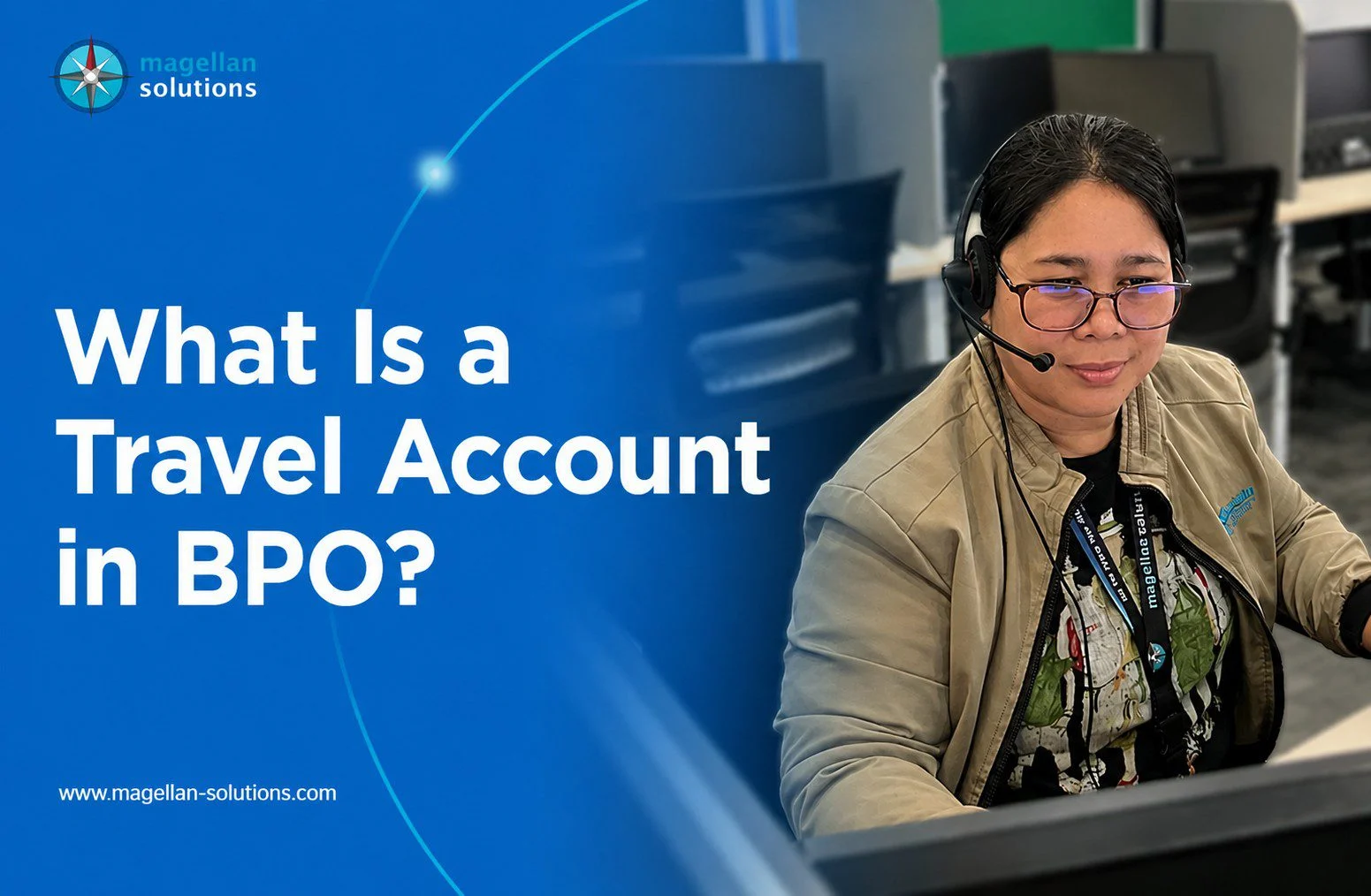
A travel account is a client campaign in a call center or BPO that handles customer service for a travel business — an airline, a hotel group, a tour operator, or most often an online travel agency. Agents assigned to it take bookings, change and cancel itineraries, chase refunds, and answer travelers before, during and after a trip.
“Account” here means the client, not a financial account. A BPO runs many accounts at once; a travel account is simply the one whose client sells travel. If you have heard someone say they “work a travel account,” that is what they mean.
This post covers what the work actually involves, how a travel account differs from the hospitality, hotel and airline accounts it gets confused with, and what makes it harder than it looks. If you run a travel business and are looking at setting one up rather than working on one, travel agency outsourcing is the page you want.
What the work involves day to day
The shape of a shift depends on whether the account is inbound, outbound, or both, and on the client’s hours rather than the agent’s.
Most of the volume is booking and post-booking. A traveler wants to know whether a fare includes baggage. Someone needs a name corrected on a reservation before check-in closes. A family wants to move a package two weeks later and needs to know what the supplier will charge for it. Individually none of these is complicated. What makes the job is the volume and the fact that each one has a deadline attached to somebody’s trip.
A meaningful slice is disruption. Cancelled flights, missed connections, a hotel that cannot honor a booking. These calls arrive in bursts, usually out of hours, and the caller is already having a bad day. This is the part of a travel account that separates experienced agents from new ones, and it is why disruption handling comes up in every interview for one.
The systems matter more than on most accounts. An agent typically works in the client’s booking engine, a global distribution system, a reservation or ticketing platform, and a CRM — often several at once on a single call. Learning the account means learning that stack, plus the client’s fare rules, supplier policies, and the destinations they sell.
The boundary is written down. Every travel account has a documented limit on what an agent can confirm, change, refund or waive without escalating. Knowing that boundary cold is most of what “experienced on a travel account” means in practice.
Travel account vs. hospitality, hotel, and airline accounts
These get used interchangeably and they are not the same, which matters if you are choosing between them or hiring for one.
A travel account sits with the business that sells and services the booking — an OTA, a travel agency, a tour operator. The agent’s world is reservations, itineraries, fare and supplier rules, changes and cancellations across multiple suppliers.
A hospitality account sits with the business that hosts the guest — a hotel, resort, or vacation rental company. The work is reservations too, but it is one property or one brand’s properties, and it extends into guest services: room requests, amenities, complaints during a stay.
A hotel reservation account is a narrower version of that — booking rooms for one chain, usually with a single reservation system and a fixed rate structure to learn.
An airline account is narrower again and usually more regulated: one carrier’s inventory, one set of fare rules, and often compliance requirements around ticketing and involuntary changes that do not apply elsewhere.
The practical difference is breadth. A travel account agent deals with many suppliers and has to reason across their rules. A hotel or airline account agent deals with one and has to know it exhaustively. Neither is easier; they are hard in different directions.
Voice, non-voice, inbound and outbound
Travel accounts run across all four, and most run several at once.
Inbound voice is the bulk of it — travelers calling with a booking question or a problem. Non-voice covers email, live chat, and increasingly messaging apps and social channels. Chat suits low-complexity booking questions; anything time-critical tends to move to a call. Outbound is confirmations, reminders, schedule-change notifications, and follow-up after a disruption. It is calmer work and often a starting point for agents new to the account.
Many travel accounts also run overnight, because a client’s travelers are in time zones its head office is not.
Is a travel account hard?
It has a reputation for being one of the more demanding accounts, and the reasons are specific rather than general.
The training curve is real. Product knowledge, destinations, supplier rules and several systems, most of it before taking live calls unaided. Expect a supervised period on the floor after classroom training.
The stakes are visible. A mishandled billing query is annoying. A mishandled rebooking means someone misses a funeral, a wedding, or a connection in a country they do not speak the language of. Callers know that, and it shows in the tone of the call.
Peak seasons are genuinely heavy. Holiday booking windows and disruption events produce volume that does not taper politely.
Against that: the work is varied, the product is interesting, the skills transfer across the travel industry, and agents who learn the systems well become hard to replace. It is not an account people drift into, and it is not usually one they leave quickly either.
If you run a travel business and are considering setting one up
Different question, different answer, and mostly out of scope here.
The short version: what moves well to an outsourced travel account is the routine, rule-bound, always-on tier — booking inquiries, itinerary changes and cancellations against supplier rules, confirmations, after-hours coverage and seasonal overflow. What does not move is supplier negotiation, commercial policy, and the client relationships your own people hold.
For the service detail — what a desk covers, which systems it works inside, how it is set up and what it costs — see travel agency outsourcing, or talk to us about what your current volume looks like.
Frequently asked questions
Is a travel account the same as a hospitality account?
No. A travel account serves the business selling the booking — an agency, OTA or tour operator. A hospitality account serves the business hosting the guest, usually a hotel or resort, and extends into in-stay guest service. The confusion is common because both involve reservations.
Do you need travel industry experience to work a travel account?
Usually not to start. Accounts train on product, destinations, supplier rules and systems, because those are client-specific and could not be assumed anyway. What is expected coming in is clear communication and the composure to handle a call from someone whose trip has gone wrong.
What is the difference between a travel account and travel BPO?
“Travel account” describes one client campaign inside a BPO. “Travel BPO” describes the provider or the service category as a whole. One is a specific team; the other is an industry.
What systems do travel account agents use?
The client’s, typically — a booking engine, a global distribution system such as the one the agency already runs on, a reservation or ticketing platform, and a CRM or support desk. Access levels are set by the client.
Are travel accounts only for airlines and OTAs?
No. Tour operators, corporate travel agencies, vacation package specialists, destination management companies, group travel companies and booking platforms all run them. The common factor is that the client sells or services travel rather than provides the accommodation or the flight.