
Deploying outsourced ecommerce support has become the decisive operational factor for high-growth online retailers preparing customer service for ecommerce ahead of the intense year-end rush. For online merchants, the final two months of the year represent both the greatest revenue opportunity and the steepest operational hazard.
With Black Friday 2026 landing on November 27, the margin for operational error has shrunk to near zero. Online order volumes multiply overnight, but customer patience thins dramatically. Research from the National Retail Federation indicates holiday retail sales will surpass historic highs, while direct transaction metrics from the Adobe Holiday Shopping Report project U.S. online spending will reach a record $275.1 billion across November and December.
When transaction volumes climb by 200% to 500%, support ticket inboxes follow the exact same curve. Brands that delay their holiday capacity commitments find themselves trapped in reactive triage: response times stretch from minutes to days, shopping carts are abandoned over simple checkout questions, and negative reviews permanently tarnish customer lifetime value.
To protect both fourth-quarter revenue and brand reputation, digital merchants must implement a data-driven staffing blueprint that balances automated workflows, specialized internal teams, and flexible external capacity.
Peak holiday ticket volumes typically spike between 200% and 500% from Thanksgiving through late December. Waiting until November to hire guarantees customer service failures, because agent onboarding, systems training, and workflow testing require a six to eight week operational runway. Successful merchants commit extra capacity by early October, delegate repetitive tier-1 tasks (such as order tracking and return authorizations) to outsourced teams, and retain complex white-glove interactions in-house.
The Q4 Staffing Timeline: Why Early October Is the Commitment Deadline
The most common mistake retail operators make during peak season is treating calendar holidays as start dates rather than finish lines.
Customer support volume does not wait for Thanksgiving Day. Pre-holiday promotional events, early bird discount campaigns, and gift research drive an initial ticket surge as early as late October. Once Cyber Week arrives, inbound support requests spike by 80% or more compared to standard baselines.
Building elastic capacity for your customer service for ecommerce requires a structured, multi-week progression:
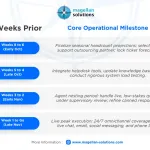
If your customer support operations are not locked in by early October, you forfeit the necessary ramp-up runway. Bringing on seasonal agents in November leads to unvetted staff handling live customer friction during your most profitable shopping days, resulting in slow resolutions and costly ordering mistakes.
Anticipating the Surge: Key Ticket Spikes in Customer Service for Ecommerce
Effective staffing depends on understanding what types of inquiries your team will actually face. While general product inquiries occur, holiday support queues are dominated by three highly predictable categories:
1. “Where Is My Order?” (WISMO) Inquiries
Order tracking inquiries consistently represent the single largest category of ecommerce support during the holidays, frequently comprising 40% to 60% of total ticket volume. Post-purchase anxiety intensifies during December because deliveries are tied to hard holiday deadlines. Customers check tracking details multiple times a day, and minor carrier scan delays prompt immediate contacts across chat and email.
2. Returns, Exchanges, and RMA Processing
Post-purchase inquiries do not conclude when the gift is unwrapped. The period spanning late December through January brings a secondary surge driven by returns, size exchanges, warranty claims, and gift card balances. Without dedicated seasonal staff to process Return Merchandise Authorizations (RMAs) swiftly, warehouse inventory restock delays compound, creating additional customer complaints that strain customer service for ecommerce.
3. Checkout Friction and Payment Failures
Unlike WISMO inquiries, pre-purchase payment failures and coupon code snags represent urgent, active revenue at risk. Industry data from Salesforce Retail Insights notes that mobile commerce accounts for over half of all digital transactions. Shoppers running into cart errors, failed “Buy Now, Pay Later” (BNPL) authorizations, or invalid promotional codes will leave for a competitor within minutes if live chat assistance is unavailable.
The Allocation Matrix: What to Outsource vs. Keep In-House
Managing holiday customer service for ecommerce does not require sending your entire operation overseas. The most resilient brands use an operational split: high-volume, standardized interactions are routed to outsourced teams, while complex, high-touch brand situations remain with domestic in-house managers.
| Customer Support Function | In-House Team | Outsourced Support Team | Strategic Rationale |
|---|---|---|---|
| WISMO and Tracking Lookups | Oversight only | Primary Ownership | Highly procedural; easily resolved using standardized carrier and CRM lookups
. |
| Basic Returns and Exchanges | Exception approval | Primary Ownership | Governed by explicit return policies; ideal for structured, high-volume queue clearing. |
| Live Chat Pre-Sale Assistance | Escalation only | Primary Ownership | Instant response times prevent cart abandonment during high-traffic promotional hours
. |
| VIP Customer and Influencer Care | Primary Ownership | No involvement | Protects lifetime brand relationships requiring nuanced discretion and custom concessions. |
| Complex Damaged Goods Claims | Primary Ownership | Initial intake only | Involves manufacturer warranties, high financial liability, or vendor supplier chargebacks. |
| Overnight and Weekend Queues | Off-duty | Primary Ownership | Delivers true 24/7 coverage across global time zones without incurring domestic overtime penalties
. |
Quantifying the ROI: Capacity Benchmarks and Cost Realities
Scaling an in-house customer service department exclusively for a two-month surge is financially inefficient. Recruiting, onboarding, equipping, and managing temporary domestic workers creates immense administrative friction, only for those employees to be let go in January.
Strategic outsourcing delivers verified operational and financial relief:
- Direct Cost Reduction: Independent economic analyses indicate that strategic business process outsourcing cuts customer care labor costs by 30% to 70% compared to domestic staffing.
- Process Redesign Efficiencies: Research by Bain & Company reveals that structured outsourcing partnerships drive 25% to 45% reductions in total operating overhead through standardized workflows, digital triage, and specialized management.
- Response Velocity: Outsourced teams structured with dedicated tier-1 agents routinely achieve average live chat response times under 60 seconds, preventing the 61% customer defection rate triggered by slow holiday support.
Prospective Client Profile: Scaling the Mid-Market Retailer
Consider a direct-to-consumer lifestyle and apparel retailer generating $20 million in annual gross merchandise value. During a normal operating month, their four-person in-house team handles an average of 350 tickets per day with reasonable success.
However, during Black Friday and Cyber Week, incoming ticket volume surges past 1,800 daily inquiries. If the brand attempts to manage this volume internally, hold times exceed 48 hours, team burnout escalates, and abandoned carts spike.
By partnering with an agile outsourced team in early October to manage their customer service for ecommerce, the brand integrates 12 dedicated seasonal specialists for live chat and WISMO tickets. The in-house staff focuses exclusively on high-tier wholesale relationships and sensitive escalations. The outcome: first-contact resolution exceeds 90%, average handle times drop by 35%, and the brand avoids thousands of dollars in temporary domestic payroll overhead.
5-Point Operational Checklist for Peak Season Readiness
Before peak traffic arrives, test your support operations against this operational readiness checklist:
- Calculate Your Peak Ticket Ratio: Review historical order data from the past two holiday cycles. Identify your exact ratio of tickets per 100 orders (typically between 15 and 35) to forecast exact headcount requirements.
- Standardize Canned Macros and Decision Trees: Document clear, unambiguous rules for every holiday policy, including shipping cut-off deadlines, damaged item replacements, and promotional adjustments.
- Establish Real-Time Escalation Paths: Ensure tier-1 outsourced agents have direct, structured communication channels (such as dedicated Slack or Teams bridge rooms) to escalate inventory discrepancies or payment gateway outages to core stakeholders.
- Implement Omnichannel Coverage: Connect your customer service software across email, live chat, SMS, and social media direct messages into a unified workspace to eliminate duplicate customer contacts.
- Simulate Stress Load Scenarios: Run a full-scale volume drill in late October. Test whether systems, dashboards, and remote agents maintain agreed-upon service level agreements (SLAs) under a simulated 3x surge.
Secure Your Holiday Growth with Magellan Solutions
Handling intense holiday support volume while maintaining impeccable service quality requires an experienced, agile outsourcing provider. At Magellan Solutions, we deliver enterprise-grade customer support, multichannel technical assistance, and scalable back-office order processing tailored to the fast-moving needs of modern ecommerce brands.
Our ISO-certified delivery centers provide vetted, highly trained customer care professionals who master your brand voice, navigate your Shopify or Magento systems seamlessly, and maintain rapid response times across every channel. Whether you need 24/7 live chat coverage during Cyber Week or dedicated agents to manage returns through January, we scale up or down based on your real-time transaction demands.
Do not let holiday ticket spikes damage your brand reputation or drain your operational budget. Please contact us to inquire about our services today to design a customized peak season staffing plan that protects your margins and delights your customers.
Frequently Asked Questions
When should an online retailer start hiring seasonal customer service agents?
Retailers should finalize seasonal staffing contracts no later than early October. Hiring, onboarding, technical integration, and system nesting require four to six weeks. Starting in November leaves insufficient time to train staff before Cyber Week volume spikes hit.
What is the most effective way to reduce holiday WISMO tickets?
The most reliable method combines proactive automated notifications with dedicated tier-1 support. Sending automated SMS and email updates at four key fulfillment milestones (Order Packed, Shipped, Out for Delivery, and Delivery Exception) resolves customer anxiety before they submit a ticket. Any remaining inquiries should be routed to fast-acting live chat agents.
How much extra support capacity is needed during Black Friday and Cyber Monday?
Most online merchants require 2x to 4x their standard support capacity during the holiday peak. The exact volume depends on your specific product complexity, average fulfillment speed, and whether your business runs flash promotions that drive sudden order spikes.
Can customer service outsourcing integrate with our existing ecommerce platform?
Yes. Modern outsourced teams operate directly inside your existing tech stack, including helpdesk platforms like Zendesk, Gorgias, Freshdesk, and Salesforce Service Cloud, as well as ecommerce backends like Shopify, BigCommerce, and Magento.