



Every community manager and moderator knows the feeling. You open your forum, group, or comment section and spot that comment.
It contains no banned curse words, no overt threats, and no explicit slurs. On paper, it breaks zero written guidelines. Yet within thirty minutes, the entire room feels tense. Helpful members stop talking, new users log off, and your internal team wastes half the workday playing referee instead of building your product.
This is the hardest part of community content management. It is the gray area: behavior that stays within the literal rules on paper, but ruins the culture in practice.
When your space relies only on automated keyword blockers, these borderline posts slip right through. Keeping your space safe, welcoming, and productive requires thoughtful online community moderation that can read between the lines and manage human behavior.
The 6 Gray Areas That Slowly Ruin Your Community
People posting in the gray area thrive on plausible deniability. When called out, they almost always reply: “Show me the rule I broke!”
Here are the six most common ways people stir up trouble without breaking a formal rule—and how your moderators should handle each.
1. Sarcasm and “Just Joking” Hostility
- What it looks like: Snarky one-liners, mocking dismissals, and passive-aggressive replies disguised as dry humor. When confronted, the poster claims: “Relax, can’t anyone take a joke anymore?”
- Example: “Oh, what a revolutionary discovery. Thank you so much for explaining what everyone here already knew.”
- Why it hurts: It kills psychological safety. Beginners stop asking questions or sharing feedback out of fear of public ridicule.
- How to handle it: Do not debate whether it is funny. Drop a calm, public reminder: “Let’s keep replies helpful and welcoming.” If the person repeatedly snipes at others, hide the comment and issue a private warning.
2. Coded Language and Dog-Whistles
- What it looks like: Everyday words, symbols, numbers, or emojis that seem innocent to outsiders, but deliver a targeted insult or intimidating message to a specific group.
- Example: Leaving specific combinations of food or animal emojis under a creator’s post to quietly mock their identity or background.
- Why it hurts: The targeted individual feels threatened and leaves, while general moderators might miss the context entirely. Doing nothing makes your brand look complicit.
- How to handle it: Keep an updated internal list of trending slang and symbols. When context shows deliberate bad-faith targeting, treat coded language as an outright harassment violation and remove it.
3. Distributed Pile-Ons
- What it looks like: A user shares an unpopular opinion or makes an honest mistake. No single response breaks a rule, but thirty people jump in to tell them they are wrong.
- Example: Dozens of separate accounts replying: “Did you actually think before posting this?” or “Delete this post.”
- Why it hurts: While each individual comment is relatively mild, the collective weight feels like mob intimidation. It overwhelms the user and derails the entire thread.
- How to handle it: Slow the conversation down immediately. Turn on thread cooldown timers, lock the comments temporarily, or collapse duplicate replies so the user is not flooded with notifications.
4. Topic Hijackers and Thread Derailers
- What it looks like: Jumping into a productive, high-visibility thread to vent about an unrelated personal complaint, company policy, or political debate.
- Example: Turning an announcement about an app feature update into a massive argument about executive pay.
- Why it hurts: It buries real customer questions, confuses readers, and wastes the time of people who came to discuss the actual topic.
- How to handle it: Step in before the derailment gains momentum. Move the off-topic posts to an open discussion room and post a clear boundary: “Let’s keep this thread focused on the feature release. Please take general feedback to our open discussion channel.”
5. Sneaky Self-Promotion (Soft Spam)
- What it looks like: A reply that looks helpful on the surface, but exists only to drive clicks, drop affiliate links, or poach your audience.
- Example: “I ran into this exact issue last month! I built a free template that solves it completely—just click the link in my profile bio to grab it.”
- Why it hurts: It turns authentic peer-to-peer conversations into a commercial bulletin board, making your community feel cheap.
- How to handle it: Set up a dedicated “Promotions” thread. Everywhere else, strip out external sales links while leaving the helpful text intact.
6. Bad-Faith “Just Asking Questions”
- What it looks like: Spreading baseless rumors or casting doubt on safety and product integrity under the guise of innocent curiosity.
- Example: “I’m not saying the company is hiding security flaws, but why haven’t they shown us their entire internal database? I’m just asking questions here.”
- Why it hurts: It manufactures panic and distrust while allowing the author to act completely blameless when challenged.
- How to handle it: Pin a factual answer or an official documentation link directly to the top of the thread. If the user keeps repeating the same speculative question, close the discussion to prevent circular arguments.
Gray-Area Moderation Playbook
| Gray Area | What It Looks Like | Why It Hurts | Recommended Action |
| Sarcastic Hostility | Mocking insults disguised as humor | Scares away new members | Issue public reminder; hide repeat jabs |
| Coded Language | Innocent symbols with hidden, hurtful meanings | Alienates targeted groups | Check user history; treat verified intent as a rule breach |
| Distributed Pile-Ons | Dozens of mild criticisms swarming one person | Feels like mob bullying | Turn on thread cooldowns; collapse repetitive comments |
| Topic Hijacking | Steering productive chats toward personal gripes | Buries helpful customer questions | Move comments to off-topic rooms; pin a topic anchor |
| Sneaky Self-Promo | Helpful advice that secretly promotes paid links | Degrades community quality | Strip commercial links; direct to a promo channel |
| Bad-Faith Questions | Unverified rumors framed as open-minded curiosity | Breeds unnecessary panic and mistrust | Pin verified facts; stop circular debate |
The 4-Part Decision Test: How Moderators Should Judge the Gray
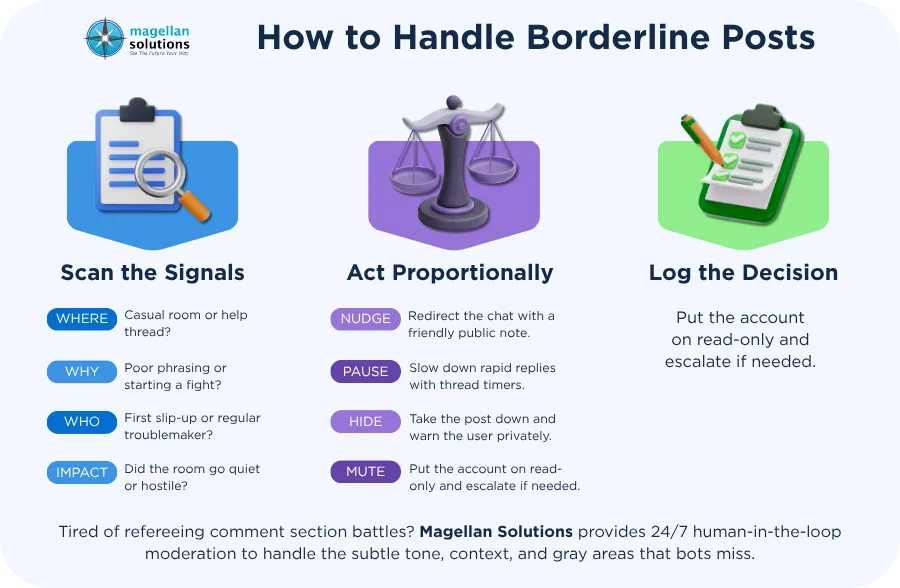
When a post lands right on the borderline, moderators should never react out of personal annoyance. Use this practical four-part test to make fair, consistent calls:
- Context: Where did this happen? Sarcastic banter between two long-time members in a casual lounge channel is very different from that same remark aimed at a new user asking for setup help.
- Intent Signals: Is the user making an awkward attempt to solve a problem, or are they deliberately poking someone to get a reaction?
- User History: Is this an active, helpful community member who had a bad day, or an account with a constant pattern of stirring up conflict?
- Impact on the Room: What happened after the post went live? Did conversation freeze? Did onlookers jump in defensively? Observed impact on the space always matters more than the author’s claimed intent.
Use Proportional Discipline
Gray-area moderation doesn’t mean choosing between doing nothing and handing out a lifetime ban. Match the response to the situation:
- Guide: Leave a quick, friendly comment steering members back to the topic.
- Slow Down: Set a post-delay timer so people must pause before replying.
- Warn: Send a brief private note explaining the friction the post caused.
- Hide: Remove the post from public view while keeping records for internal review.
- Mute: Place the user on a 24-hour read-only break to let tempers cool.
- Escalate: Send repeat bad-faith accounts to a lead for permanent removal.
Why Gray Areas Hurt Your Bottom Line and Waste Payroll
Ignoring borderline behavior is not just a community management headache—it carries real business costs.
A major Deloitte study found that 88% of customers who trust a brand will buy again. Brand trust is rarely lost in a single day. It slips away slowly when your official groups, product forums, or social spaces feel hostile, chaotic, or neglected.
When gray areas go unmanaged, businesses face three major drains on their budget:
- High-value users leave quietly: Your best customers, power users, and brand advocates simply stop engaging when threads become toxic.
- Support costs climb: When community forums become chaotic, customers stop searching them for self-service help and flood your paid support desk with tickets.
- Expensive employees waste time refereeing: Having senior product managers, developers, and marketing leads spend hours untangling community arguments is an expensive misuse of company payroll.
Strong community content management protects your brand reputation, retains loyal buyers, and saves your in-house team dozens of wasted hours every week.
How Policy Should Handle the Gray
You do not need a 40-page legal document that nobody will read. To handle gray areas smoothly, build simple, transparent internal systems:
- Add Clear Examples to Guidelines: Pair general guidelines (like “Be Constructive”) with plain-English examples of acceptable debate versus passive-aggressive hostility.
- Keep Brief Decision Notes: When a moderator hides a post or warns a user, have them log a quick note (“Hidden: persistent sarcasm toward new users in help thread”). This keeps the whole team aligned across different shifts.
- Run a Weekly 15-Minute Calibration: Review two or three tricky borderline comments as a team each week. Comparing decisions ensures that different moderators make consistent, fair calls.
- Define an Escalation Path: Frontline moderators should never feel pressured to make high-stakes, brand-sensitive calls alone. Give them a simple path to pass controversial posts to senior leadership.
- Keep Public Notes Short and Neutral: When moderating in public, explain the action simply (“Closing this thread because it turned into personal arguments”). Never debate policy details in public threads.
Scale Your Community Safely with Professional Moderation
Trying to cover your community 24/7 with in-house product or marketing staff leads to employee burnout and inconsistent enforcement. At the same time, automated filters lack the cultural nuance required to catch sarcasm, passive-aggressive hostility, and evolving slang.
Magellan Solutions bridges this gap by delivering dedicated, highly trained moderation teams that work as a direct extension of your brand. Covering text, images, and video around the clock, our specialists understand tone and context and enforce your standards consistently at scale. This keeps your community welcoming, protects your brand reputation, and frees your internal team to focus on core growth.
Ready to protect your community and eliminate moderation headaches? Schedule a strategy consultation today to build a custom moderation plan.
Frequently Asked Questions About Community Content Management
What are community moderation gray areas?
Gray areas are online posts that follow your written community guidelines but still damage the conversational environment. Examples include passive-aggressive sarcasm, coded bullying, and bad-faith circular questioning.
How do you moderate sarcasm and bad-faith questions?
Do not argue about intent. State the behavior clearly, pin factual answers directly to the top of the thread, and hide repetitive or mocking comments if they continue to disrupt the space.
Why should businesses outsource community content moderation?
Outsourcing provides 24/7 coverage by trained specialists at a lower cost than building an in-house team. It keeps your highly paid developers and managers from wasting hours playing referee on social threads.
Key Takeaways
- The gray zone kills participation: Posts that technically follow the rules can still silence newcomers and push valuable members away.
- Proportional action beats instant bans: Moderation is not all-or-nothing. Use tools like redirecting, thread-slowing, and comment-hiding before handing down account bans.
- Bad moderation drains revenue: Neglected spaces spike customer support tickets, burn out internal staff, and damage buyer trust.
- Human judgment is irreplaceable: Automated filters catch explicit words, but calibrated human teams are essential to spot sarcasm, dog-whistles, and bad-faith disruption.