

Independent hotels need someone who can complete a reservation while the night clerk handles the property. A failed keycard, a noise complaint, or the daily audit can pull the clerk away from a caller ready to book.
Hotel call answering services can provide that coverage. Their value depends on whether agents can check rooms, explain prices, and confirm reservations within the hotel’s rules.
When evaluating hotel reservation phone support, follow the call through to its finish. Does the traveler receive a booking confirmation, or a promise that someone will call tomorrow?
The Front Desk Cannot Give Every Task Its Full Attention
The evening desk serves guests already at the property and travelers deciding where to stay. During busy arrivals, a reservation call can become another interruption. Overnight, the clerk may also reconcile transactions and prepare reports.
In its March 2026 survey, the American Hotel & Lodging Association reported that more than half of respondents described their properties as somewhat or severely understaffed. The finding covers surveyed U.S. hotels broadly and supports reviewing evening responsibilities against available coverage.
Start with calls after 8 PM, then adjust the review window to your property’s actual demand. Check when callers reach voicemail, hang up before an answer, or leave a message because staff is occupied.
A Message-Taking Service Leaves The Booking Unfinished
“Someone will call you tomorrow at 9 AM” may be appropriate for an administrative request. It offers little help to a traveler arranging a weekend stay that evening.
The caller may need to confirm parking, room occupancy, or late check-in before paying. If those questions remain open, they can continue through an online travel agency, or OTA, or choose another hotel.
Each coverage model handles that moment differently.
The front desk can answer property questions and make reservations, but guest needs can interrupt the conversation.
A message-taking service records the inquiry and arranges follow-up. The traveler may still leave without a reservation.
A voice reservations team can check availability, explain approved offers, and create bookings when it has the necessary access and authority.
Ask whether “dedicated” means agents assigned exclusively to your property or a shared team trained to handle your reservations. Define the work before comparing prices.
Hotel Call Answering Services Need Live Booking Access
Agents need current room availability, rates, and restrictions. A rate sheet sent earlier cannot reliably reflect rooms sold during the evening.
That information may come through authorized access to the property management system, or PMS, such as Cloudbeds or OPERA. An approved connected reservation system can also provide it. Both platforms document availability checks and reservation creation, subject to the hotel’s configuration and permissions.
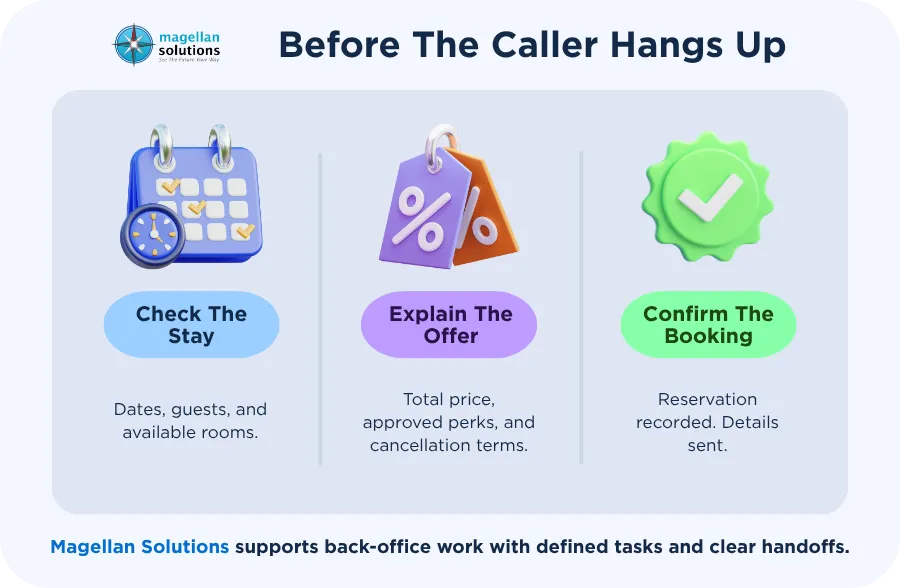
Before launch, test whether agents can:
- Check dates, occupancy, room types, and stay restrictions.
- Explain the price, mandatory charges, deposits, and cancellation terms.
- Record the reservation through the approved process.
- Send confirmation and document arrival instructions.
Agree on fallback steps for outages or any system restrictions during the daily audit. Agents must know when they can confirm a booking and when property approval is still required.
Answer “Expedia Is Cheaper” With A Clear Comparison
Start by checking whether the caller is comparing the same stay. Dates, occupancy, room type, refund terms, and included benefits can affect the price.
Check The Details
“Let’s compare the same stay. Are those the same dates and room type? Does that offer include free cancellation?”
Keep the conversation helpful. The caller is giving your hotel an opportunity to explain its offer.
Explain An Approved Direct Benefit
“Our direct offer for those dates includes a parking credit. Let me confirm the total price and cancellation terms so you can compare both options.”
Use this only when the benefit is authorized and available.
Be Honest About Price-Matching Authority
“I can confirm our available direct offer, but I don’t have approval to match that price. Here’s what our offer includes.”
An accurate answer is better than repeated holds or a discount the hotel has not approved. Avoid claims that an OTA booking will receive worse treatment.
Set The Rules For Direct Perks Before Offering Them
A parking credit, early check-in, or fee waiver needs review against the hotel’s OTA agreements. Rate-parity provisions may cover rates, conditions, and benefits. Making an offer by telephone does not automatically place it outside those terms.
Have the revenue lead and legal reviewer approve each offer, its eligibility rules, and the wording agents use.
Parking credits need a defined amount and clear recording instructions. Confirm how the offer fits the hotel’s distribution agreements.
Complimentary early check-in should be guaranteed only when the hotel authorizes it and can deliver it. Otherwise, describe it as subject to availability.
Resort-fee waivers change the price paid. Confirm approval authority, contractual implications, and how the revised total appears in the booking.
FTC guidance requires lodging offers to disclose total prices, including mandatory fees, with specified exclusions such as government charges. Agents should use approved wording and clearly explain the final payment amount.
Calculate Commission Costs Using Your Agreement
If your property’s contracted commission falls between 18% and 25%, use that range in its cost analysis. Expedia states that compensation varies and is disclosed during contracting.
For an illustrative commissionable booking value of $400, that represents 72–100 in commission. Apply the correct commission base from your agreement.
Compare that cost with call coverage, payment processing, and any direct-booking benefit. A completed phone booking alone does not establish that the service recovered an otherwise lost sale, so review booking outcomes alongside costs.
Set Overflow Rules That Keep Callers Moving
For an initial operating rule, trigger reservation overflow after 15 seconds of unanswered ringing. Test the actual elapsed time. “Three rings” is an approximation because telephone systems use different ring patterns.
During predictable check-in surges, routing reservation calls directly to the outside team may give the desk more room to help arriving guests.
Use 3–5% abandonment as a starting management target, then evaluate it against caller behavior and service results. ICMI cautions against treating abandonment as a rigid standard because it is partly driven by caller behavior.
Abandonment Rate = Calls Disconnected Before Answer ÷ Calls Offered To The Measured Queue × 100
Define short-call exclusions consistently. Measure the experience across transfers so overflow does not move callers into another unanswered queue.
Give Evening Reservation Calls Their Own Coverage
Bring Magellan Solutions the hours when calls compete with arrivals, audit work, and overnight guest needs. Include the questions callers ask and the booking steps agents would need to complete.
Discuss Your Hotel’s After-Hours Reservations to review coverage, system access, approved offers, and the decisions that should remain with your property team.
Frequently Asked Questions About After-Hours Hotel Reservations
Does A Small Hotel Need Coverage All Night?
Review when reservation inquiries arrive and when staff cannot complete them. Evening overflow may be enough. Overnight coverage is worth considering when demand continues beyond those hours.
Can Outside Agents Handle Urgent Guest Problems?
They can follow the hotel’s approved routing process, but on-property problems need a reliable path to staff who can act. Keep urgent guest assistance clearly separated from reservation inquiries.
What Should The Morning Shift Receive?
Confirmed bookings, arrival instructions, unresolved inquiries, and requests needing action. Each open item should have an owner and enough detail to continue the conversation.
Keep The Desk Available And The Booking Moving
A guest locked out of a room needs the night clerk. A traveler choosing accommodation needs someone who can answer questions and complete the reservation.
Effective evening coverage gives each request a clear owner. On-site staff handle the property while reservation agents work within approved systems, prices, and authority.
Review the arrangement by what happens before the call ends: accurate bookings, clear confirmations, and fewer unresolved inquiries waiting for the morning shift.