


Nobody launches an enterprise just to spend late Friday evenings cross-referencing invoice numbers against bank statements. Yet, securing administrative support outsourcing solutions is usually the turning point when an organization moves past the survival stage. Specifically, rapid sales expansion always brings an avalanche of clerical friction. Customer files get misplaced, accounts payable stall, and purchase orders pile up across unread inboxes. Therefore, adopting reliable back-office outsourcing for small businesses gives management the operational runway to manage higher sales volumes without taking on costly payroll obligations.
Still, handing off operational workflows requires structured preparation. Administrative tasks represent the operational engine of your company. Consequently, when billing entries or CRM records get mismanaged, your entire delivery pipeline suffers. Because of this reality, business owners need an honest look at the day-to-day mechanics, measurable upsides, and genuine management trade-offs before delegating core operational work.
Why Administrative Overload Stalls Reliable Back-Office Operations
Early-stage companies thrive on informal collaboration and fast problem solving. In the initial months, founders and core team members pitch in to reconcile accounts, file regulatory paperwork, and enter client data. Naturally, this ad-hoc approach works well when transaction volume is low.
However, as client volume multiplies, administrative chores multiply just as quickly. Valuable team members hired for business development or product delivery find themselves buried under repetitive administrative routines. For instance, account executives waste mornings formatting status spreadsheets, and creative staff spend afternoons tracking missing vendor receipts. Furthermore, research from the Harvard Business Review confirms that administrative drag diminishes executive focus and weakens strategic execution across growing firms.
Because of these routine interruptions, core company growth stalls when your most talented employees act as full-time clerks. Customer onboarding drags out, invoices sit unpaid, and customer shipments get delayed. In short, this operational bottleneck creates costly internal drag that caps revenue potential.
Financial Administration, Invoicing, and Bookkeeping Support
Cash flow keeps small businesses solvent. When client invoices go out late, incoming cash flow dries up immediately.
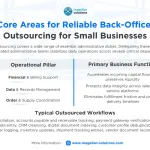
To solve this problem, dedicated administrative specialists handle daily invoice preparation, incoming payment tracking, and friendly payment reminders. In addition, they organize vendor receipts, track business expenses, and reconcile accounts. Consequently, this routine upkeep keeps financial books audit-ready and minimizes late payments from commercial accounts.
High-Accuracy Data Entry and CRM Record Management
Modern companies run on accurate business data. However, manually inputting contact details and sales notes is repetitive work that leads to costly errors when handled by rushed employees.
For this reason, specialized back-office teams systematically log customer records, digitize paper documents, and verify database fields. Similarly, they merge duplicate CRM profiles and update contact details. As a result, your sales and support representatives always have reliable data when communicating with clients.
Order Processing, Inventory Updates, and Document Indexing
Fulfilling commercial orders demands close coordination between client portals, warehouse inventories, and delivery carriers.
Accordingly, trained administrative specialists process purchase orders, log shipment tracking numbers, and update stock counts. When returns or address changes occur, administrative staff adjust records across every system. Indeed, this consistent coordination prevents fulfillment delays and protects delivery expectations.
Key Benefits of Reliable Back-Office Outsourcing for Small Businesses
Moving administrative burdens off internal staff to dedicated support specialists produces measurable operational improvements across your business.
Predictable Cost Control and Lower Operational Overhead
Hiring full-time administrative staff involves substantial overhead expenses. Beyond base salaries, employers must pay health benefits, payroll taxes, recruiting fees, office space, and specialized software seats.
In contrast, external providers operate on shared infrastructure and specialized staffing models. According to findings from the Deloitte Global Outsourcing Survey, cost reduction remains a primary objective, with organizations achieving up to 70% in operating expense savings through strategic outsourcing partnerships. Consequently, choosing reliable back-office outsourcing for small businesses allows companies to convert fixed payroll liabilities into flexible monthly operational expenses, preserving capital for product development and client acquisition.
Accelerated Turnaround Times and Continuous Productivity
Relying on a small internal team often creates administrative backlogs during peak sales seasons, holidays, or staff sick leave. Similarly, industry data from Clutch indicates that over 80% of small businesses plan to maintain or expand their outsourced services specifically to sustain operational agility and prevent capacity bottlenecks.
Fortunately, established outsourcing providers maintain structured staffing redundancies and multi-shift operations. Administrative tasks submitted at the close of your local business day can be processed overnight by overseas specialists. Therefore, your daytime team arrives to clean inboxes, updated records, and reconciled spreadsheets every morning.
Measurable Impact on Prospects and Customer Retention
Administrative bottlenecks do not merely slow internal workflows; rather, they directly damage client relationships and sales pipeline velocity. When sales professionals are bogged down by clerical data entry and contract generation, response times to incoming prospective clients lag. In fact, industry studies demonstrate that reaching out to prospective leads within the first hour increases qualification rates by up to 21%.
Furthermore, existing customer retention hinges on operational precision. In particular, billing discrepancies, misfiled customer preferences, and shipping documentation errors account for widespread customer frustration and churn. By deploying dedicated administrative support to maintain zero-defect database integrity and prompt order execution, small businesses deliver seamless service experiences that protect long-term account value.
Restoring Leadership Focus on Strategic Revenue Growth
Small business founders and senior managers must spend their limited time on high-impact initiatives. Hence, every hour devoted to reconciling invoices or auditing customer spreadsheets is an hour lost to business development.
Delegating administrative routines removes operational clutter from leadership schedules. As an illustration, executives regain the headspace needed to nurture enterprise clients, refine product features, and pursue market partnerships. Ultimately, total company velocity accelerates.
Operational Trade-Offs in External Administrative Support
While the financial and productivity advantages are compelling, external operational management requires deliberate preparation and ongoing supervision.
Creating Detailed Standard Operating Procedures (SOPs)
Internal employees often execute tasks using intuitive, unwritten context. For example, they understand subtle client preferences and know how to resolve minor system glitches through trial and error.
Conversely, external administrative teams depend entirely on structured documentation. If your internal workflows lack detailed, step-by-step guidance, external agents will pause workflows or introduce inconsistencies. Therefore, small businesses must invest early effort into building comprehensive process maps, video walkthroughs, and quality checklists.
Quality Control and Error-Rate Governance
Administrative work demands steady precision. Naturally, repeated errors in billing, shipping records, or customer databases quickly disrupt downstream operations and irritate clients.
To mitigate this risk, operators must institute structured quality assurance workflows. Conducting regular sample audits, setting accuracy benchmarks, and maintaining open feedback channels ensures that external teams deliver consistent output over time.
Data Security and Access Privileges
Sharing corporate files, financial books, and client contact details with external personnel introduces understandable security considerations.
Because of these concerns, businesses must enforce role-based access control (RBAC) and strict least-privilege policies. External assistants should access only the specific spreadsheets, software modules, or database records necessary to execute their daily tasks. Furthermore, leadership must verify that service providers adhere to verified data privacy protocols and maintain secure network environments.
Evaluating Reliable Back-Office Outsourcing for Small Businesses: In-House vs. Partner
To determine the ideal staffing approach for your current operational volume, evaluate your needs against these structural trade-offs:
| Operational Dimension | In-House Administrative Staff | Outsourced Back-Office Partner |
|---|---|---|
| Direct Expense Model | High fixed overhead (salaries, taxes, benefits) | Predictable, flexible monthly operational spend |
| Scalability | Slow (requires recruiting, onboarding, training) | Agile (headcount scales up or down on demand) |
| Operational Coverage | Restricted to local 9-to-5 business hours | Multi-shift, overnight, and continuous options |
| Process Dependency | Often informal, reliant on tribal knowledge | Structured, disciplined, reliant on written SOPs |
| Executive Headspace | Divided by daily clerical firefighting | Protected, allowing focus on strategic expansion |
Practical Checklist Before Handing Off Back-Office Workflows
Never transfer company administrative tasks to an external team without laying proper operational groundwork. Execute these four foundational steps to maximize your return on reliable back-office outsourcing for small businesses:
- Map Your Most Repetitive Daily Workflows: First, identify the top three to five administrative tasks that consume the most internal hours each week. Next, document the software tools used, step-by-step actions required, and expected output formats.
- Establish Clear Turnaround and Accuracy Benchmarks: Define unambiguous Service Level Agreements (SLAs). Specifically, set explicit standards for document processing times, invoice reconciliation speed, and acceptable error thresholds. Comprehensive research from Gartner highlights that well-defined SLA metrics form the bedrock of successful business process outsourcing partnerships.
- Configure Role-Based Tool Permissions: In addition, set up dedicated user logins with restricted administrative privileges. Restrict access to master bank accounts, confidential customer data, and high-level company configuration menus.
- Schedule Regular Weekly Review Cadences: Finally, establish a structured communication rhythm with your account supervisor during the first ninety days. Regular feedback meetings help identify process bottlenecks early and fine-tune team performance.
Scaling Your Operations with Magellan Solutions
You should never let administrative backlogs cap your business growth or exhaust your core staff. When paperwork, data entry, and record management begin pulling your team away from serving clients, partnering with an experienced outsourcing specialist is the most practical solution.
This is where Magellan Solutions delivers measurable operational support. With over a decade of proven experience providing comprehensive BPO and back-office services to growing enterprises, Magellan Solutions builds customized administrative teams aligned directly with your unique workflows. Their services provide:
- Trained Administrative Specialists: Dedicated professionals skilled in data processing, accounting support, document indexing, and CRM management.
- Flexible Scaling Capacity: Agile staffing arrangements that scale smoothly alongside seasonal surges, customer expansions, or operational transitions.
- Rigorous Security Standards: ISO-certified and HIPAA-compliant operating environments engineered to protect sensitive corporate documentation and proprietary workflows.
- Seamless Process Integration: Teams trained to work directly inside your existing software stack, including QuickBooks, Salesforce, Google Workspace, and Microsoft 365.
Eliminate administrative bottlenecks and empower your key employees to focus on driving revenue. If your company is seeking reliable back-office outsourcing for small businesses, contact us to inquire about our services and discover how our administrative solutions can support your company’s long-term momentum.
Frequently Asked Questions
What types of back-office tasks can small businesses safely outsource?
Small businesses can outsource a wide range of structured, rules-based administrative duties. Common delegated functions include invoice creation, accounts payable tracking, invoice reconciliation, data entry, CRM contact updating, document transcription, and order processing. As long as a workflow has clear rules and standardized documentation, an external team can manage it efficiently.
How does an external administrative team access our internal software tools?
External administrative teams connect to your business applications using individual, authenticated credentials provided by your organization. They work directly inside your cloud-based tools, such as your accounting platform, CRM, or document drive, through secure virtual private networks (VPNs). This setup ensures all updates occur directly within your systems without manual data transfers.
How long does it take to onboard an outsourced back-office team?
Onboarding timelines typically range from two to four weeks depending on workflow complexity. During this period, the provider reviews your standard operating procedures, configures user permissions, trains designated specialists, and conducts initial test runs. Once accuracy benchmarks are consistently met, the team begins handling live daily administrative tasks.