


There is one call every immigration attorney dreads missing. A family member reaches out in total distress, speaking quickly in Spanish, trying to explain that their loved one was taken into custody earlier that day. They don’t know which facility the person was taken to; they don’t understand what papers were signed, and they don’t know what to do next.
In those first hours, panic runs high. When someone in crisis reaches an impersonal automated beep and an English voicemail greeting, they almost never leave a message. They hang up and call the next firm on their screen until a real person answers. Having responsive immigration client intake support is what stands between helping a vulnerable family and losing an urgent case to another firm.
A professional immigration law firm answering service ensures your practice never goes dark. By putting trained, bilingual intake specialists on your lines, you can calm frightened callers and gather the exact details attorneys need to act.
The 5 Calls Immigration Firms Receive Every Day
Immigration offices handle much more than planned desk consultations. Phone lines take in a wide mix of inquiries across different hours, time zones, and stress levels:
- Detention Emergencies: Distressed family members calling immediately after an enforcement stop, transfer, or workplace action.
- Court Notice and Hearing Calls: Potential clients who just received a Notice to Appear (NTA) and have an upcoming hearing date.
- Existing Client Updates: Current clients checking on pending petitions, work permits, or green card applications.
- Overseas Callers: Family members or sponsors calling from different countries across opposite time zones.
- Business Inquiries: Employers and HR managers seeking help with work visas and workplace immigration rules.
Intake Overview: Call Types and Routing
| Call Type | Who Is Calling | Key Information to Capture | Routing Priority |
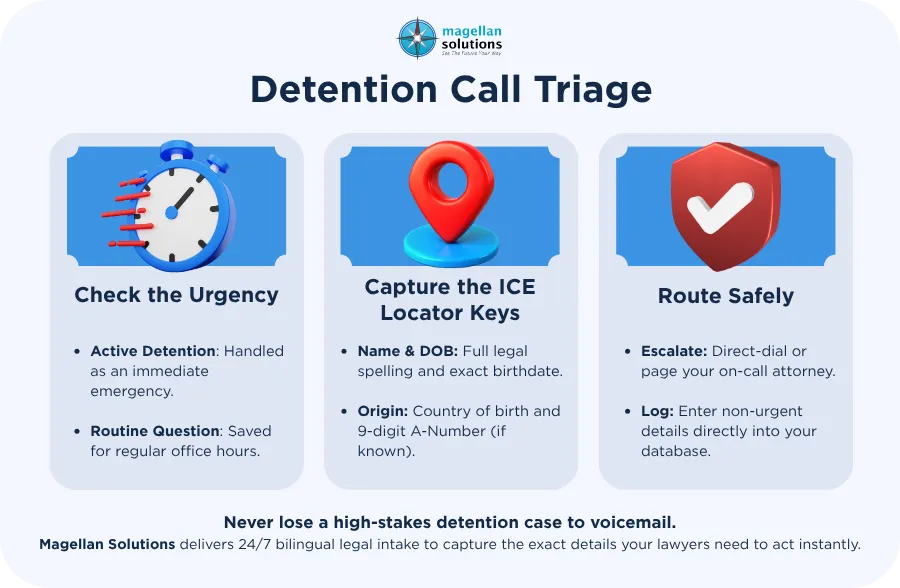
| Detention Emergency | Family member or sponsor | Full legal name, DOB, country of birth, A-Number, arrest location | Urgent: Route to on-call attorney |
| Court Notice / NTA | Prospective client | Notice type, hearing date, assigned immigration court | High: Same-day business callback |
| Case Status Update | Existing client | Full name, receipt number, primary handling attorney | Standard: Log in firm CRM for office hours |
| International Call | Overseas family or sponsor | Country, local time zone, preferred contact platform | Standard: Schedule during office hours |
| Employer Inquiry | HR manager / Business owner | Company name, employee name, visa category (e.g., H-1B, L-1) | Normal: Route to business immigration team |
What to Capture on a Detention Call (The ICE Locator Essentials)
When a person is taken into custody, an attorney cannot file paperwork, request a bond hearing, or visit the facility until they locate where the client is being held.
Immigration and Customs Enforcement (ICE) operates the Online Detainee Locator System (locator.ice.gov). The tool is available 24/7 and operates in Spanish and seven other languages. However, it is an exact-match system. If a name has a single spelling mistake, or if a maternal last name is left off, the system returns zero results.
To make sure your legal team finds the person on the first search, a trained immigration law firm answering service captures these exact facts:
- Full Legal Name: The person’s complete name as it appears on birth certificates or identity cards, including both maternal and paternal surnames.
- Alien Registration Number (A-Number): The unique nine-digit number assigned to noncitizens. If the family has paperwork showing this number, locating the person takes only seconds.
- Date of Birth: The exact day, month, and year.
- Country of Birth: The detainee’s home country of citizenship.
- Arrest Details: The city, state, approximate time, and arresting agency (local police, Border Patrol, or ICE).
- Caller Contact Information: The caller’s full name, direct phone number, and relationship to the detainee.
Gathering these details right away prevents hours of back-and-forth phone tag the following morning.
Language Realities: Why Bilingual Intake Matters
Language barriers are often the main reason prospective clients hang up without leaving a message.
According to the U.S. Census Bureau, Spanish is the most common language other than English spoken at home in the United States, used by 61.1% of people who speak a non-English language at home.
When a family member calls an attorney during a crisis, they are under immense stress. Trying to explain complex legal troubles in a second language only creates more panic. If an answering agent only speaks English, the caller will assume the firm cannot help. A dedicated immigration law firm answering service provides fluent Spanish-speaking agents who calm callers, capture accurate spellings, and deliver clear English intake notes to your desk.
Handling Fear and Building Trust Safely
Callers asking about a detained relative are often terrified that sharing names or addresses might put other undocumented family members at risk.
Answering the phone under your firm’s name reassures callers that they have reached a safe, confidential legal office. Intake agents must listen patiently without sounding like investigators or aggressively demanding answers.
What an Answering Service Must NEVER Do
While intake agents play an essential administrative role, they are not lawyers. To protect your practice, agents must stay within strict boundaries:
- Never give legal advice: Agents must never tell callers whether a relative should sign voluntary departure forms or speak with enforcement officers.
- Never interpret legal notices: Agents must not explain what a court document or NTA means.
- Never guess at outcomes: Agents must never promise that a judge will grant bond, predict release times, or estimate bond costs.
An answering service exists strictly to gather facts so your attorneys can provide legal counsel.
Setting Up Urgent Escalation Protocols
Your legal team should not be disturbed in the middle of the night for routine questions. A current client asking about an address change can easily wait until regular business hours.
To keep your attorneys from burning out while protecting urgent cases, establish clear escalation rules in advance with your immigration law firm answering service:
- Urgent Detention Alert: If a caller confirms a relative was taken into custody within the past 24 hours and provides basic locator details, the service immediately notifies your on-call attorney by phone or priority message.
- Standard Intake Log: Calls concerning general consultation bookings or non-urgent document updates are logged into your legal management software for regular office hours.
Protect Your Practice and Never Miss a Critical Intake
Relying on in-house staff to answer phones around the clock leads to rapid burnout and inconsistent coverage. Relying on basic voicemail means losing urgent, high-value cases to competing firms that answer right away.
Magellan Solutions provides dedicated, 24/7 bilingual answering services tailored specifically for immigration attorneys. Our trained agents handle emotional callers with care, accurately collect ICE locator details, and follow your firm’s custom escalation rules to ensure emergencies reach your team instantly.
Ready to streamline your intake and safeguard your practice from missed calls? Schedule a consultation today to set up a customized intake workflow for your firm.
Frequently Asked Questions About Immigration Answering Services
What information is required to find someone in ICE detention?
You need the person’s full legal name, date of birth, and country of birth. If available, their nine-digit Alien Registration Number (A-Number) makes the search significantly faster.
Can an answering service give legal advice during a detention call?
No. Answering agents can only collect factual information. They must never advise callers on whether to sign paperwork, speak to officers, or predict bond amounts.
How does an answering service know when to contact an on-call attorney?
Calls are routed based on written criteria established by your firm. Urgent situations, like a confirmed detention within the last 24 hours, trigger immediate attorney contact, while routine questions are saved for business hours.
Key Takeaways
- Detention intake requires exact data: Locating a client through ICE’s online tool requires their full legal name, date of birth, country of citizenship, and A-Number if available.
- Spanish-language intake prevents lost cases: Most emergency detention calls come from Spanish-speaking households; bilingual answering helps keep families on the line.
- Agents collect facts, not legal advice: Answering staff must remain calm and supportive while strictly avoiding legal guidance or case predictions.
- Custom escalation rules protect attorney time: Pre-set guidelines ensure on-call attorneys are only notified for active, time-sensitive emergencies.