

The claim finally clears. The insurance pays out, leaving the patient balance sitting right there on your ledger.
The visit is still fresh in the patient’s mind, the bill is recognizable, and that remaining self-pay balance is still just a simple, helpful customer service conversation. But the longer that balance sits untouched, the harder it gets to resolve. Momentum dies, accounts age, and what should have been an easy payment conversation turns into an uncollectible loss.
Just as law practices streamline administrative workflows through specialized law firm data entry outsourcing, healthcare providers must protect their teams from non-clinical overhead. If you manage a hospital, physician group, or ambulatory surgery center, keeping every routine balance follow-up in-house drains your staff.
What is Early-Out Patient-Access Outsourcing?
Early-out outsourcing is first-party outreach operating directly under your facility’s name. Instead of waiting until an account goes completely cold and shipping it off to a third-party bad-debt collection agency, an early-out partner acts as a smooth extension of your internal business office.
They step in right after insurance pays their part, while the patient relationship is still fresh and positive.
Early-Out vs. Bad-Debt Collections
| Feature | Early-Out Program | Bad-Debt Collections |
| Who the Patient Thinks They Are Talking To | Your facility’s internal business office team | A separate, third-party debt collection agency |
| Tone of Conversation | Helpful, customer-service oriented, and supportive | Firm, transactional, and recovery-focused |
| Account Status | Active accounts with recent balance updates | Delinquent, written-off accounts |
| Patient Relationship | Protected and nurtured for future care | Frequently strained or permanently damaged |
What Does an Early-Out Program Actually Do?
An experienced outsourced team handles the heavy lifting of routine self-pay balances so your internal staff can focus on complex clinical operations. Their core daily work includes:
- Statement Follow-Up: Timely, patient-friendly check-ins so medical bills do not get forgotten in a pile of mail.
- Flexible Payment Plans: Setting up structured, manageable monthly payments strictly within your facility’s approved rules.
- Financial Assistance Routing: Spotting patients who qualify for charity care or financial aid early and guiding them through the application.
- Insurance Discovery: Running deep checks to find missed secondary coverage or primary insurance details that were overlooked during registration.
The Financial Assistance and Compliance Reality
For nonprofit hospitals, compliance is mandatory. Under Section 501(r) of the IRS code, tax-exempt hospitals must maintain a clear Financial Assistance Policy and make reasonable efforts to determine if a patient qualifies for aid before taking any extraordinary collection actions.
When bad records or missed insurance details go uncorrected, costs add up fast. Poor data quality costs organizations at least $12.9 million per year on average, according to research, and in healthcare, those errors leave valid claims unpaid and eligible patients without aid. Routing likely-eligible patients into financial assistance early protects your facility’s nonprofit status, prevents unnecessary debt, and keeps you fully compliant with federal rules.
What to Keep In-House vs. What to Delegate
| Function | Keep In-House | Delegate to Early-Out Partner |
| Patient Outreach & Support | Complex dispute resolutions & hardship appeals | Routine statement check-ins & basic payment plans |
| Data Clean-Up & Review | Final account write-off decisions | Insurance discovery & legacy records clean-up |
| Compliance Setup | Setting facility payment terms & charity policies | Carrying out daily outreach using your facility’s name |
When an account reaches the end of its early-out timeframe without resolution, your internal leadership team decides whether to send it to traditional bad-debt collections.
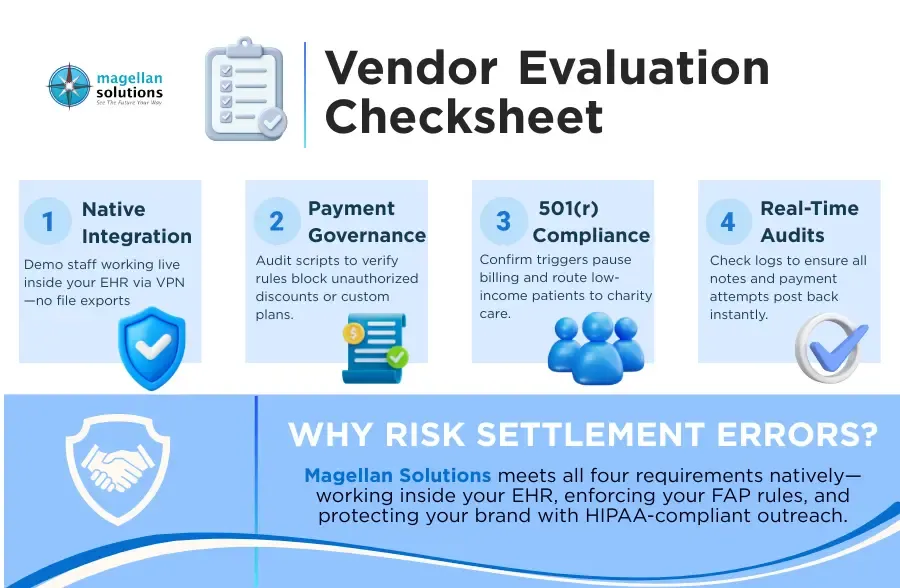
Ready to Clear Your Patient Balances?
Stop letting routine self-pay accounts overwhelm your business office. Partnering with Magellan Solutions gives your team a seamless, first-party extension that protects patient relationships while keeping revenue moving.
Visit our contact page to connect with our healthcare business office specialists today.
Frequently Asked Questions About Early-Out Patient Billing
1. What is an early-out program in healthcare billing?
An early-out program is a first-party service in which an outside team contacts patients under your hospital or clinic’s name to help them resolve self-pay balances shortly after care.
2. How does early-out differ from traditional debt collections?
Early-out acts as a friendly customer-service extension of your office for recent bills. Traditional collections step in much later for defaulted debt using a firmer, recovery-focused approach.
3. Will patients know an outside company is contacting them?
No. Early-out representatives speak and write in your facility’s name, following your customer service standards so patients feel they are working directly with your office.
4. What happens if a patient cannot afford to pay their bill?
The early-out team identifies patients who may qualify for financial aid or charity care and routes them into your approved application process before any further billing happens.
5. Why is IRS Section 501(r) important for nonprofit hospital billing?
Section 501(r) requires nonprofit hospitals to make reasonable efforts to determine whether a patient qualifies for financial assistance before pursuing aggressive collection actions. Early-out programs help complete these checks early.
6. Does your facility lose control of the billing process?
Not at all. You set the payment terms, discount rules, and financial assistance guidelines. Your team also retains full authority over which accounts move to bad-debt collections.
7. How does early-out software integration work?
A qualified partner works directly inside your existing patient accounting system, making real-time updates so your internal team always sees complete account notes and payment history.
Key Takeaways
- Act While Fresh: Self-pay balances are easiest to collect right after insurance pays, while the doctor visit is still fresh in the patient’s mind.
- Protect Patient Loyalty: Early-out outreach works under your facility’s name as a helpful service team, keeping patient trust intact.
- Automate Routine Work: Offloading basic payment plans, statement follow-ups, and insurance checks frees your in-house staff to focus on complex billing tasks.
- Stay 501(r) Compliant: Screening patients early for financial aid protects nonprofit hospital tax status and prevents improper collection steps.
- Retain Full Ownership: Your facility sets all payment rules and maintains final approval over any account sent to bad-debt collections.