


Legal teams deal with large volumes of recorded information every day. A legal transcription service turns that raw audio into structured, searchable documents that support case preparation and compliance. In practice, this means faster access to facts, clearer records, and fewer delays when building legal arguments.
For Australian law firms and solicitors, outsourced legal transcription services play a direct role in keeping case files organized. They turn what is said in client conferences, witness interviews, tribunal hearings and matter meetings into written records your team can review, reference, and share with confidence.
How Legal Transcription Service Supports Organized Case Documentation
A legal transcription service creates a bridge between spoken proceedings and written legal records. This connection improves how legal teams manage information across multiple cases.
Key outcomes for legal teams
- Clear documentation: Every spoken detail is captured in a readable format
- Searchable records: Lawyers can locate specific statements without replaying hours of audio
- Consistent formatting: Case files follow a uniform structure across the firm
- Stronger case preparation: Accurate transcripts support evidence review and legal arguments
When these elements come together, legal document transcription reduces time spent on manual note-taking and improves the overall flow of legal work.
What Makes Legal Document Transcription Essential in Australian Legal Workflows
Australian law firms operate under strict documentation and compliance requirements. A legal transcription service helps meet these expectations by delivering precise and complete records.
Common use cases
- Tribunal and hearing audio
Recordings your firm holds from tribunals, mediations and hearings, transcribed for your own preparation and review. - Client conferences and conferences with counsel
Transcripts keep an exact record of instructions and advice that the file can refer back to. - Witness interviews and proofs of evidence
A transcript your team can draft the proof or affidavit from, without replaying the audio. - Internal case discussions
Teams rely on transcripts to align strategies and track decisions.
Each of these benefits from reliable transcription, especially across several matters at once. These are working transcripts for your team. A court’s official transcript comes from the provider that court appoints.
How Searchable Transcripts Improve Workflow Efficiency
Modern legal operations rely on systems that are easy to search, categorize, and reuse. A well-structured legal transcription service supports these needs by producing documents that integrate with digital tools and case management platforms.
Why structure matters for case management systems
- Keyword recognition: Transcripts allow systems to identify key legal terms quickly
- Context mapping: Related concepts are easier to connect across documents
- Data retrieval: Organized text improves search accuracy in legal databases
- Workflow automation: Structured content supports tagging and indexing
For example, when transcripts include consistent terminology and formatting, legal software can group related cases or highlight relevant sections faster. This is where legal document transcription adds measurable value.
How much does a transcription service cost?
The cost of a legal transcription service depends on several practical factors. Legal agencies usually evaluate pricing based on workload and urgency.
Main pricing factors
- Audio length: Most providers charge per audio minute
- Complexity: Multiple speakers or unclear audio increase effort
- Turnaround time: Faster delivery often comes at a higher rate
- Formatting needs: Detailed structuring or timestamps can affect pricing
Typical cost breakdown
| Factor | Impact on Cost | Example Scenario |
|---|---|---|
| Short audio files | Lower total cost | Single client interview |
| High-volume projects | Discounted rates possible | Ongoing case documentation |
| Urgent requests | Higher pricing tier | Same-day court transcript delivery |
| Complex recordings | Increased cost per minute | Multi-speaker deposition with legal terms |
In most cases, pricing ranges from $1 to $5 per audio minute. For firms handling regular transcription needs, outsourcing legal document transcription often leads to better cost control compared to building an internal team.
Choosing a Legal Transcription Service That Aligns With Your Workflow
Selecting the right provider goes beyond basic transcription. Legal agencies need a legal transcription service that fits into their existing processes and scales with demand.
What to look for
- Legal expertise: Familiarity with legal terminology and formats
- Data security: Secure handling of confidential case information
- Scalability: Ability to manage increasing transcription volumes
- Quality checks: Review systems that ensure accuracy
- Privacy Act accountability: A contract that covers how the provider handles personal information, because under APP 8 that’s where your firm’s protection sits
Quick comparison
| Feature | Basic Transcription Provider | Legal Transcription Service |
|---|---|---|
| Legal terminology accuracy | Limited | High |
| Confidentiality standards | General | Strict |
| Formatting consistency | Variable | Structured |
| Scalability | Limited capacity | Multi-team support |
A specialized legal transcription service provides the level of precision and reliability required in legal environments.
Benefits of Outsourcing Legal Document Transcription
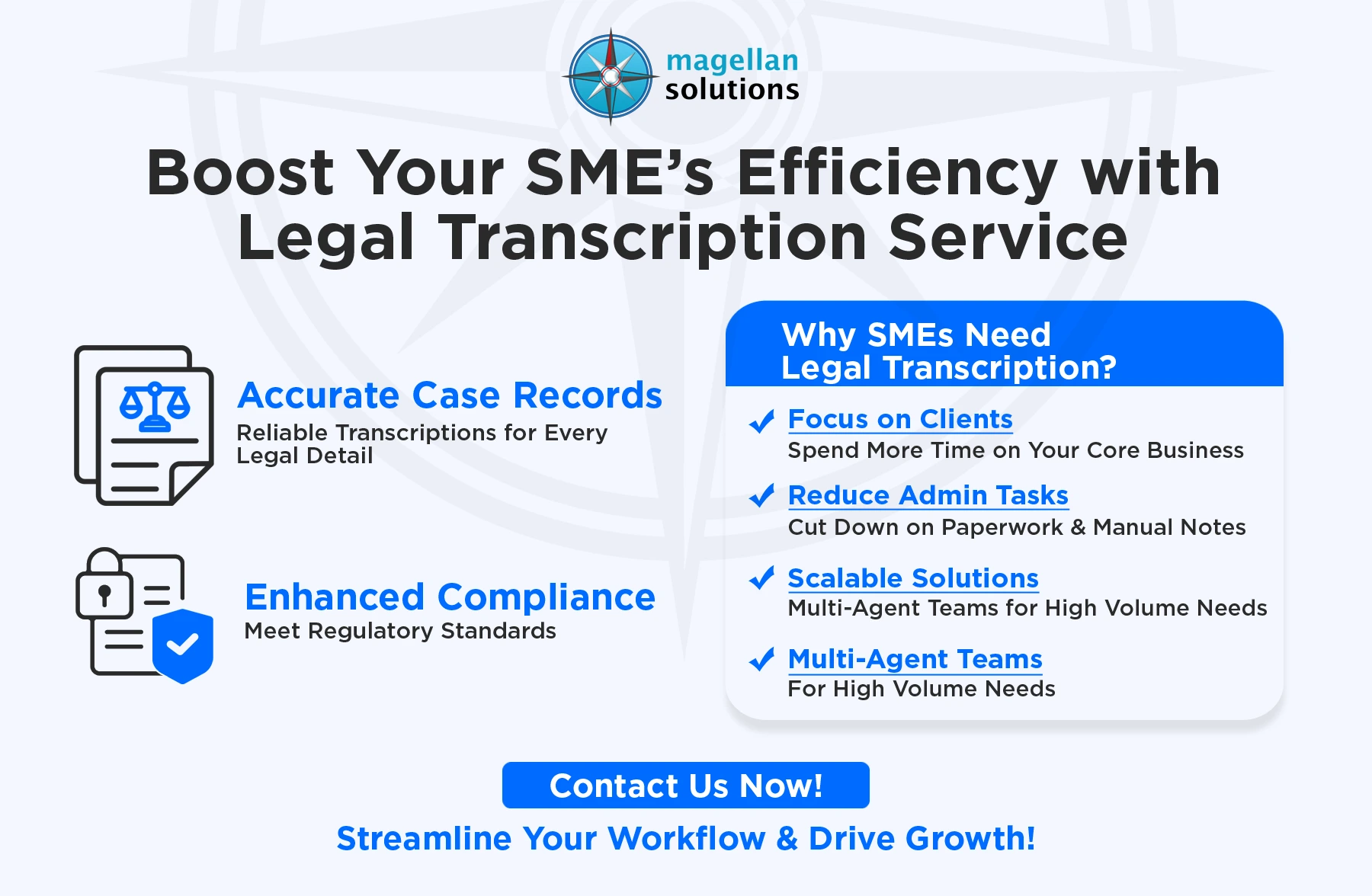
Outsourcing legal transcription service functions allows legal teams to focus on higher-value tasks. It also introduces operational flexibility that internal teams may struggle to maintain.
Practical advantages
- Time savings: Lawyers spend more time on legal strategy instead of documentation
- Operational efficiency: Transcription workloads are handled externally
- Consistent output: Dedicated teams maintain uniform quality
- Flexible capacity: Services scale based on case volume
These benefits make legal document transcription a practical solution for firms managing fluctuating workloads.
Working With an Australian Practice
Time zone. The Philippines keeps Perth time and is two to three hours behind Sydney, Melbourne and Brisbane, depending on daylight saving. Recordings sent from the east coast in the morning reach a team that’s already partway through its day.
Your conventions. Transcripts follow your firm’s format, with speakers named the way you refer to them, verbatim or clean verbatim as the matter needs, and timestamps where you want them.
The Privacy Act. Under APP 8, a firm that sends personal information offshore stays accountable for how the recipient handles it, and section 16C of the Privacy Act 1988 treats a breach by the overseas recipient as a breach by the firm itself. A provider’s privacy policy doesn’t discharge that; the contract does. Magellan contracts to the Australian Privacy Principles on Australian legal accounts.
Confidentiality. At Magellan, every staff member signs a confidentiality agreement, enforceable under Philippine law, before assignment, and access is limited to the team working your account. Magellan operates under ISO 27001, PCI-DSS, and GDPR compliance (see our certifications).
Where Transcription Stops
Legal typing and dictation. A solicitor dictating a letter, an affidavit or file notes is a different service. Outsourced legal typing turns dictation into a finished document.
Analysis. Summarizing an interview or pulling the issues out of a witness’s evidence is legal work, and it stays with your team.
For corporate and commercial practices, see legal transcription for Australian corporate law firms. For in-house teams across the Tasman, see legal transcription for NZ corporate legal departments.
Work With a Transcription Partner That Understands Legal Scale
Magellan Solutions delivers a legal transcription service designed for law firms and legal agencies that require accuracy, speed, and scalability. The service runs as a managed team, and every transcript is checked against the audio before it comes back, with inaudible passages marked rather than guessed.
Legal teams gain structured, reliable legal document transcription that integrates smoothly into existing workflows. This approach helps maintain organized case files while meeting tight deadlines.
Build Stronger Case Documentation Today
If your firm needs dependable transcription support, Magellan Solutions offers the capability and scale to handle complex legal requirements. See our legal transcription services to learn how outsourced transcription can keep your case documentation accurate and organized.