
The demand letter is an important source of leverage for litigation boutiques and solo practitioners. It is a strategic document that seeks a settlement and establishes a timeline. However, drafting a highly effective demand letter takes significant time and effort. It needs long hours of extensive factual extraction, chronological sorting, cross-referencing, and structural formatting. A lead attorney can’t afford to spend long hours creating the factual narrative of every single demand letter.
This is why forward-thinking law firms increasingly rely on legal drafting services. By integrating an outsourced drafting services model, firms create an assembly line of high-quality drafts without sacrificing legal integrity.
However, a fundamental operational and ethical question often stalls this transition: Where does the outsourcing partner’s work end, and where does the attorney’s absolute control begin?
To protect your practice, comply with ethical guidelines on a lawyer’s non-delegable duties, and maximize leverage in negotiations, you must establish a clear division of labor. Here is the definitive breakdown of what an outsourced drafting team prepares and what the attorney must decide, review, and sign.
The Division of Labor: Who Does What?
To scale a law firm effectively, the attorney-outsourced drafting team relationship must operate like a master-builder dynamic. The outsourced team operates as the high-precision mason, gathering, cutting, and arranging the stones. The attorney acts as the structural architect, determining the load-bearing requirements, validating the structure’s integrity, and placing their personal seal of approval on the final building.
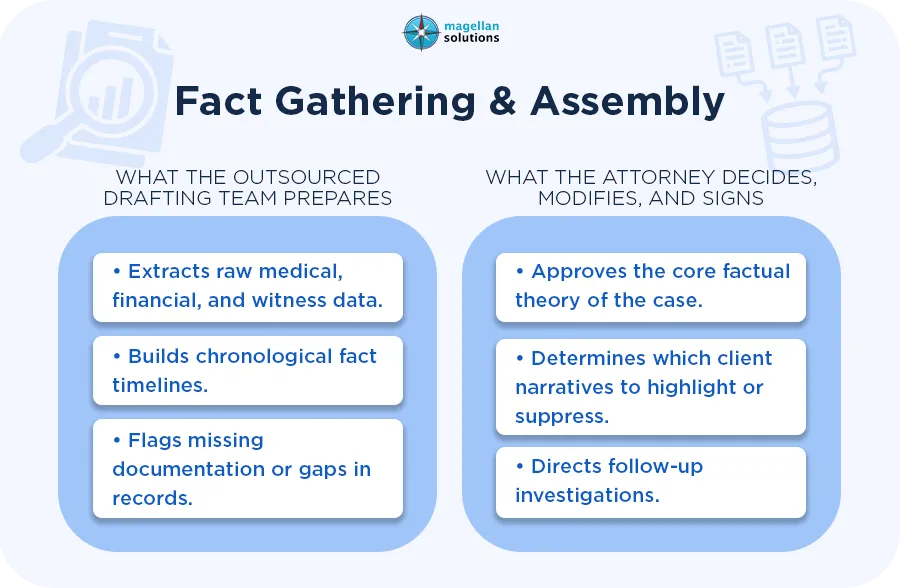
What the Outsourced Drafting Team Prepares
An outsourced drafting team composed of experienced legal analysts, paralegals, and document specialists handles the labor-intensive “heavy lifting” of the drafting process. Their focus is on operational accuracy, organization, and synthesis.
1. Chronological Case Timelines and Fact Extraction
A demand letter must be factually accurate. As a result, the outsourced team carefully analyzes the raw evidence before developing a legal argument. They analyze dates, medical diagnoses, and liability evidence from police reports, medical bills, insurance communications, and witness statements. They turn disorganized data into a clear, organized timeline that supports the demand letter’s narrative.
2. Comprehensive Special Damages Calculations
Calculating special damages is a tedious mathematical exercise. The outsourced team collects, categorizes, and totals all economic damages, including:
- Outstanding and paid medical bills.
- Projected future medical care costs based on lifecycles and treatment plans.
- Lost wages verified by employer documentation and tax records.
- Property damage estimates.
They create an organized, bulleted breakdown within the draft. This ensures that there is a referenced exhibit for every single dollar demanded.
3. Primary Legal Research and Statutory Frameworks
An outsourced drafting team can do foundational legal research. They know how to find relevant case law and determine the best statutory language for personal injury cases.
4. Exhibit Organization and Formatting
Insurance adjusters or opposing counsel will simply disregard a disorganized demand letter. The outsourced team ensures the professional presentation of a demand letter. They ensure that all supporting evidence is organized, paginated, and indexed.
What the Attorney Decides and Signs
An outsourced drafting team is unauthorized to practice law. Thus, an attorney has a professional responsibility to supervise all outsourced work and make strategic decisions actively.
1. The Strategic Legal Theory of the Case
The outsourced team can identify the facts, but only the attorney can decide the legal framing. The attorney must determine:
- Which specific causes of action will be asserted (and which will be held in reserve for a formal complaint).
- The primary target of the demand (for example, pursuing the individual tortfeasor, the employer under respondeat superior, or the insurance carrier directly).
- How to navigate potential comparative negligence issues.
2. The Final Settlement Figure (The “Ask”)
An outsourced team can calculate exact economic losses (special damages), but they cannot value non-economic losses. Evaluating pain and suffering, emotional distress, or loss of consortium is a subjective art form that requires deep legal experience. The attorney alone must analyze the case’s venue, the client’s credibility and jury verdict trends to calculate general damages and set the final strategic settlement demand.
3. The Tone, Rhetoric, and Strategic Nuance
A demand letter involves an exercise in persuasion. Thus, the attorney must adjust the tone of the demand letter depending on the strategic goals. The attorney decides if the demand letter should be collaborative and professional, or aggressive and uncompromising.
4. Ethical Responsibility and the Final Signature
A demand letter must have an attorney’s signature to validate the accuracy of all factual assertions and legal claims. The attorney assumes full legal and professional liability for the details in the demand letter.
Operational Scenarios: The Assembly Line in Action
To understand how this partnership works in real-world practice, let’s look at two common legal scenarios.
Scenario A: A Complex Personal Injury Case
- What the Outsourced Team Prepares: They read 800 pages of disorganized medical records. They build a treatment timeline showing the client’s visits to the ER, physical therapists, and orthopedists. They calculate the total medical expenses ($42,150) and draft the liability section using the police report’s description of the rear-end collision.
- What the Attorney Decides: The attorney analyzes the medical timeline and emphasizes the client’s pre-existing back injury. A decision is made regarding the framing of the “eggshell plaintiff” doctrine in the draft. The attorney computes the non-economic pain and suffering damages at 3x the medical specials. The attorney includes a 14-day response deadline and signs the letter.
Scenario B: A Breach of Contract Dispute
- What the Outsourced Team Prepares: They study the commercial contract and determine the particular termination and payment clauses. They identify the specific dates on which the defendant defaulted. They gather outstanding invoices, compute interest under the contract, and draft a formal demand for payment.
- What the Attorney Decides: The attorney analyzes the draft and realizes that a strict alternative dispute resolution (ADR) clause requires mediation before filing a lawsuit. The attorney edits the demand letter to specifically mention that the firm is ready to begin mediation right away if payment is not received. This ensures compliance with the contract’s procedural terms, and then signs the letter.
Practical Recommendations: Implementing Your Workflow
If you are ready to scale your firm’s output and free up hours of billable time, implement this systematic approach to outsourcing:
- Establish Standard Operating Procedures (SOPs): Produce clear templates for demand letters. There must be organized sections for liability, damages, and administrative boilerplate.
- Build a Secure Document Transfer System: A cloud-based folder can help the drafting team securely handle client intakes, medical records and incident reports. Ensure strict HIPAA compliance and robust encryption.
- Draft a Strategic Instruction Memo: Spend five minutes writing a short memo for the drafting team for each new case. The drafting team must be aware of the strategic theory of the case, relevant specific laws, and identified weak points.
- Schedule Dedicated Review Windows: Block 30 minutes on your calendar to review, refine, and sign the drafts your outsourcing team returns, turning what used to be a five-hour drafting task into a highly efficient review process.
Frequently Asked Questions (FAQ)
Does outsourcing the drafting of demand letters violate attorney-client privilege?
No, as long as you have proper safeguards in place. An outsourcing provider must sign a detailed Non-Disclosure Agreement (NDA). The outsourcing provider should also use secure, encrypted document management systems. The work-product doctrine and attorney-client privilege apply to agents the attorney hires to help represent the client, as long as the attorney actively supervises them.
How do state bar ethical rules view outsourced legal drafting?
All state bars allow the outsourcing of legal drafting, paralegal work, and legal research. However, the attorney must have active supervision of the outsourced work and will assume full responsibility for the final work product. The attorney must also exercise professional judgment and avoid the Unauthorized Practice of Law (UPL). Non-attorney staff must never provide legal advice to clients nor sign legal documents.
What is the typical turnaround time for an outsourced demand letter draft?
An outsourced drafting team typically produces an initial draft within 3 to 5 business days for typical personal injury or breach-of-contract issues. However, it may take longer for complex cases with many pages or records.