


This report was originally published in 2020. It has been completely rewritten and updated for June 2026 to reflect the latest market data, economic forecasts, revenue milestones, and AI integration trends shaping the BPO industry.
There is a strong expectation that the Philippine business process outsourcing (BPO) industry will continue to grow in 2026, even amid concerning economic and political uncertainties worldwide. Many executives in the Philippine BPO industry remain optimistic despite geopolitical tensions in the Middle East and the emergence of artificial intelligence technologies that are significantly impacting companies worldwide.
BPO Industry in the Philippines: 2026 Forecast of Statistics, Trends, and Growth Insights
Some of the key takeaways about the state of the Philippine BPO industry in 2026 include the following:
- Continued growth in revenue and employment, even amid concerning economic and political uncertainties worldwide
- Sustained artificial intelligence (AI) integration
- The projection that the Philippines will remain the contact center capital of the world
- Unstoppable rise and influence of global capacity centers
- Inevitable geographical diversification outside of Metro Manila and Cebu
- The push for the passage of the BPO Workers’ Welfare and Protection Act
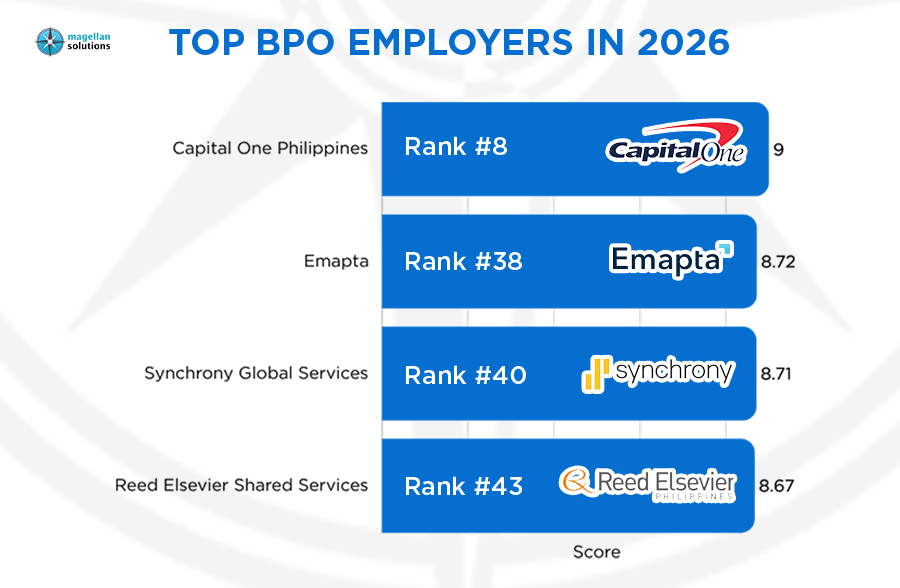
Top BPO Employers in 2026
The Philippine Daily Inquirer, in partnership with Statista, the world’s leading data and business intelligence portal, compiled a list of the Best Employers 2026. This list includes 300 companies and government agencies ranked by employees’ perceptions of their performance as employers. Thousands of employees rated their willingness to recommend their own employer directly to friends and family using a scale from 0 to 10, with 0 meaning “I wouldn’t recommend my employer under any circumstances” and 10 meaning “I would definitely recommend my employer.”
Significant Increase in Revenue and Employment
The Customer Xperience Association of the Philippines (CXAP) projects that the Philippine BPO industry will grow by 5.31% to $35.7 billion in 2026, from an estimated $33.9 billion in 2025 and $31.7 billion in 2024. The Philippine BPO industry currently contributes an estimated 8.5% of Gross Domestic Product (GDP) and around 16% of global market share.
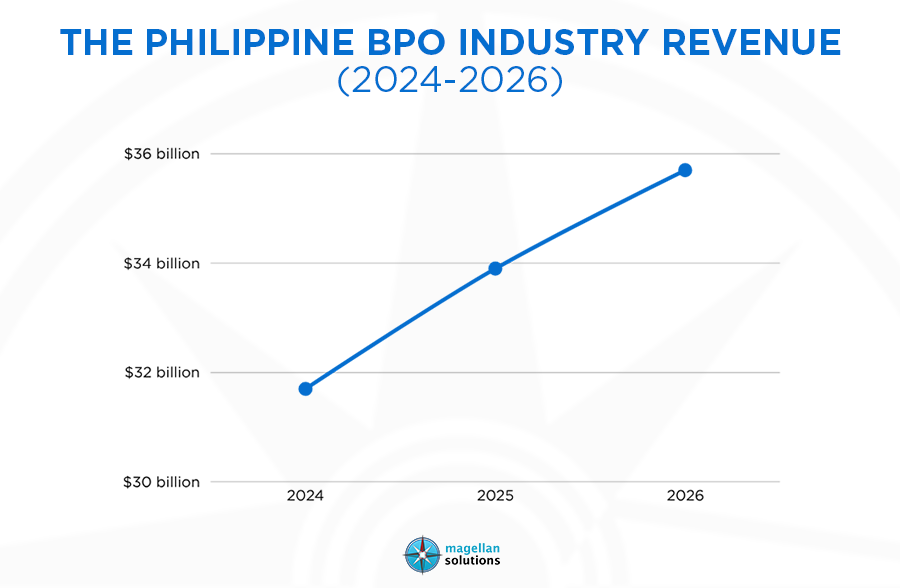
The Philippine BPO Industry Revenue (2024-2026)
In terms of employment, the Philippine BPO industry hired at least 60,000 workers in 2025, bringing total employment to 1.68 million full-time employees. In 2026, there is a strong possibility that employment in the Philippine BPO industry will increase further to 1.97 million, making it the world’s largest customer experience workforce. According to the Philippine IT-BPM Industry Roadmap, the goal is to increase the number of full-time employees to 2.5 million by 2028. This expansion in employment reflects the industry’s successful adjustment towards better customer experience and artificial intelligence (AI)-assisted operations. In short, the Philippine BPO industry is well-positioned to achieve sustained growth as AI improves service delivery worldwide.
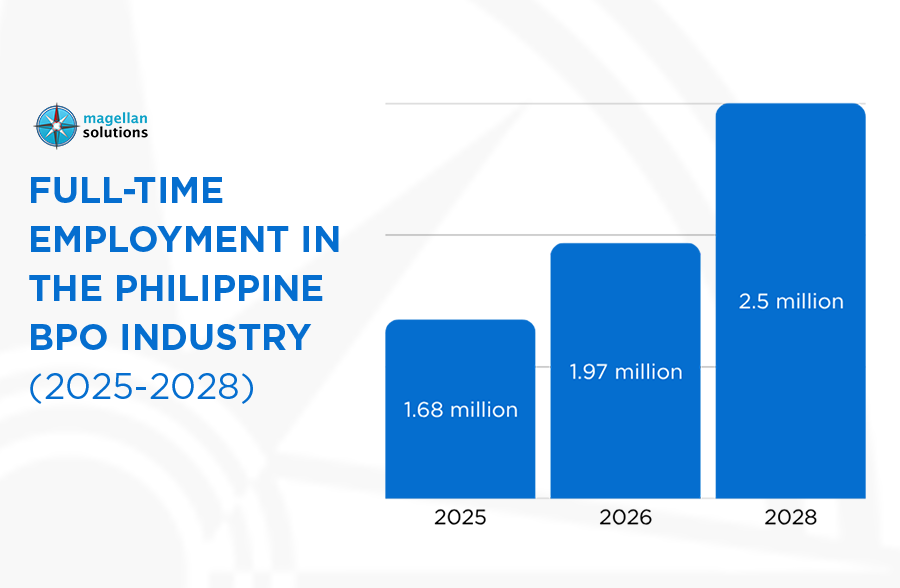
Full-Time Employment in the Philippine BPO Industry (2025-2028)
Artificial Intelligence (AI) Integration
The goal of integrating AI into the Philippine BPO industry is not to replace employees. Instead, AI is a tool that improves productivity and facilitates specialized services. According to CXAP’s 2026 Executive Survey, 52% of BPO companies in the Philippines are integrating AI technologies, while 43% are scaling AI integration across operations. There is no doubt that the Philippine BPO industry is beginning to transition from merely transactional services to analytics-enabled, data-driven, and GenAI-supported workflows. Data blending has become a common approach for producing accurate insights.
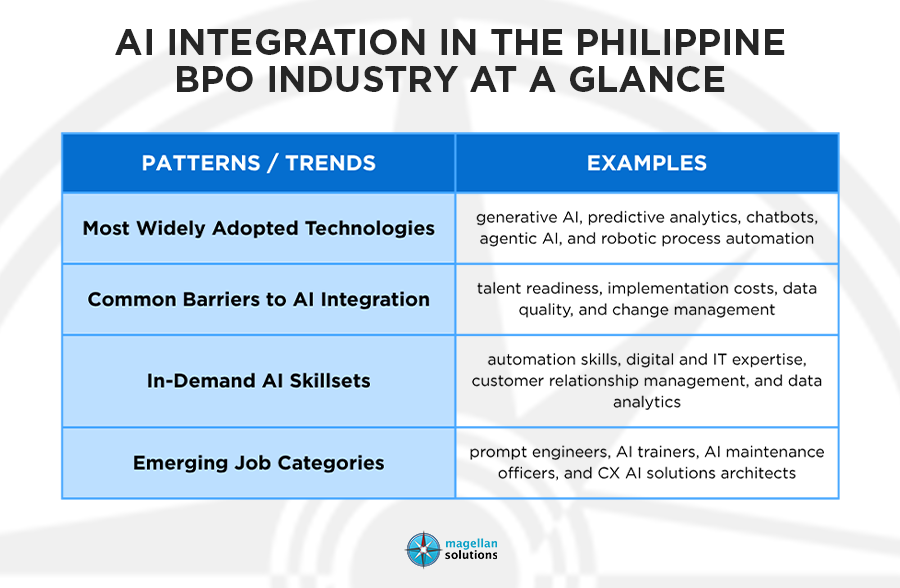
AI Integration in the Philippine BPO Industry at a Glance
Why the Philippines Remains the World’s Undisputed Contact Center Capital
- Impressive English Proficiency: According to the 2025 EF English Proficiency Index, the Philippines ranks #28 globally and #2 in Asia for English proficiency. In fact, the Philippines is the only Southeast Asian country to achieve “High Proficiency” status, which should no longer be surprising, given that at least 100 million Filipinos speak English.
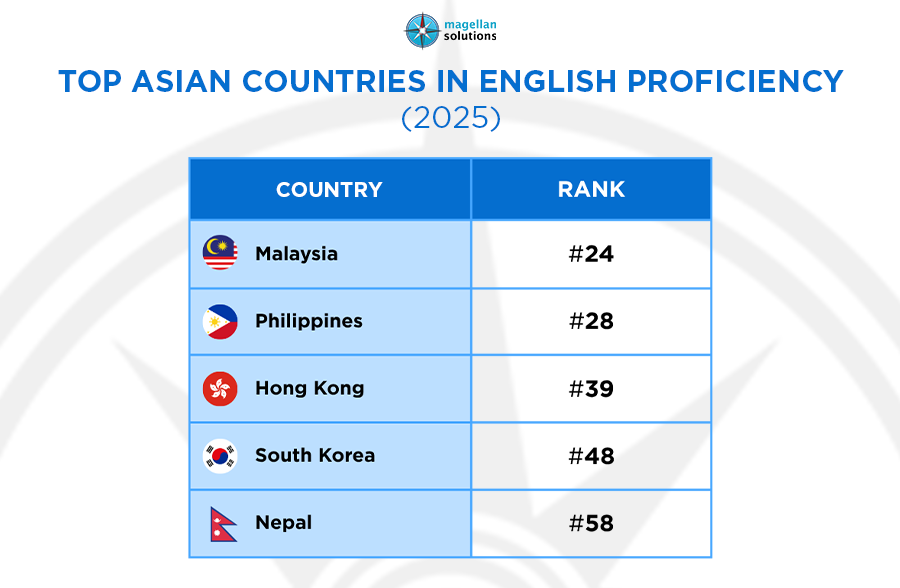
Top Asian Countries in English Proficiency (2025)
- Steady Talent Pipeline: At least 700,000 Filipinos enter the job market every year. These fresh graduates specialize in IT, finance, and healthcare, making it incredibly difficult for other countries to compete with the Philippines’ steady talent pipeline.
- Government Support: The CREATE MORE Act (2024) improves Philippine tax incentives to attract more foreign investment. Foreign investors now appreciate transparent tax rules and the reduced corporate income tax.
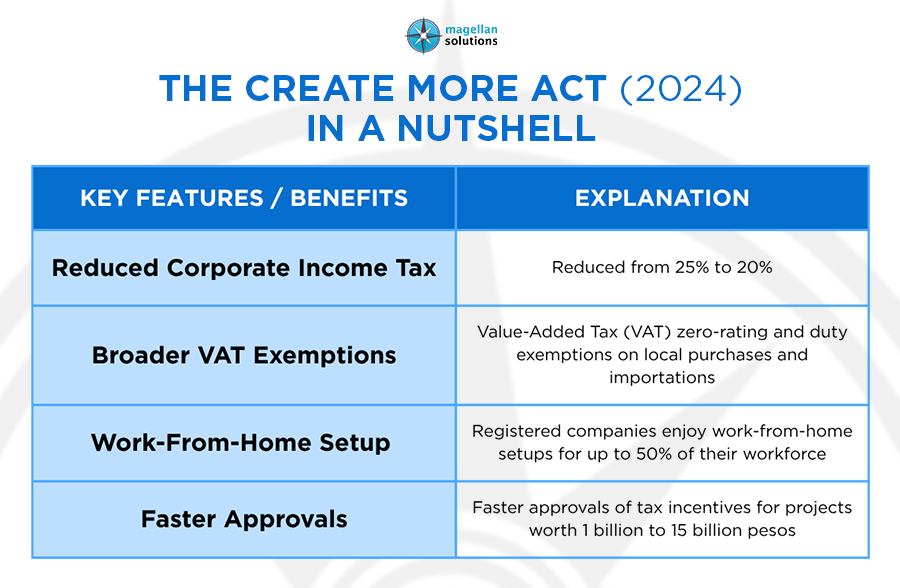
The CREATE MORE Act (2024) in a Nutshell
- Lower Labor Costs: While labor costs worldwide continue to rise in 2026, the Philippines remains a highly cost-effective outsourcing and remote-hiring hub. Employers continue to enjoy around 50%-75% labor cost savings compared to Western markets. The usual median base salaries for BPO employees in the Philippines range from $325 to $360 per month.
The Rise of Global Capacity Centers (GCCs) in BPO industry
A global capacity center (GCC) is the in-house offshore arm of a multinational company. Rather than outsourcing work to another provider, the multinational company establishes its own office in the Philippines. It employs its own people to do tasks such as finance, IT, engineering, human resources, and research and development. GCCs hire people for more specialized roles to establish long-term capability hubs. According to the 2026 Philippine Property Market Report, the active office leasing pipeline totals 227,000 sqm, with IT-BPM occupiers accounting for 114,000 sqm. Among these IT-BPM occupiers, third-party outsourcers account for 61% of pipeline activity, while GCCs account for 39%.
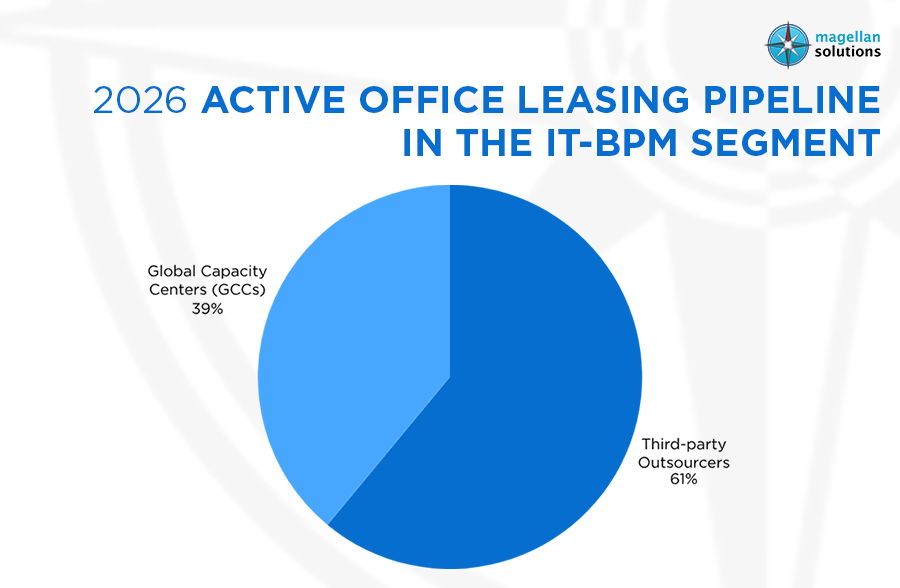 2026 Active Office Leasing Pipeline in the IT-BPM Segment
Geographic Diversification
For the past 20 years, Metro Manila and Cebu have served as the major hubs of the Philippine BPO industry. However, in the next three years, a significant geographic diversification is about to unfold. Iloilo, Bacolod, Davao, Cagayan de Oro, and Baguio are showing tremendous potential to become the next centers of investment, leading to a significant 10% increase in office space.
Challenges and Opportunities Ahead in BPO industry
Workers in the Philippine BPO industry continue to clamor for better protection of their rights and welfare. Senate Bill No. 1493, or the BPO Workers’ Welfare and Protection Act, will guarantee job security, overtime pay, leave pay, rest days, safe and humane working conditions, mandatory health insurance coverage, and the protection of workers’ right to self-organization, once it becomes a law.
Future Outlook
Outsourcing and offshoring to the Philippines remain feasible business strategies in 2026 and beyond, particularly for companies seeking greater operational efficiency. The emergence of GCCs indicates that they intend to become more efficient through setting up their own offices and hiring their own people. Thus, it is clear that the IT-BPM sector is evolving toward greater complexity and resilience.
Interested in BPO Services?
Since 2005, Magellan Solutions has been a provider of inbound and outbound call center services and business process outsourcing in the Philippines. Fast forward to 2026, and the company already has extensive experience providing best-in-class outsourced solutions to small and medium-sized enterprises (SMEs) and large global enterprises. Combining unrivaled expertise and capabilities across industries and business functions, Magellan Solutions brings fresh approaches to strategy and operational performance by delivering the right BPO and customer management solutions that span the entire customer lifecycle.
As a leading business process outsourcing provider of customer management solutions, Magellan Solutions is committed to delivering an outstanding customer experience with every interaction. Visit Magellan-Solutions.com to learn more about our BPO services. You can also contact us now and receive a complimentary 60-minute consultation.