

Healthcare organizations lose more time to claims than to almost any other back-office process, and the loss is invisible until it shows up as an AR report nobody can explain. Medical claims processing outsourcing is one answer to that. Whether it’s the right answer depends on things worth thinking through before you talk to a vendor.
This guide covers what the term actually means, where the honest trade-offs are, and how to tell whether your organization is a fit.
Why Claims Backlogs Build Up
Backlogs rarely start with a single failure. They accumulate.
Payer requirements change without much warning, and rules that differ by plan and by state mean a workflow that was compliant last quarter quietly stops being compliant this one. Staffing is the second pressure: claims work is specialised, turnover in billing and coding roles is high, and every departure takes undocumented process knowledge with it. Volume is the third — patient census rises, a new service line opens, or a payer switches submission formats, and the same team absorbs it.
What follows is predictable. Claims sit longer before submission. Error rates climb under time pressure. Denials arrive and go unworked because the team is already behind on new claims. Administrative staff spend their days on rework rather than on the claims that would actually close, and clinical staff start absorbing the overflow that lands on them.
“Claims Processing” Means Different Things to Different People
This is worth pinning down before you scope anything, because vendors use the phrase loosely and you can end up buying a narrower service than you thought — or paying for one wider than you need.
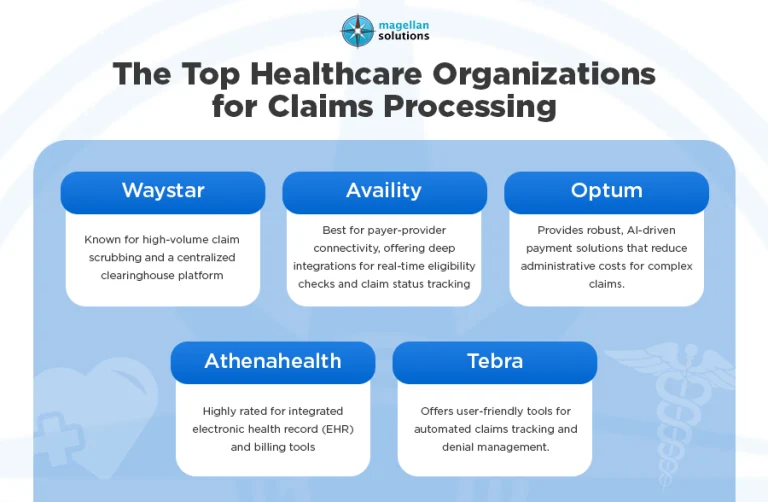
Strictly, claims processing is the submission leg of the revenue cycle: scrubbing claims against payer rules, submitting them, tracking status, and working rejections and denials. That’s it. The stages either side of it are separate disciplines with their own specialists:
- Before the visit — insurance benefits verification confirms coverage, and prior authorization secures approvals. Most denials are actually born here.
- After the visit — medical coding translates documentation into ICD-10, CPT and HCPCS codes.
- The submission leg — claims processing itself.
- After adjudication — medical billing handles payment posting, patient balances and AR follow-up.
The practical consequence: if your problem is denials, claims processing alone may not fix it. A claim denied for no active coverage was lost at verification, weeks before anyone submitted anything. Diagnose where your claims are actually failing before deciding what to outsource — or scope the whole cycle together under revenue cycle outsourcing rather than one stage at a time.
One more distinction worth knowing: everything above is provider-side. Carriers, TPAs and health plans adjudicating claims on the other side of the transaction run a different operation entirely — see insurance claims processing outsourcing for that.
The Honest Case: Advantages and Disadvantages
What you gain. Capacity that doesn’t require a hiring cycle, and doesn’t have to be carried through slower months. Specialists who work payer rules daily rather than occasionally. Denials that get appealed instead of written off, because someone has the hours. Follow-up on a schedule rather than when a person gets to it. And, where delivery is offshore, work that happens overnight against your business day.
What it costs you, beyond the fee. Three things, and vendors tend not to lead with them:
Vendor management is real work. Someone on your side owns the relationship, reviews quality, and handles escalations. Budget for that person’s time. Organizations that treat outsourcing as a handoff rather than a partnership get the worst results.
Transition takes weeks before it pays back. Workflow documentation, system access, compliance setup and a parallel-run period all come before any benefit shows up. Anyone promising immediate improvement is describing a sales cycle, not an implementation.
Complex and disputed claims still need you. Edge cases, unusual payer disputes and anything requiring clinical judgment come back to your team. The escalation path needs defining up front, or those claims become the new backlog.
The trade-off is usually worth it for high-volume, rule-driven claims work. It’s rarely worth it if your claim volume is low enough that one experienced person handles it comfortably.
Does It Work for Small Practices?
Yes, and small practices often feel the change fastest — precisely because they have no redundancy. In a single-site practice where one person handles billing, a two-week absence becomes a month-long backlog, and there’s nobody to hand it to.
The practical question isn’t whether it works but whether you can buy it at your size. Ask about small-team or shared-resource arrangements rather than assuming outsourcing starts at hospital scale. And be honest about what you actually need: a small practice with no billing function at all is usually better served by outsourcing billing entire than by carving out the claims leg on its own.
Why So Much Claims Work Runs From the Philippines
A large share of outsourced claims processing is delivered from Manila and other Philippine hubs, and the reasons are practical rather than purely financial.
The country has a deep pool of healthcare-trained administrative staff and strong English proficiency, which matters more than it sounds — a significant part of claims follow-up is phone work with payer representatives, and that’s a conversation, not a form. The time zone runs against the US business day, so claims and rejections queued at the end of your day are worked before the next one starts. Cost is real too, but it’s the least distinctive of the three.
The more useful question when evaluating an offshore claims administration partner is whether they can show you HIPAA-compliant infrastructure and certified security standards, healthcare-specific training rather than general contact-centre training, and the ability to scale a team during enrolment periods without a hiring cycle.
How to Judge a Claims Processing Partner
Four things separate a partner from a vendor:
They work in your systems. A partner trains to your practice management system, clearinghouse and payer portals. A vendor asks you to move onto theirs.
They can show compliance, not assert it. Certified standards, signed BAAs, documented access controls. “Of course it’s secure” is not an answer to a question about PHI.
They report against quality, not activity. Claims touched is an activity metric. First-pass acceptance rate, denial rate by reason code and days in AR are quality metrics. Agree which ones before you start.
They tell you when the problem isn’t theirs. A partner who notices your denials trace back to eligibility checks and says so is worth more than one who quietly reworks the same claims every month.
Cheaper claims processing that produces more denials costs more than it saves. Judge on accuracy and turnaround together, never on rate alone.
Frequently Asked Questions
What are the advantages and disadvantages of outsourcing medical claims processing? The advantages are capacity without hiring, specialist payer knowledge, denials that actually get appealed, and overnight turnaround where delivery is offshore. The disadvantages are vendor management overhead, a transition period of several weeks before benefit appears, and complex or disputed claims that still route back to your team. It works well for high-volume rule-driven work and poorly where volume is low enough for one person to manage comfortably.
Is it cheaper than hiring in-house? Usually, though the comparison people make is often too narrow. The real in-house cost includes recruitment, training, benefits, software seats, management time and the cost of carrying that capacity through slow months — plus the revenue lost during the gap after someone resigns. Compare against that, not against a salary figure.
Do we lose visibility into our own claims? You shouldn’t, and if a prospective partner can’t describe their reporting cadence and give you direct access to claim status in your own system, that’s the answer to a different question. Agree reporting frequency and metrics before signing.
Which claim types can be outsourced? Commercial, Medicare and Medicare Advantage, Medicaid, workers’ compensation and secondary/coordination-of-benefits claims can all be handled externally, along with denial management across all of them. Mixed payer mixes are the norm.
Next Steps
If you’ve decided claims are the stage to address, our medical claims processing outsourcing page covers what a program includes and how one is set up.
If you’re not yet sure which stage is failing, revenue cycle outsourcing is the wider view, and part of Magellan’s healthcare BPO services.
Contact us for a complimentary 60-minute consultation.