


Most writing about legal transcription services is written for law firms: depositions, hearings, trial preparation. In-house legal teams record different things for different reasons. The interview behind an internal investigation, the board meeting a regulator may one day ask about, the call with an agency that someone needs to quote accurately next week. None of it is litigation yet, and most of it never will be. All of it needs a record that can be relied on.
What an in-house legal team actually records
Internal investigations. Interviews with the employee who raised a concern, the people named in it, and the witnesses around them. If the matter escalates, the transcript of what was said, and when, becomes one of the first documents anyone asks for.
HR and compliance interviews. Misconduct, grievance and whistleblower interviews, and the conversations that follow a compliance flag. The record has to show what was asked as clearly as what was answered.
Board and committee meetings. Minutes are a summary; the recording is the record. A transcript gives whoever drafts the minutes something accurate to work from, and gives the legal team something to check them against.
Regulatory hearings and calls. Agency hearings, examinations and recorded calls with a regulator, where the company’s own account of what was said needs to be exact.
Depositions through outside counsel. When the company is a party, outside counsel usually handles the deposition. The in-house team often still wants its own working transcript to review on its own timetable.
Why this work leaves the legal department
Transcription lands on whoever is nearest to the recording. In a legal department, that is usually a lawyer or a paralegal, because the recordings are sensitive and nobody wants them handled casually. The result is expensive people typing, slowly, and interviews sitting untranscribed while the matter moves on.
The work itself doesn’t need legal judgment. It needs a trained listener, a consistent format and a second person checking the file before it comes back. What the transcript means, and what to do about it, stays with your team.
How it works
Transcription is run as a managed service rather than a person you supervise. You send the recordings through the secure transfer method agreed at the start, along with your format: verbatim or clean verbatim, how speakers should be labelled, whether you want timestamps. Transcripts come back in that format, checked against the audio.
Where the audio is poor, the transcript says so. Passages that can’t be heard are marked with a timestamp, not guessed at, so your team can go straight to that point in the recording. For an investigation interview, a marked gap is far more useful than a confident guess.
Recordings in other languages can be transcribed too, which matters for groups with offices and employees outside the English-speaking world. Multilingual legal transcription covers how that works.
Turnaround is committed up front and depends on recording length, audio quality, the number of speakers and your volume.
Confidentiality
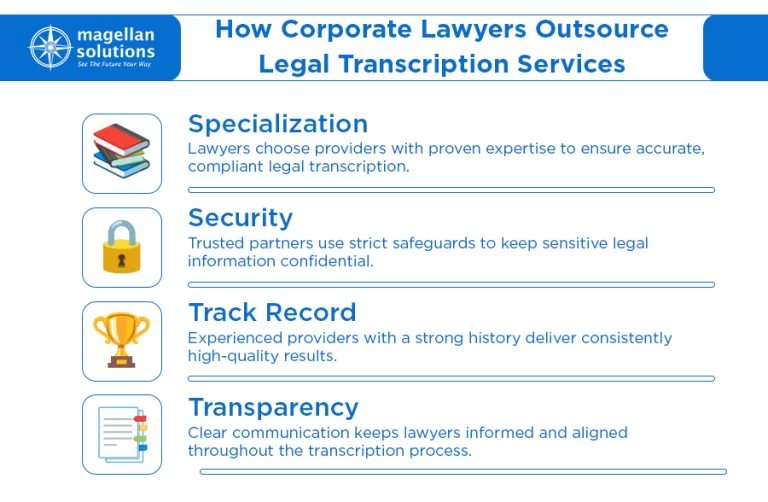
A legal department’s recordings are among the most sensitive material a company holds. An investigation interview can name people who have not been told they are under review.
Every Magellan staff member signs a confidentiality agreement, enforceable under Philippine law, before assignment. Access to your files is limited to the team working your account. Magellan operates under ISO 27001, PCI-DSS, and GDPR compliance (see our certifications).
How a transcript is labelled, stored and shared is your legal team’s decision, not ours. We produce the record; your team decides how it is handled.
Where transcription stops
Transcription produces the record. The work either side of it belongs elsewhere.
Summaries and analysis. Digesting an interview or a deposition, pulling out the admissions and inconsistencies, is analysis of the transcript, not production of it. For litigation matters, that is paralegal work.
Dictation. A lawyer dictating a memo or a letter is a different service: dictation turned into a finished document is part of legal document and word processing.
Conclusions. What the interview shows, whether to escalate, what to tell the board. That never leaves your team.
Transcription is one part of broader legal process outsourcing. For a fuller picture of how firms and legal departments buy it, see the legal transcription outsourcing guide. Law firms preparing for trial will find the litigation side covered separately.
For New Zealand in-house teams, including how the Privacy Act 2020 applies, see legal transcription for NZ corporate legal departments.
Questions legal departments ask
Are the transcripts certified? No. They are working transcripts for your team’s use. Where a certified transcript from a court reporter is required, that requirement stays with the reporter.
Do you summarize the interviews? No. We transcribe them. Summaries and conclusions stay with your team, which is where most legal departments want them for sensitive matters.
What does it cost against doing it in-house? Philippine delivery runs 40–60% below onshore staffing. The larger saving is usually the time of whoever is transcribing today, if that is a lawyer or a paralegal.
Can you work from video as well as audio? Yes. Video recordings of interviews and meetings are transcribed from the audio track, with timestamps so any line can be found in the recording.
If your team has recordings waiting, the next step is a conversation about volume and format. Legal transcription services has the full capability list and a quote form.