


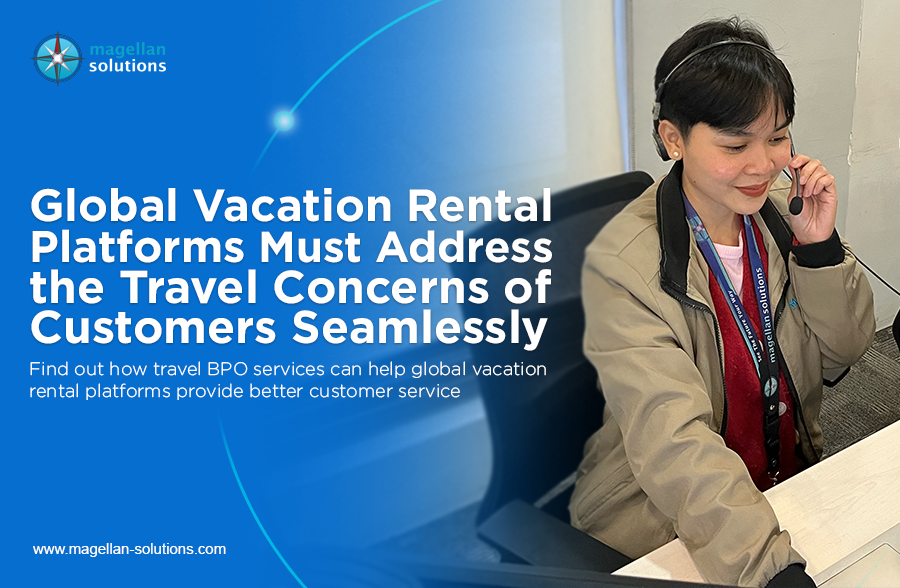
Guests at a vacation rental don’t have a front desk to walk up to. When the door code fails, the hot water stops or a flight lands three hours late, they call or message whoever is behind the listing, and they expect someone to answer. For property managers running dozens of units, and for the platforms they list on, that’s a support operation in its own right. Many outsource it to a vacation rental call center or, for smaller portfolios, to a vacation rental answering service that covers the hours the team can’t.
This guide covers what an outsourced team handles, the advantages over in-house cover, what it can’t do, and how to tell which kind of support your portfolio needs.
What a Vacation Rental Call Center Handles
Most guest contact falls into five groups:
- Pre-booking questions. Availability, pets, parking, minimum stays, whether the place suits a family of six. These turn into bookings when someone answers them quickly.
- Arrival and access. Directions, check-in times, door codes and lockbox instructions, released under the rules you set.
- Changes and cancellations. Date changes, extra guests and early check-in requests, handled under your policies and passed to you when they need a decision.
- Problems during a stay. No Wi-Fi, a broken appliance, a noise complaint, a lockout. The agent records the details and reaches your maintenance contact or on-call manager.
- Overflow and after-hours calls. The calls that arrive while your own team is busy with turnovers, or asleep.
The channel matters as much as the work. Airbnb guests mostly message inside the platform, while direct-booking guests call, text and email. A team that works all of them from one record gives the guest one answer wherever they asked. For Airbnb listings, that’s what an Airbnb answering service does.
What Are the Advantages of Using a Call Center for Vacation Rental Inquiries?
Someone answers at the hours guests actually travel. Late arrivals, red-eye flights and weekend lockouts don’t keep office hours. An outsourced team covers nights, weekends and public holidays without anyone on your side being on call.
Booking questions get answered while the guest is still deciding. A prospective guest who waits until morning has often booked somewhere else by then.
Your property team stops being interrupted. Turnovers, inspections and owner meetings go faster when the person doing them isn’t also the phone.
Peak weeks don’t need peak hiring. Summer and holiday volume can be covered without recruiting and training seasonal staff for a few weeks of the year.
Every guest hears the same answer. Agents work from your house rules and property notes, not from memory, so the answer on the fortieth call matches the first.
What a Call Center Can’t Do for You
A remote team handles everything that happens through a phone or a screen. It can’t handle anything that happens at the property. It can’t confirm a repair is finished, judge whether a unit is ready for the next guest, or inspect damage. What it can do is document what a guest reports, in detail, and get it to the right person within minutes.
It also can’t decide for you. Refunds above a set limit, exceptions to house rules, and pricing and calendar changes stay with you unless you hand them over explicitly. A good partner will ask you to write those limits down before the first call; be wary of one that doesn’t.
And it’s only as good as your escalation list. If the agent doesn’t know who to call about a lockout at 2 a.m., the guest still waits. Building that list is the first job, not an afterthought.
Answering Service, Dedicated Team or Platform-Scale Contact Center?
“Vacation rental call center” covers three different arrangements, and the right one depends on your size.
An answering service suits owners and managers with a handful of listings up to a few dozen. A shared team is briefed on your properties and covers after-hours and overflow calls and messages. If what you need is one person for the admin rather than round-the-clock cover, read what an Airbnb virtual assistant does instead.
A dedicated team suits larger property managers, where guest contact never stops and agents need to know the portfolio well. Agents work only on your account, inside your property management software and channel manager.
A platform-scale contact center is for the platforms and the largest operators: thousands of hosts and guests, several languages, and phone, chat, email and messaging on one record. Platforms usually buy this as customer service BPO for the travel industry, and it’s closer to an online travel agency’s support operation than to a property manager’s. That’s travel and hospitality contact center work.
How to Judge a Vacation Rental Support Partner
- Ask who answers. A shared team, or agents assigned to you? Both are legitimate; know which one you’re being quoted for.
- Check they work in your systems. Agents should see the reservation, not ask the guest to read it out. Ask which property management platforms they’ve worked in.
- Ask how they handle access codes. Who gets a code, when it’s released, and what’s logged.
- Ask what they won’t do. A partner that says it handles everything is describing a promise, not a process.
- Ask about security. Guest names, contact details and door codes are sensitive. Look for named standards such as ISO 27001 and PCI-DSS, and a confidentiality agreement for every agent.
- Run a test. Have someone call at 11 p.m. on a Saturday with one question your listing answers and one it doesn’t.
Where to Start
Start with the calls you’re already missing: overnight, at weekends and on your busiest changeover days. That’s where an outsourced team makes the most difference first.
See what our 24/7 vacation rental answering service covers or, if you host on Airbnb, how guest messaging and calls for Airbnb listings work. Magellan Solutions also supports travel companies more widely through its travel BPO services. Or contact us and tell us about your portfolio.