
For IT leaders, the hardest part of keeping internal systems running smoothly isn’t putting out sudden, major fires. It’s staying afloat under the daily, unrelenting stream of minor tech glitches. Managing that ticket volume through reliable IT help desk services often becomes the most labor-intensive part of running a department.
Password resets, MFA lockouts, minor software glitches, and printer mapping demand continuous attention. When every single user request routes directly to senior engineers, an operational bottleneck is inevitable. Your best tech talent gets trapped between patching critical security vulnerabilities and explaining how to unmute a web browser.
To run a lean, high-performing department, you need a firm line between frontline troubleshooting and senior-level engineering. Bringing in an outsourced IT help desk gives your in-house team the breathing room to tackle high-value projects instead of resetting credentials all day.
Scope Guide: What Stays Internal vs. What Can Be Outsourced
Drawing a clear line between basic Tier 1 requests and complex Tier 2/3 engineering keeps critical projects moving without drowning your senior staff.
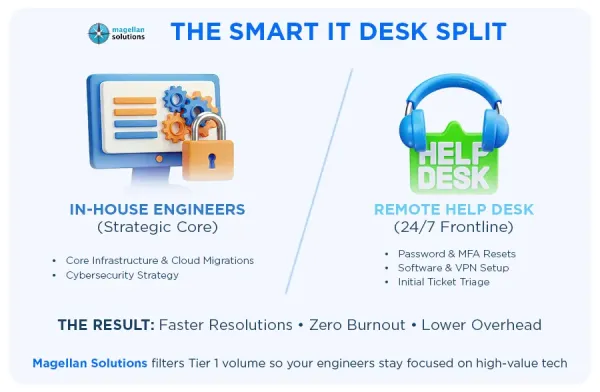
Your internal team should hold onto anything requiring high-level administrative access, physical server handling, or core architecture decisions. That means network infrastructure updates, database administration, primary security policies, and custom software deployments. Keeping these responsibilities in-house protects core assets and frees up your senior talent to drive growth-oriented tech initiatives.
Frontline support, on the other hand, belongs with a team trained to handle routine, rule-based issues. Handing off account unlocks, standard software setups, basic VPN fixes, and initial ticket logging cuts out daily office distractions while giving your employees reliable, round-the-clock help.
The strain of unmanaged ticket volume shows up clearly in industry benchmarks. Industry research shows that routine password resets and authentication requests account for 20% to 50% of all IT service desk calls, and each manual reset costs organizations an average of $70 in labor and lost productivity. When senior engineers get pulled into these repetitive admin tasks while managing system upgrades, project deadlines slip, resolution times drag out, and labor costs surge.
Support Responsibilities: In-House vs. Tier 1 Outsourced
| Task Category | In-House Engineering Team (Keep Internal) | Tier 1 Remote Help Desk (Outsource) |
| Access & Credentials | Security governance, domain policy, and privileged IAM access | Password resets, account unlocks, and MFA setup assistance |
| Software & Applications | Proprietary software updates, custom API builds, and database administration | Microsoft 365 navigation, SaaS login errors, and browser cache fixes |
| Infrastructure & Hardware | Physical server handling, data center ops, and enterprise firewall updates | Remote VPN setup, local printer mapping, and initial device provisioning |
| Ticket & Incident Ops | High-level Tier 2/3 engineering, system migrations, and cloud shifts | Incident logging, basic symptom documentation, priority tagging, and initial triage |
Operational Alignment: Integrating Off-Site Teams into Your IT Ecosystem
Shifting basic tickets away from internal engineers takes more than just adding warm bodies to a phone line. It requires plugging your technical workflows directly into a specialized partner equipped for modern helpdesk support.
A true operational partner works as a seamless extension of your company, not a glorified message-taking service. Instead of taking notes and dumping tickets back on your team, remote reps log straight into your existing professional services automation (PSA) tools, ticketing systems, and knowledge bases. Whether they’re updating user permissions, resolving a SaaS login error, or triaging a hardware glitch, an integrated team solves issues on the first touch—taking the administrative load completely off your senior staff.
Evaluating Solutions: In-House vs. Partnered Outsourcing
IT leaders usually consider three paths for handling support queues: forcing internal staff to handle every tier, building a dedicated internal Tier 1 desk, or partnering with a specialized remote support team.
Relying on senior engineers for basic support leads to slow response times, inflated payroll expenses, and developer burnout. Building an internal, 24/7 Tier 1 desk solves the focus problem, but it comes with massive overhead, continuous training costs, and constant staffing headaches.
A specialized support partner delivers round-the-clock coverage, quick scaling as the company grows, and sharp cost reductions. In fact, organizations that offload Tier 1 ticket handling to a specialized BPO partner typically see 30% to 50% savings on support labor costs compared to maintaining full-time, around-the-clock internal coverage.
Common Mistakes to Avoid When Building an Escalation Matrix
Delegating Tier 1 support takes careful setup. Watch out for these common operational traps:
- Siloed Knowledge Bases: Choosing a partner without giving them clear, updated documentation leads to unnecessary escalations. Make sure remote reps can access your standard operating procedures and troubleshooting guides instantly.
- Vague Escalation Rules: Blurry lines between Tier 1 triage and Tier 2 engineering create mass confusion. Establish strict, documented guidelines for what remote reps can resolve versus what needs a senior admin’s eyes.
- Ignoring Digital Support Channels: Many employees prefer live chat, web portals, or email over calling a phone line. Ensure your support partner covers omnichannel ticketing alongside voice support.
Frequently Asked Questions
Can an external IT support team integrate directly with our current ticketing system?
Yes. Remote reps log directly into your existing PSA or ticketing software (like ServiceNow, Zendesk, or Jira) to update tickets, record troubleshooting steps, and close requests in real time.
How does an outsourced team handle security and data privacy?
Reputable support providers follow strict global compliance standards (including ISO certifications, SOC 2, and HIPAA guidelines where needed), using encrypted remote access protocols and strict role-based permissions.
Will outsourcing Tier 1 tickets lower our overall IT operating expenses?
Yes. Offloading high-volume, repetitive support requests to a remote partner cuts overall support costs compared to paying high-salaried internal engineers to handle basic tasks.
Stop Letting Routine Tickets Hold Your IT Team Hostage
Scaling company technology shouldn’t mean turning your senior engineers into an overworked password reset desk. Partnering with Magellan Solutions lets you hand off Tier 1 admin tasks, routine software questions, and account lockouts to a dedicated remote team. That leaves your internal IT talent free to focus on what actually moves the needle—securing infrastructure, completing migrations, and building a reliable tech ecosystem.
Ready to clear your ticket queue, eliminate engineer burnout, and build a 24/7 support framework for your organization? Let’s build your custom support strategy and get your IT team back to doing what they do best.